

Learn a high-ROI strength framework for golfers over 40. Master five compound movements to increase clubhead speed in just two weekly sessions.




Training like a bodybuilder five days a week is the fastest way to lose your swing mobility and stall your golf game. Older golfers require longer recovery windows, and training more than three times a week can lead to over-training syndrome. This condition manifests as a drop in swing speed and increased injury risk, according to research from Fitness Drum. The conventional fitness industry pushes high-volume isolation workouts for everyone, but that approach fails the mature player.
The mainstream fitness narrative revolves around aesthetic muscle growth rather than athletic performance. Bodybuilding focuses on isolated muscle hypertrophy, which often restricts a player's range of motion. Increasing strength without simultaneous mobility work can lead to a shorter swing if the golfer becomes too stiff. This stiffness can potentially decrease clubhead speed instead of adding yardage to your drives, per Yahoo Sports columnists.
Performance coaches stress that golf requires usable strength over raw physical size. Functional golf training prioritizes the kinetic chain and trunk stiffness to improve energy sequencing through impact. Building huge biceps or a massive chest provides little return on investment for your scorecard. It often gets in the way of a smooth, fluid swing on the course.
When we isolate muscles on machines, we ignore how the body actually moves during athletic rotation. The golf swing requires total body coordination, and focusing on one muscle group at a time creates severe imbalances. A time-pressed golfer simply cannot afford to waste energy on movements that do not translate to the tee box. We need a different path that respects our time and our joints.
Most recreational players struggle with distance because they cannot properly sequence their swing or stabilize their spine. The true restriction usually comes from weak glutes and a lack of core stability. The posterior chain, encompassing the glutes, hamstrings, and lower back, is identified as the primary engine for hip extension and power transfer at impact. Strengthening the glute medius and core helps protect the lower back, which guarantees the hips handle rotational forces.
Many older players blame their age for a loss of yardage. In reality, the culprit is often a simple loss of muscular power and ground reaction force. When you lose the ability to push into the turf, your swing becomes entirely reliant on the upper body. This overcompensation is what leads to joint stress and erratic ball flights.
Pain and restriction often stem from a fundamental misunderstanding of tissue load and recovery. We tend to rest completely when something hurts, which rarely solves the underlying muscular weakness. When I developed medial epicondylitis, commonly known as golfer's elbow, I thought I needed complete rest. Six weeks off the course did nothing to help.
I finally learned that active recovery with a flexbar was the actual solution. It taught me that treating golf injuries requires loading the tissue properly, not just sitting on the couch and hoping for the best. Building a resilient body means targeting the specific mechanics of the golf swing and treating the body as an interconnected system. For deeper recovery strategies, reviewing a soft tissue management routine can provide excellent support.
The team at golfergy advocates for a sensible, time-efficient strength program built around minimal effective dose. Research indicates that just two strength sessions per week, lasting 45 to 60 minutes each, are sufficient to maintain and even increase power potential in recreational golfers. You do not need to live in the gym to see noticeable results. A targeted approach saves time while protecting your joints for the long haul.
Industry experts have converged on five movement patterns that yield the highest impact on clubhead speed and swing stability. These include the hip hinge like a deadlift, a knee dominant movement like a goblet squat, and a push movement like a push-up. You must also incorporate a pull movement like a rotational row, and a rotational or anti-rotational core exercise. By focusing only on these five compound movements, a busy golfer can complete a high-impact workout in under an hour twice a week.
The hip hinge directly targets the glutes and hamstrings to build real power. This movement trains the body to produce vertical ground force, which translates directly to higher swing speeds. Knee dominant exercises build the necessary quad strength to stabilize your base during the backswing. Together, these two patterns build a rock-solid lower body foundation that supports aggressive rotation.
A balanced upper body prevents the hunched posture that often ruins swing mechanics. Push movements develop chest and triceps power for an aggressive downswing. Pulling exercises strengthen the upper back and lats to maintain your spine angle. This balance prevents early extension and keeps you grounded through the hitting zone.
Perhaps the most neglected area for recreational players is proper core stability training. Rotational or anti-rotational core exercises are vital for transferring power from the ground to the club safely. The Pallof Press is a staple in modern golf fitness for its ability to train anti-rotation and trunk stiffness during the swing. It forces the midsection to resist twisting, which protects the lumbar spine from dangerous shearing forces.
Proper technique is non-negotiable for the older golfer looking to stay healthy. High-ROI movements like deadlifts and squats carry a higher injury risk if performed with poor technique, especially for those with existing lower back issues common in the 40+ demographic. It is crucial to master the form before adding heavy resistance to any bar. Strict attention to movement quality aids the proper maintenance of the aging shoulder and other critical joints.
For general performance and longevity, 2 to 4 sets of 5 to 8 reps are highly recommended. You should leave 1 to 3 reps in reserve to avoid excessive fatigue that could interfere with your practice sessions. If your goal is to increase maximal strength, programs typically use heavy loads of 80 to 85% of one-rep max for three to six sets of three to six repetitions. Incorporating suitcase carries into the routine addresses forearm grip strength for better club control and lateral stability to prevent swaying.
Experts from entities like the Titleist Performance Institute suggest that for golfers over 40, the focus should heavily favor anti-rotation exercises. The use of speed-training systems alongside strength training has become a standard for golfers looking to quantify the return on their gym time. Modern 2026 programs frequently bundle 90/90 hip stretches and thoracic rotations directly into the strength routine. This strategy makes sure that increased muscle density does not come at the cost of the X-factor, which is the separation between shoulder and hip rotation.
Building a foundation of usable strength opens the door to more dynamic athletic training. Coaches recommend combining heavy strength movements with power movements, such as medicine ball slams or jumps, to train the rate of force development. This is the ability to produce force quickly and transfer it into the golf ball. There is a growing trend of recreational golfers adopting the training habits of pros like Scottie Scheffler.
These elite players utilize transferable fitness programs that emphasize pelvic control and thoracic mobility over traditional weightlifting routines. Taking this sensible path changes everything about how you prepare for a demanding weekend on the links. Maintaining energy levels over multiple days is critical, and a tactical approach to managing cumulative fatigue complements this strength routine perfectly. You stop chasing exhaustion and start chasing capability.
Instead of spending five days a week lifting weights and constantly feeling stiff, you adopt a minimalist approach. Two focused sessions per week give you your time and your physical freedom back. You arrive at the first tee feeling completely fresh, powerful, and ready to play your best golf.
Follow Golfergy for practical insights on performance, mobility, recovery and healthy ageing. Stay connected for new articles, research-led guidance and ideas to help you play better for longer.


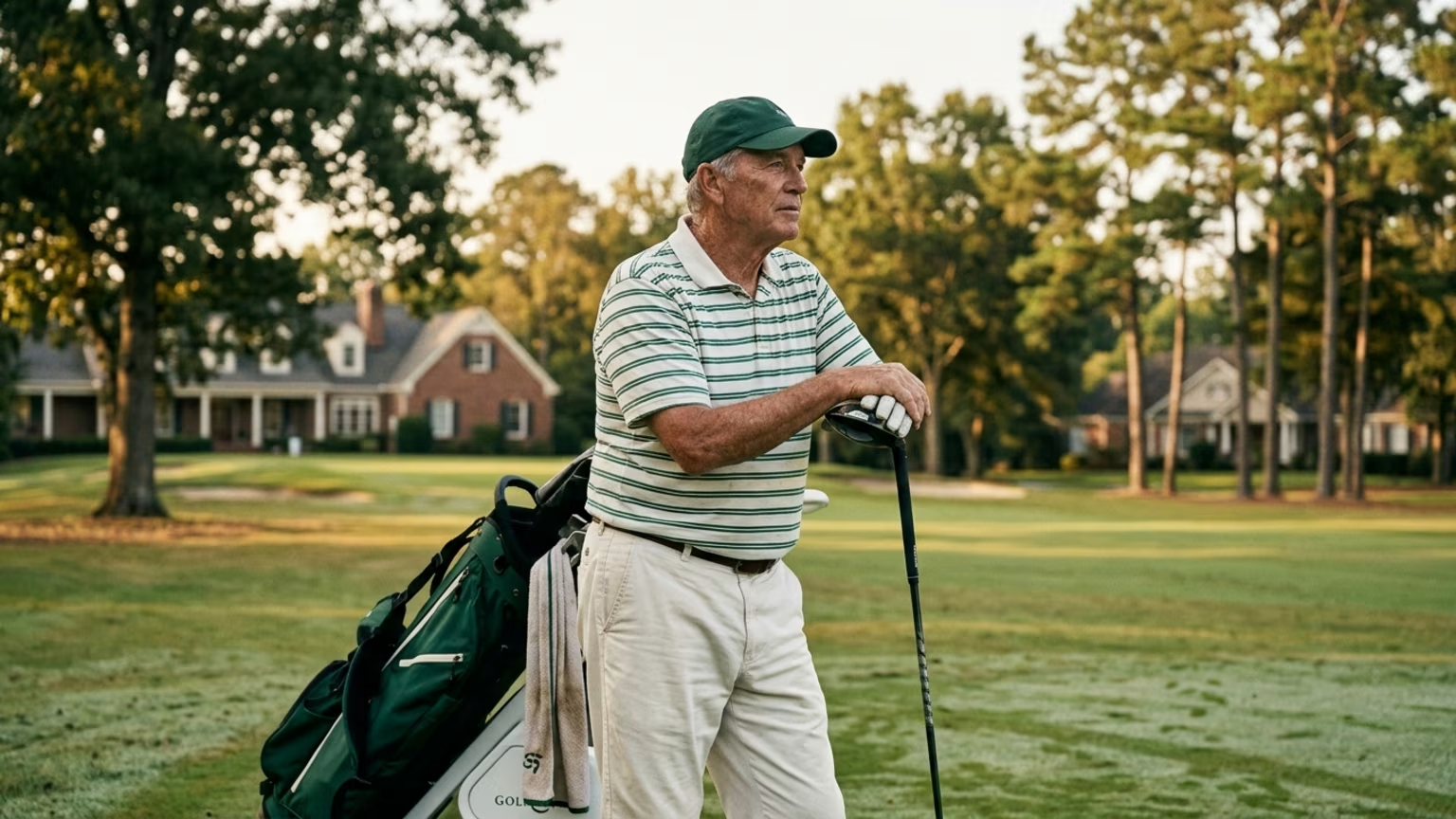
A new cellular study reveals how aging muscle affects your golf swing. Learn why older golfers need resistance training to protect their tissue capacity.


Golf Digest recently published a five-part single-leg fitness challenge. Learn what this movement reveals about your balance, strength, and golf longevity.

Elite tournament recovery relies on sleep hygiene and structured training. Golfers over 40 can use these exact methods to prevent late-round fatigue.
Explore practical resources on performance, recovery, mobility and golf longevity.
Read the Blog