
Hall of Famer Hollis Stacy finished top 25 at the 2026 U.S. Senior Women's Open at age 72. Read why older golfers should prioritize accuracy over distance.




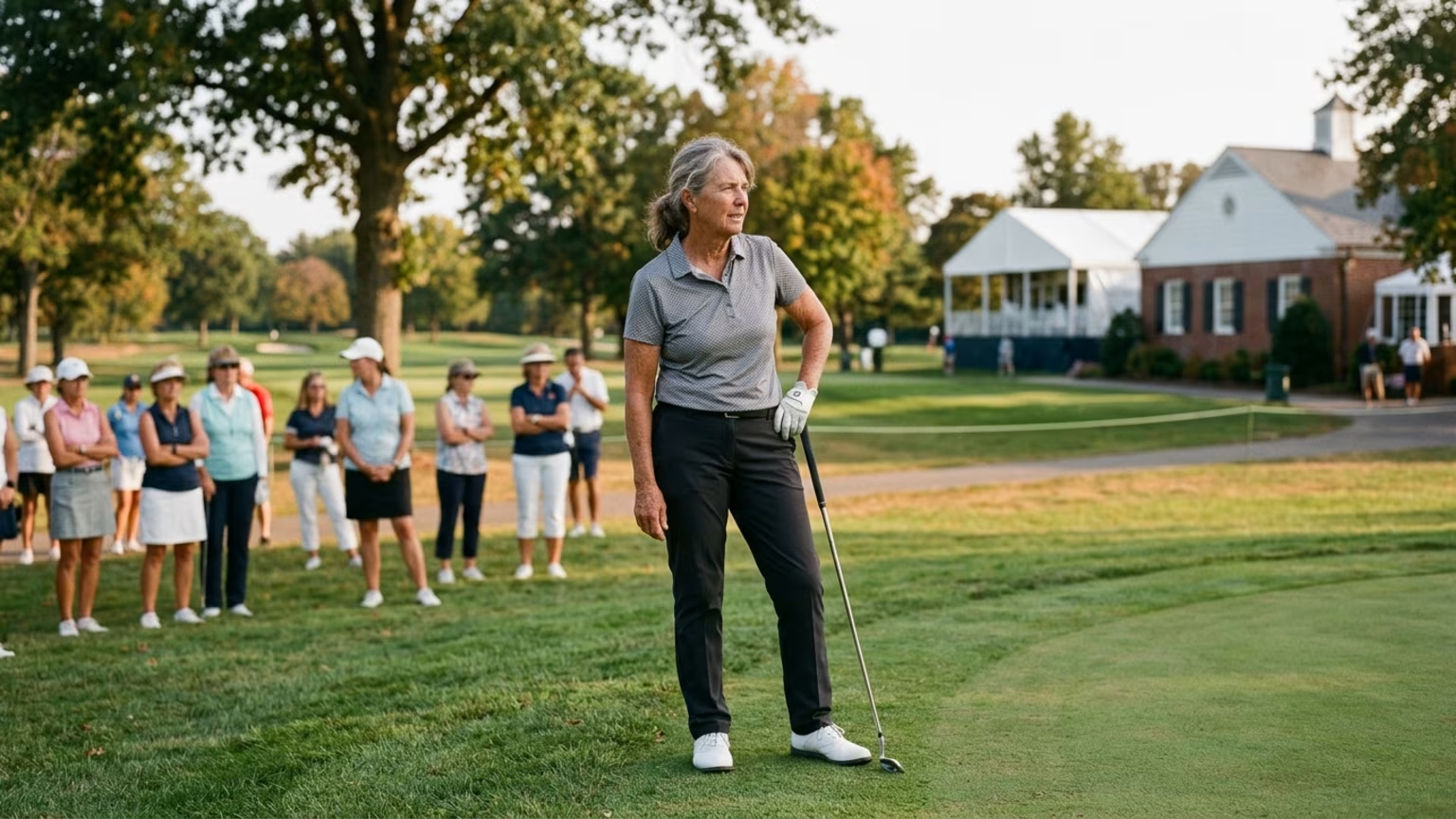
Hollis Stacy faces a 25-foot par putt on the 18th hole at Barton Hills Country Club. At 72 years old, she is finishing her fourth round at the 2026 U.S. Senior Women’s Open. The tension peaks as the ball drops into the cup.
Chasing extra swing speed at the driving range is the quickest route to an early golfing retirement. Mainstream golf media constantly pushes older players to regain their youthful rotation. This advice is terrible for the mature recreational golfer. Attempting to swing like a much younger player only leads to joint pain and frustration.
Many players believe that losing distance means losing their ability to score. This common advice forces older golfers to overswing and strain their lower backs. The recreational golfer's body reacts poorly to this aggressive approach. Muscle recovery slows down naturally as we age, making those forceful swings dangerous.
Consider the performance of Hollis Stacy in Ann Arbor, Michigan. She was the oldest player in the field for Sunday’s final round. Stacy tied for 24th with a four-round total of 303, finishing 15 over par. She followed a challenging third-round 78 with an impressive closing 74.
Her final round was her second-best score of the entire week. This scoring pattern shows her ability to recover and perform under pressure. The 2026 U.S. Senior Women’s Open provides a powerful lesson for older amateurs. The field represented an incredible depth of talent and experience.
Stacy tied for 24th alongside Kayoko Hayashi and Audra Burks. She finished 21 strokes behind winner Maria McBride, who posted a score of 282 for 6 under par. McBride’s victory demonstrates the high level of competition in the senior ranks. At 52 years old, McBride finished two strokes ahead of Annika Sorenstam, 55.
Stacy’s top-25 finish came in a highly competitive field of established legends and younger players. This proves that smart course management can hold its own against younger competitors. Stacy openly acknowledges that she no longer hits the ball as far as she once did. Instead of fighting reality, she relies heavily on pinpoint accuracy.
During the entire championship, she missed only five fairways. Keeping the ball in play is vastly more valuable than raw distance for older players. She relies on specialized equipment and ball characteristics to adapt her game. Working on swing mechanics helps her maintain her effectiveness on the course.
Older players can also benefit from adjusting their shafts and lofts to match their current physical capabilities. Adaptation is far better than denial for long-term enjoyment. The 2026 championship featured 120 players from 44 U.S. states and 15 countries. Stacy was one of 17 players to compete in all eight editions of the event.
She has successfully made the cut in six of those eight appearances. Consistency like this requires a highly rational approach to the game.
The real problem restricting your swing is a failure to adapt to your changing body. Older golfers often ignore their physical history and past injuries. Ignoring these realities leads directly to late-round fatigue and higher scores. Your joints simply cannot handle the same forces they did three decades ago.
The physical demands of a four-day tournament are immense for any player. Older amateurs frequently try to replicate their past swings, leading to severe joint stress. Refusing to alter your mechanics is a recipe for chronic pain. Your body requires a swing that honors its current flexibility and strength levels.
Stacy provides a perfect example of managing physical limitations at a high level. She has undergone two knee replacements and a right shoulder replacement. After her shoulder replacement in 2000, she joked about being good for another 50,000 miles. Her history shows why a scorecard is not a medical assessment.
Stacy’s joint replacement history highlights the importance of listening to your body. Having two knee replacements fundamentally changes how a golfer interacts with the ground. Her right shoulder replacement also required significant mechanical adjustments. Golfers with similar medical histories must coordinate their return to play with a qualified clinician.
Players restrict their own potential by refusing to modify their movement habits. Golfers who adapt can protect their front leg and hips during the swing. You must tailor your game to your current physical condition. Acceptance is the true root cause of longevity on the golf course.
Stacy is a World Golf Hall of Fame member who won 18 times on the LPGA. Her three U.S. Women’s Open victories came in 1977, 1978 and 1984. She also won three consecutive U.S. Girls’ Junior titles from 1969 through 1971. Even with this elite pedigree, she understands the necessity of adapting her mechanics.
Golfergy advocates for a rational approach to maintaining your physical base. World Health Organization guidance separates aerobic activity from strength and balance work. A practical weekly plan involves walking along with moderate aerobic exercise. Resistance training for major muscle groups should happen on at least two days a week.
Many amateurs mistakenly believe that playing a round of golf is a complete workout. Golf certainly contributes to the aerobic portions of an active lifestyle. However, a round should never be treated as a complete strength program. The World Health Organization clearly identifies aerobic, strengthening and balance work as separate components.
Following these WHO guidelines means incorporating varied activities into your routine. Older adults should aim for functional balance training on at least three days per week. This specific focus helps improve functional capacity and prevents dangerous falls on the course. Targeted physical preparation builds the necessary armor against common golfing injuries.
Balance work is equally critical for controlling your body during the backswing. Proper movement helps you maintain stability on uneven lies across the course. This focus on functional balance supports the joints far better than aggressive stretching. Building a strong foundation allows you to swing comfortably without forcing maximum effort.
Research points to the benefits of structured activity for older adults. The LIFE trial focused on sedentary adults aged 70 to 89 who already had physical limitations. The study found that structured moderate physical activity significantly reduced major mobility disability. This specific group saw their disability rates drop from 35.5% to 30.1% over 2.6 years.
While golf is not a medical cure, it provides an excellent framework for staying active. A Swedish analysis of approximately 300,000 golfers found fascinating observational associations. Golfers demonstrated a 40% lower mortality risk and roughly five years longer life expectancy. These statistics show the broader lifestyle benefits of staying engaged with the sport.
You should measure your accuracy instead of solely tracking clubhead speed. Count your fairways hit, penalty strokes, and recovery shots. Producing usable shots throughout a round is the key to consistent scoring. A controlled swing limits fatigue and keeps you competitive through the 18th hole.
Maintaining a connection to the sport requires finding joy in the process. Older players can easily become discouraged by lost yardage off the tee. Focusing on new challenges like course management can reignite your passion for the game. This mental shift turns aging from a frustrating decline into an engaging puzzle.
Social enjoyment also plays a massive role in playing longevity. Stacy noted she participates partly because she enjoys seeing old friends and finds the championship fun. Golfers are much more likely to maintain their physical activity when it remains socially rewarding. Treating the game as a long-term performance project makes every round more enjoyable.
Your longevity in the game depends on practical habits and smart decisions. Look closely at your pre-round routine to see where you might be forcing movements. Focus entirely on turning your trail hip without straining your lower back. Evaluate your physical readiness before you ever step onto the first tee.
Track your fairway accuracy during your next round to see where you truly lose strokes.
Follow Golfergy for practical insights on performance, mobility, recovery and healthy ageing. Stay connected for new articles, research-led guidance and ideas to help you play better for longer.


A practical strength framework for golfers over 40, built around everyday goals, sensible progression and a careful look at limited golf research.


A research-led look at strength, balance, mobility and trunk control, with a flexible planning framework for golfers over 40.
Understand golf mobility after 40 with a comfortable-turn self-check, hip and shoulder guidance, and a clear look at flexibility and swing speed.
Explore practical resources on performance, recovery, mobility and golf longevity.
Read the Blog


