
A 2026 report examined links between grip strength and longevity. Learn why hand endurance is a critical health marker for club control in older golfers.




On September 18, 2026, the New York Post published a report revisiting claims that grip strength is associated with longevity and overall health. The article noted that hand strength is not a standalone prediction of how long someone will live. It presented a consumer grip-strengthening kit as a practical training option. For golfers over 40, this news intersects directly with concerns about club control and fatigue resistance on the back nine.
The report cited a systematic review associating grip strength with bone density, nutrition, hospitalization, and mortality outcomes. This coverage illustrates how longevity research is being translated into inexpensive consumer fitness products. The featured FitBeast Grip Strengthener kit was reported as discounted 62% to $10. This markdown occurred ahead of Amazon’s October Prime Day, which is scheduled for October 6 and 7, 2026.
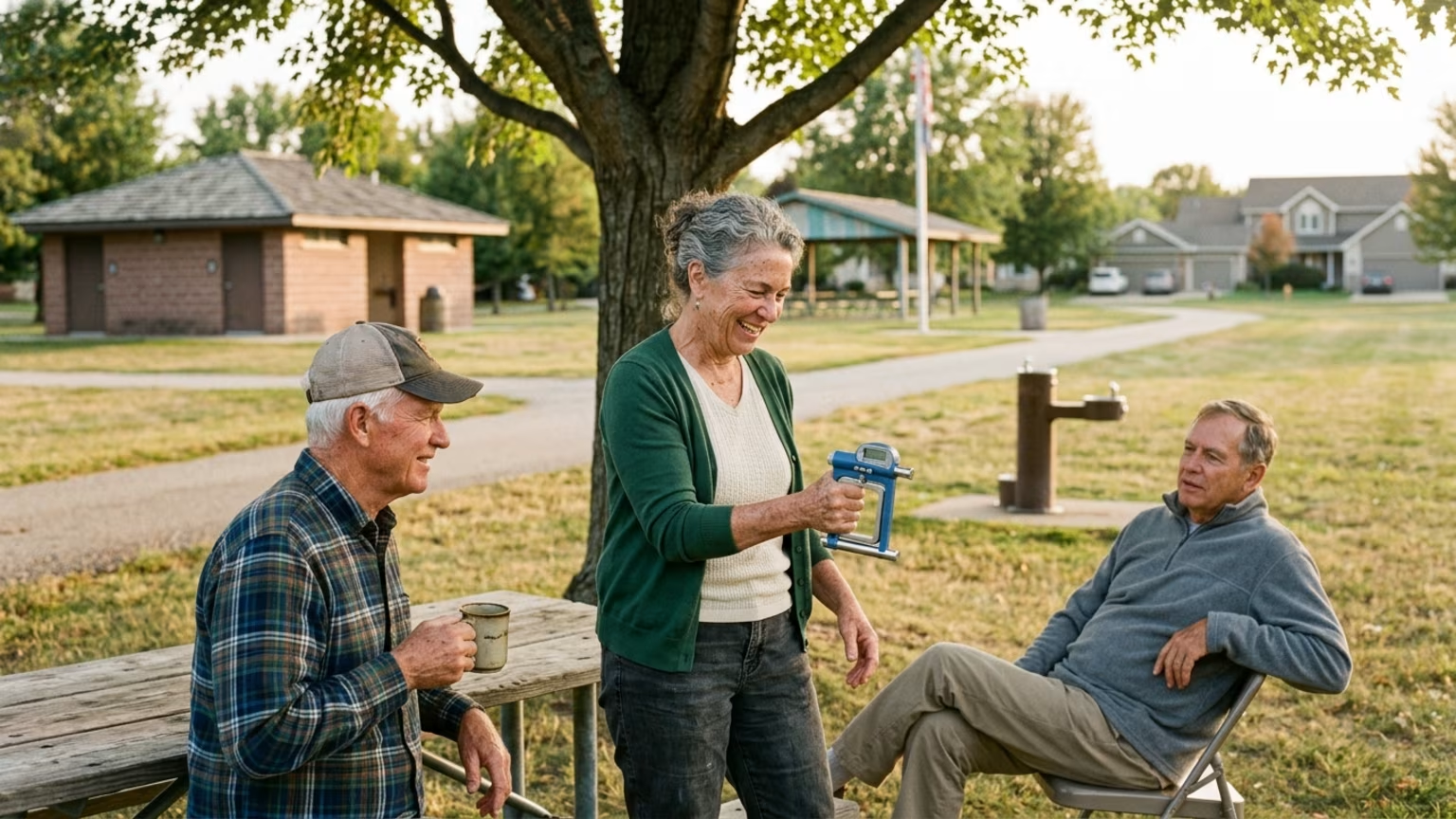
The promotional kit includes a contoured handle, a grip ball, and a finger exerciser. These functional accessories represent a growing consumer market for longevity tools. However, the temporary price reflects commerce details rather than proof of long-term health changes. Still, the underlying science offers a compelling reason to pay attention to your hands.
PGA Tour coverage of Bob Toski’s golf instruction legacy described the hands as the golfer’s physical connection to the club. The article aptly called the hands the lifeblood of the swing. A proper golf motion requires repeated gripping, stabilizing, and releasing of the handle over a long round. The hands and forearms must secure the club against the violent forces generated at impact.
This physical connection dictates how well the clubface is controlled through the strike zone. When hand strength is insufficient, players often compensate with poor swing mechanics. A weak hold can cause the club to twist upon contact with thick rough or firm turf. To prevent this twisting motion, golfers might instinctively squeeze the handle as tightly as possible.
Excessive grip tension can interfere with relaxed wrist action, tempo, and clubface control. The tissues in the hands and forearms fatigue quickly under maximum tension. Over 18 holes, this exhaustion degrades a player's ability to compress the golf ball. Players who maintain functional hand strength protect the most overlooked links in the swing.
When your hands tire, the heavier muscles of the arms and shoulders often take over the swing. This physical compensation alters your swing path and robs you of natural clubhead speed. Maintaining your forearm endurance prevents this unwanted muscle recruitment late in the round. A reliable hold allows you to swing freely without fearing a loss of control.
A 2026 review in Frontiers in Aging summarized findings from the Prospective Urban Rural Epidemiology study. Known as the PURE study, this research followed nearly 140,000 adults across 17 countries. The review noted that each 5-kilogram reduction in grip strength was associated with severe mortality risks. It linked that specific reduction to a 17% increase in cardiovascular-mortality risk and a 16% increase in all-cause-mortality risk.
These reported associations remained after adjustment for body-mass index, physical activity, and lean muscle mass. This suggests that grip strength captures functional capacity not reflected by muscle size alone. The same review stated that UK Biobank data involving approximately half a million participants linked hand strength with multiple disease outcomes. Grip strength is a non-invasive measure requiring minimal clinical training.
This simplicity helps explain its use in geriatric assessment and preoperative risk assessment. The review describes grip strength as a potential systems biomarker. This means the measurement reflects the combined condition of several vital bodily functions. It captures the health of the nervous system, muscles, and tendons.
The measurement also reflects the vascular system, metabolism, and inflammatory processes. It is not simply a measurement of isolated physical output. A low grip score may be a visible indicator of broader deterioration across those multiple systems. For the everyday golfer, understanding this connection reframes how we view physical longevity.
The saddest thing I have seen in golf is watching lifelong playing partners slowly drop out of our weekend group. It usually starts with a nagging physical issue they ignore until it requires surgery. That pattern is exactly why Golfergy focuses heavily on healthy aging and structural maintenance. We do not have to stop playing as we age, provided we do the right maintenance work between rounds.
For many older amateurs, an unexplained loss of club control is the first sign of functional decline. The Frontiers in Aging review outlines a stark contrast between muscle mass and grip strength as we age. It states that muscle mass declines approximately 0.6% to 1% annually after age 50. Meanwhile, grip strength declines approximately 2.5% to 4% annually.
The review labels these life-course estimates and related age bands as conceptual rather than validated clinical thresholds. However, measurable grip-strength decline begins from the mid-40s and accelerates after age 50. It may be substantially affected by neuromuscular-junction deterioration after age 65. Age-related declines in strength and neuromuscular function can affect how comfortably a player tolerates practice and competition.
The New York Post article highlighted a consumer kit featuring multiple resistance levels and grip trainers. Using such tools requires a measured approach for the aging athlete. Use gradual resistance rather than trying to build maximum squeezing force immediately. The goal for most recreational golfers is durable control and tolerance over an entire round.
You are training to hold a golf club comfortably, not to win a maximal one-repetition grip contest. The evidence supports viewing hand strength as one component of a broader longevity and golf-performance program. It is not a replacement for aerobic fitness, mobility, or balance. Incorporating a well-rounded routine creates a solid longevity mobility plan for your body.
A separate 2026 analysis of 147,414 adults found a clear link between exercise and mortality risk. It reported that 150 minutes per week of moderate-intensity physical activity was associated with a 30% lower mortality risk compared with no activity. Golfers should train their whole physical chain rather than focusing exclusively on the hands. Your routine should include general resistance exercise, trunk strength, and lower-body work.
You should also incorporate consistent aerobic activity into your weekly schedule. If your grip declines suddenly, differs sharply between hands, or is accompanied by pain, seek a medical assessment. Use a consistent test if tracking your grip progress at home. Ideally, you should test with the same device, posture, hand, and timing.
Interpret these changes alongside your swing performance, recovery rate, and daily function. Many players assume that a stronger squeeze automatically means a better swing. However, a sensible takeaway is that grip training mainly supports club control and hand endurance. Tech entrepreneur Bryan Johnson has argued that hand strength may be a better indicator of overall health and aging than muscle size alone.
He wrote that strength matters more than simply being heavily muscled. However, Johnson’s statement is an individual commentary. It is not a clinical guideline or proof that grip strength independently determines lifespan. The Frontiers in Aging review specifically cautions against treating hand strength as a guaranteed measure of biological age.
The review describes biomarker decoupling as a conceptual possibility in physical training. Biomarker decoupling occurs when an intervention improves a marker associated with longevity without producing the same improvement in the underlying health outcome. Improving your grip with a hand exerciser may not reproduce the survival association seen in people who naturally possess higher functional capacity. Targeted training may improve one physical component without improving the other bodily systems represented by the biomarker.
The New York Post article included an Amazon customer’s claim that using the product twice weekly helped prevent hand fatigue. This is an individual reviewer experience rather than independent clinical evidence of the product’s effectiveness. Grip strength should not replace evaluation of persistent hand pain, numbness, weakness, or elbow symptoms by a qualified clinician. What adjustments will you make to your mobility routine this season to steer clear of this hazard?
Follow Golfergy for practical insights on performance, mobility, recovery and healthy ageing. Stay connected for new articles, research-led guidance and ideas to help you play better for longer.



Bob Toski's 100th birthday reminds golfers over 40 that hand control and efficient movement outlast brute force. Learn how to protect your swing today.

A new cellular study reveals how aging muscle affects your golf swing. Learn why older golfers need resistance training to protect their tissue capacity.

Golf Digest recently published a five-part single-leg fitness challenge. Learn what this movement reveals about your balance, strength, and golf longevity.
Explore practical resources on performance, recovery, mobility and golf longevity.
Read the Blog