

A calm golf warm-up built around walking, controlled mobility and progressive practice swings, with clear limits on injury-prevention claims.




A golf-focused physiotherapy article describes a 10-minute warm-up that moves from brisk walking through mobility exercises to progressive practice swings. An article about golf after 65 recommends five to ten minutes of preparation using a similar progression.
The useful theme is the order: general movement first, controlled golf-like movements next and practice swings last. For a mature recreational golfer, that gives preparation a clear shape without making the opening swing an effort test.
These are practitioner examples, not a routine proven right for every golfer. They support preparation rather than a guarantee against injury. The research does not establish a prescribed breathing pattern or a personal safe movement limit. Personal decisions about pain or unusual stiffness belong with a qualified healthcare professional.
Golfergy’s focus is practical advice that helps experienced golfers keep playing. Here, that means making the sequence clear without turning a warm-up into a quick fix.
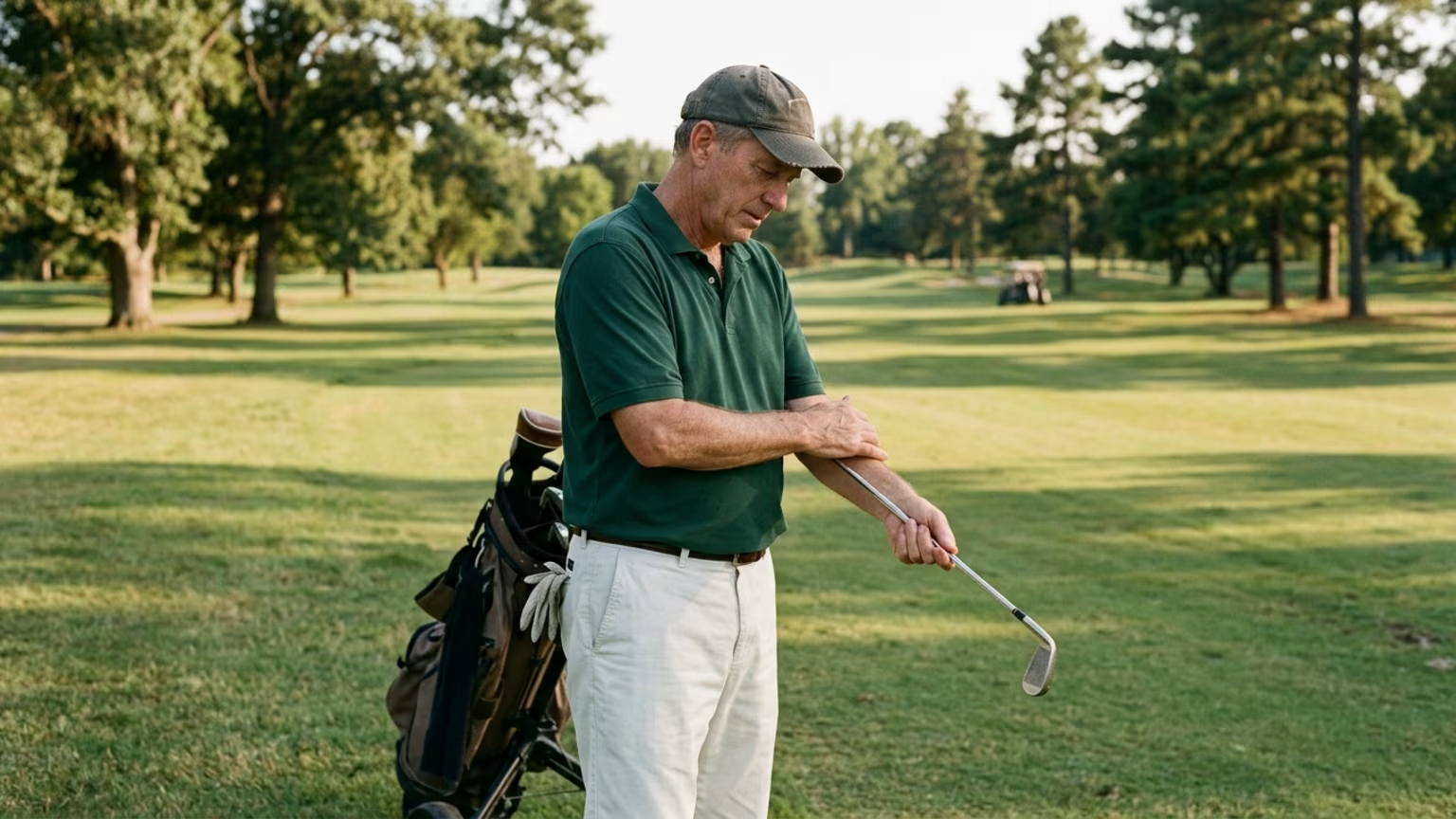
Begin by noticing any stiffness or pain already present. The article about golf after 65 advises paying attention to these sensations before increasing swing intensity. This is a simple check of how you feel, not a test of how much rotation you can produce.
Keep that observation in mind as the first controlled movements begin. Does the movement feel comfortable, or is pain becoming part of it? The point is to notice your starting condition rather than force a movement to prove that you are ready.
A familiar routine should not overrule an unfamiliar symptom. If pain or unusual stiffness makes the choice of movement uncertain, individual advice is more useful than trying to pass a warm-up test.
For a broader look at this approach, Golfergy’s guide to noticing movement limits before pushing harder provides related reading.
The walking and controlled mobility portions of this outline use bodyweight movements. The swing portion uses:
Bands, rollers and grip aids are not part of the sequence presented here. The focus stays on moving gradually toward the action of golf.
The following outline draws on the shared progression in the two practitioner articles. It uses walking, controlled hip and trunk movements, shoulder circles and progressively fuller swings. Each stage has one job before the next begins.
The physiotherapy example opens with a 60-second brisk walk with arm swings. That timing describes the source’s example rather than a personal requirement.
Walking comes before the rotations and practice swings. Keep the purpose of this stage simple: begin moving without making a golf swing the first task. There is no need to combine the walk with a stretch or rehearse several swing positions at once.
Hip rotations appear in both practitioner examples. Move through a comfortable rotation and keep attention on the hips before adding another movement.
This stage is not a full practice swing. Its place in the sequence is to give the hips attention before moving on to the trunk. A larger rotation is not the target described by the guidance; controlled movement is.
The article about golf after 65 includes trunk turns after general movement. The physiotherapy example also includes upper-back rotations.
Focus on turning the trunk as a separate movement. Keep the motion comfortable rather than trying to reproduce the size of your full golf swing. Finish attending to that movement before shifting attention to the shoulders.
Controlled shoulder circles are part of the older-golfer example. The physiotherapy routine also includes shoulder rotations.
Keep this stage about the shoulder movement itself. It does not need to become a club swing at the same time. The sequence works as an orderly progression rather than a collection of movements performed together.
The article about golf after 65 starts the swing portion with short-iron half swings before progressing to full swings. The physiotherapy example also finishes with progressive practice swings.
Begin this stage with the smaller swing described in that progression. Fuller swings follow rather than lead. Continue paying attention to the stiffness or pain noted during the baseline check before increasing swing intensity.
The key distinction is between preparing to swing and immediately trying to hit the swing you hope to use on the first tee.
Going straight to a full swing reverses the order described in the practitioner examples. Their sequence begins with walking and controlled mobility before reaching golf swings.
Treat the practice swing as the final stage of preparation rather than a shortcut around the earlier movements.
The movements described here are controlled circles and turns. They are not an invitation to force a larger rotation or add a hard stretch.
Keep the goal tied to the movement being performed. For the hip stage, attend to the hips. For the shoulder stage, attend to the shoulders.
The sources describe short preparation periods, but their advice also includes noticing stiffness or pain. Completing a timed routine should not become a reason to ignore those observations.
Running late is not a useful reason to compress every movement into a hurried burst. The same pacing principle belongs in a calmer transition from arrival to play.
The useful on-course carryover is the same attention to stiffness and pain used before the round. Before increasing swing intensity, notice how the movement feels rather than treating a completed warm-up as permission to ignore discomfort.
A pause beside the cart does not need to become another exercise session. The practical lesson is attention and pacing, not adding a new stretch between shots.
Keep the pre-round order in mind: general movement, controlled golf-like motion and progressively fuller swings. On the course, carry forward the habit of noticing your response before asking for more effort.
Bottom Line: Start with walking, move through controlled rotations and finish with gradually fuller swings. A no-rush warm-up gives preparation a clear order. The aim is to arrive at the first tee ready to move, not to prove how far or fast you can move before the round begins.
Follow Golfergy for practical insights on performance, mobility, recovery and healthy ageing. Stay connected for new articles, research-led guidance and ideas to help you play better for longer.


Review elbow and wrist pain patterns in golf through symptom notes, practice changes, ground contact and grip condition, without assuming a quick fix.


Tiger Woods’ 2017 Dubai withdrawal offers a measured lesson for golfers over 40, with NHS guidance on when back pain needs medical attention.

Understand a stiffer golf turn, notice changes without self-diagnosis and learn when comfortable movement or individualized advice may help.
Explore practical resources on performance, recovery, mobility and golf longevity.
Read the Blog



