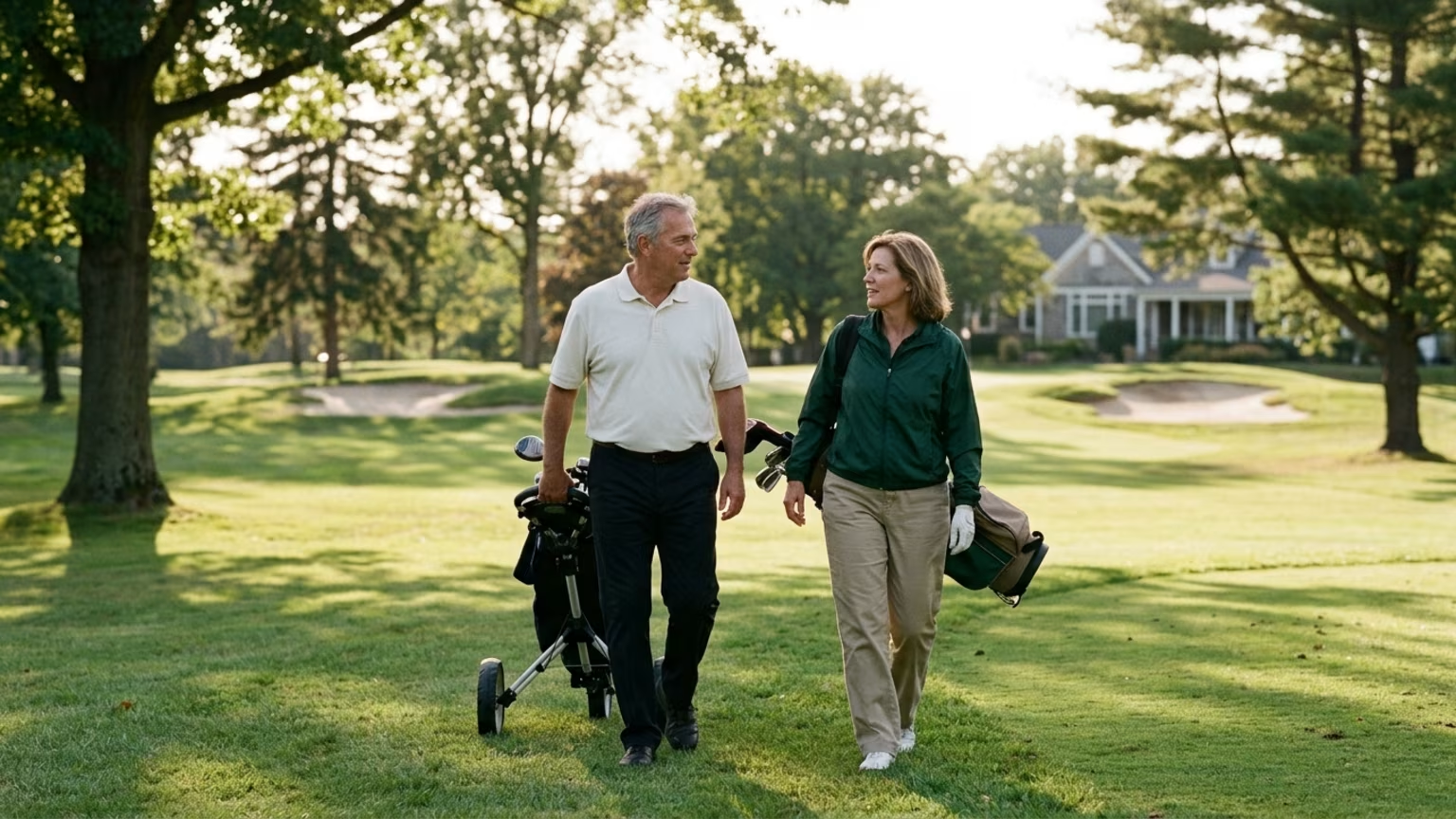
Find practical ways to manage mid-round stiffness with basic strength-training habits that help golfers over 40 maintain their swing mechanics and energy.




"Why do my legs feel completely dead and my back tighten up around the 14th hole?" It is the most common question we hear from golfers over 40. You step onto the first tee feeling completely loose and ready to play. A few hours later, your swing feels short. Your distances drop noticeably.
You start compensating with your hands just to get the ball airborne. It is a frustrating reality for experienced players who want to enjoy a full 18 holes. Walking a course requires more physical resilience than many people realize. Understanding the physical reasons behind this mid-round fade is the first step toward fixing it.
Many players accept this decline as a normal part of getting older. They buy new equipment hoping to regain their lost distance. They try radical swing changes that only lead to more frustration. The truth is that your body simply needs more structural support to handle the game. Building that support is entirely within your control.
Golf requires repeated bursts of rotational force over several hours. When your muscles lack a strong physical foundation, they fatigue much faster. As the round progresses, tired muscles stop absorbing the forces of your swing properly. Your body tightens up as a natural protective response to this muscular fatigue.
Managing physical fatigue and stiffness requires looking at your overall physical capacity. An NIH healthy-aging page recommends muscle-strengthening activity at least two days a week. The NIH page says strength training can help maintain muscle mass and bone density and support joints. Without that basic structural support, walking a hilly course and swinging a club demands too much of your body.
When the legs tire out, they can no longer drive the golf swing. The upper body is forced to take over the work. This puts excessive strain on your smaller muscle groups. The resulting stiffness is a warning sign that your body is working too hard. Building muscular endurance stops this chain reaction from happening.
When you lose physical energy, your clubhead speed typically drops. You might try to swing harder with your arms to make up for tired legs. This compensation alters your swing path and hurts your contact quality. Maintaining your rotational speed late in a round requires a baseline level of muscular endurance.
A stronger body helps you maintain your mechanics from the first tee to the last green. Research shows a modest connection between physical conditioning and golf performance. A 2026 review analyzed nine trials involving 220 golfers and found a small, statistically significant effect of core-inclusive physical training on clubhead speed. This supports the idea that targeted physical training offers a measured benefit for healthy golfers.
We can also look at older data regarding older players. A golf-focused article reports that a 2004 study by Thompson and Osness involved 31 male golfers aged 55 to 79. In this specific study, 19 men were assigned to an eight-week strength-and-flexibility program and 12 to a control group. The training group’s average clubhead speed reportedly rose from 85.0 to 87.1 mph.
You should not treat this reported 2.1 mph gain as a guaranteed outcome for your own game. It simply shows how basic training influences functional capacity in a small group. Physical preparation helps you hold your posture and control your swing path. It gives your body the resilience it needs to repeat good swings.
When stiffness hits mid-round, do not try to stretch cold muscles aggressively. Forcing a deep stretch on tired joints can cause more harm than good. Instead, adjust your swing intent for the remaining holes. Keep your swing thoughts extremely simple. Focus entirely on turning your trail hip.
Taking a slower, controlled practice swing helps reset your timing. Concentrate purely on letting that trail hip clear naturally through the impact zone. Do not try to force a massive shoulder turn if your back feels locked. Accept a slightly shorter backswing and rely on making solid contact.
Another helpful adjustment is to narrow your stance slightly. A narrower base requires less flexibility to turn through the ball. It takes the pressure off your lower back and hips. This small change helps you stay tall through impact. You can finish the back nine without feeling completely broken.
The real solution happens off the course through progressive resistance training. NIH healthy-aging guidance recommends muscle-strengthening activity at least two days a week. You do not need a complicated routine or heavy weights. The NIH identifies weights, resistance bands, and body-weight exercises as great options. Basic body-weight exercises such as push-ups and squats offer an excellent starting point.
Building a basic strengthening routine can be organized around five foundational patterns. These are squatting, hinging, pushing, pulling, and carrying. These basic motions mimic the demands of walking a golf course and stabilizing your swing. For example, a body-weight squat builds the leg capacity needed to hold your golf posture.
A proper hip hinge teaches you to use your glutes instead of your lower back. Pushing and pulling motions help build upper body control. Carrying moderate weights builds grip strength and core stability. You can perform all of these movements using resistance bands if you prefer.
Start with manageable versions of these patterns and progress gradually. This approach is general health guidance, not a clinically validated golf protocol, so always listen to your body. Committing to training two days a week builds the foundation you need. Over time, your body will handle the stress of a golf round much better.
During your next practice session, pay close attention to how your body responds after hitting 30 or 40 golf balls. Notice if your posture starts to round early. Check if your ball striking becomes inconsistent as you get deeper into your bucket of balls. If you feel tired quickly, your body is telling you it needs more foundational support.
Use this feedback to plan your off-course habits. Introduce a simple resistance routine two days a week using basic body-weight movements. Focus on building control and stability rather than chasing heavy weights. Build your volume slowly and practice good form.
Assess your energy levels again after a few consistent weeks of basic training. You should notice a subtle improvement in how your legs feel late in a practice session. This gradual progress is the key to playing better for longer. Focus on small improvements and keep your body moving well.
Follow Golfergy for practical insights on performance, mobility, recovery and healthy ageing. Stay connected for new articles, research-led guidance and ideas to help you play better for longer.


A practical look at golf strength after 40, with research on older golfers and simple habits for connecting training goals to a coordinated swing.


How legs, trunk and upper body share the work of a golf swing, with simple planning habits and a measured look at evidence for older golfers.

Understand mobility versus stability in golf, what older-golfer research reports, and two modest habits for comfortable movement control.
Explore practical resources on performance, recovery, mobility and golf longevity.
Read the Blog