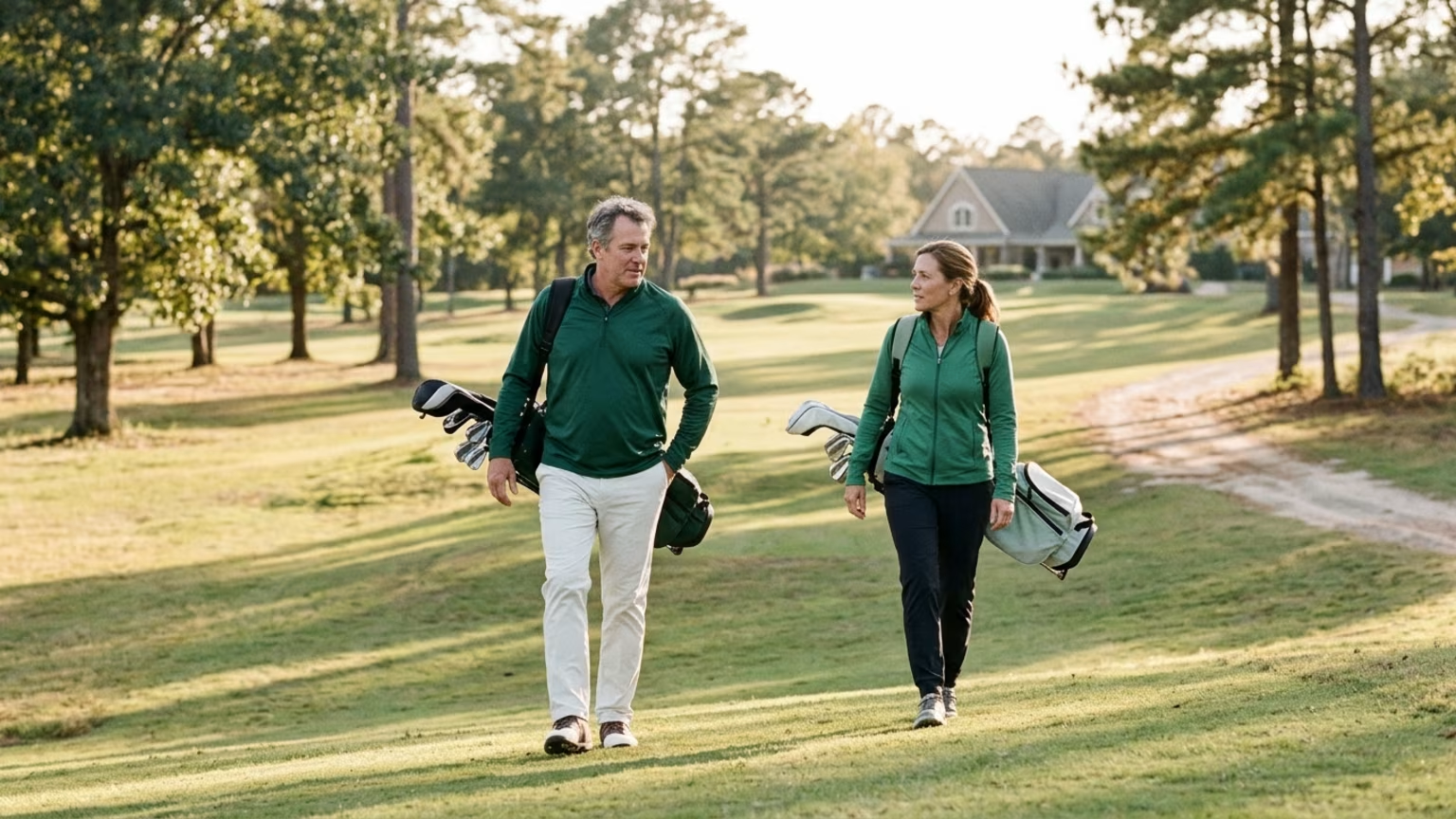

Midlife research supports combining aerobic activity and resistance work. Here is how golfers over 40 can apply that message without fixed training ratios.




An October 31, 2026 article in The Post, republished from The Times, brings together research supporting a balanced approach to midlife exercise: keep both aerobic activity and resistance training. Its message is not to pick a winner between walking and weights. It is to recognise that they offer different benefits.
The coverage includes a 47-year Swedish study that followed 427 people from age 16 to 63. It also draws on reviews of exercise and health. For recreational golfers over 40, that combination offers useful context for planning an active week beyond the next round.
The Post presents aerobic training as particularly relevant to cardiorespiratory fitness and metabolic health. Resistance training contributes a different set of muscle-related benefits.
That distinction matters because “fitness” is not a single result. A finding about glucose regulation answers a different question from a finding about muscle-related capacity. Choosing an activity based on one outcome can leave other goals out of the discussion.
Researcher Amanda Sardeli argues in the article for combining cardio and strength because they address different aspects of healthy ageing. Her position supports keeping both forms of activity rather than allowing one to replace the other.
For golfers, the useful comparison is between complementary capacities rather than competing exercise labels. Our guide to aerobic fitness and playing longevity provides related reading on the cardiovascular side of that conversation.
According to ScienceDaily’s summary of the Karolinska Institutet study, aerobic fitness and muscular endurance typically peaked between ages 26 and 36 in the Swedish cohort. Participants who became physically active as adults improved their physical capacity.
That second finding deserves attention alongside the age-related pattern. The study did not simply describe a peak followed by decline. It also documented improvement among people who became active during adulthood.
Study lead author Maria Westerståhl told The Post that physical activity can slow declines in performance but cannot completely stop them. The encouraging message is about retaining influence over physical capacity, not stopping ageing.
The Post also describes Sardeli’s review involving people over 50. In the reviewed evidence, strength-only exercise performed twice weekly did not improve glucose regulation. Sardeli characterises aerobic exercise as a first-line strategy for metabolic health while arguing for a combined approach.
A separate review of 199 studies appears in the same coverage. The article reports an association between higher cardiorespiratory fitness and lower risks of early death and several chronic conditions. That adds a broader health perspective to the discussion of exercise choices.
For an experienced golfer, the practical issue is how these findings fit around playing. The research supports keeping aerobic activity and resistance work in view together. It does not require turning the week into a contest between the course and the gym.
Golf-specific evidence needs its own reading. A summary of a 2022 systematic review of golf and health describes some studies reporting improvements in balance, blood pressure and HDL cholesterol. The overall findings were mixed. Study designs were inconsistent and long-term evidence was limited.
That evidence does not establish that playing golf supplies all the aerobic, resistance, balance or mobility training a particular person needs. For planning purposes, a round belongs within the activity picture rather than serving as proof that every conditioning need has been met.
The broader research also has clear boundaries. The Swedish results describe group patterns from one cohort rather than a personal deadline for decline. That study did not test golf performance or a golf-specific conditioning plan.
The glucose finding concerns a particular outcome and training frequency rather than the overall value of resistance exercise. The wider health associations do not predict an individual golfer’s outcome. Keeping these distinctions together prevents a narrow finding from becoming a sweeping training rule.
For golfers over 40, the useful translation is straightforward: staying active in adulthood remains worthwhile. The evidence gives a reason to maintain a range of physical capacities without promising a faster swing or fewer injuries.
The practical message in The Post’s reporting is to keep complementary forms of exercise rather than rely exclusively on one. For recreational golfers, the supported components are:
This is a way to organise the conversation about training, not a demand to adopt a complicated routine. The starting point is recognising which type of activity serves which purpose. A favourite activity can remain central without being asked to cover every goal.
The article does not report a definitive research-established cardio-to-strength ratio. Performance coach Dalton Wong suggests a roughly even split in the fifties, followed by progressively more strength and balance work with age. Those allocations are his rough coaching guide rather than a universal standard.
There is no need to turn that guide into a fixed percentage for every golfer. Its useful contribution is the idea that the mix deserves attention as people get older. Personal decisions about that mix belong with a qualified professional who can account for ability and symptoms.
Our guide to planning fitness around a week of golf provides related context for thinking about activity alongside playing. The central point here remains narrower: retain aerobic work and resistance work rather than treating either as a complete substitute for the other.
Medical circumstances also matter. The Post advises people with underlying heart disease to consult a doctor before trying exercise, particularly higher-intensity training. Decisions about exercise with pain or a medical condition belong with qualified care rather than a headline-based plan.
The documented takeaway is that aerobic activity and resistance training address different parts of healthy ageing. The Swedish cohort adds an encouraging finding: people who became active as adults improved their physical capacity. For the mature recreational golfer, that supports continued engagement rather than writing fitness off as something decided in youth.
The open questions concern the best mix for different golfers and how particular combinations relate to playing capacity over time. The sound direction is to keep both forms of activity in the picture. A fixed ratio or a promise about golf performance goes beyond the findings.
Follow Golfergy for practical insights on performance, mobility, recovery and healthy ageing. Stay connected for new articles, research-led guidance and ideas to help you play better for longer.


BMC’s roundup highlights nutrition and muscle health. We explain the findings, exercise context and limits for recreational golfers over 40.


How strength and aerobic activity fit into healthy ageing for golfers over 40, with evidence on function and guidance on technique and recovery.

A measured look at golf’s possible balance benefits, walking demands and why a round’s physical load is not proof of complete fitness.
Explore practical resources on performance, recovery, mobility and golf longevity.
Read the Blog

