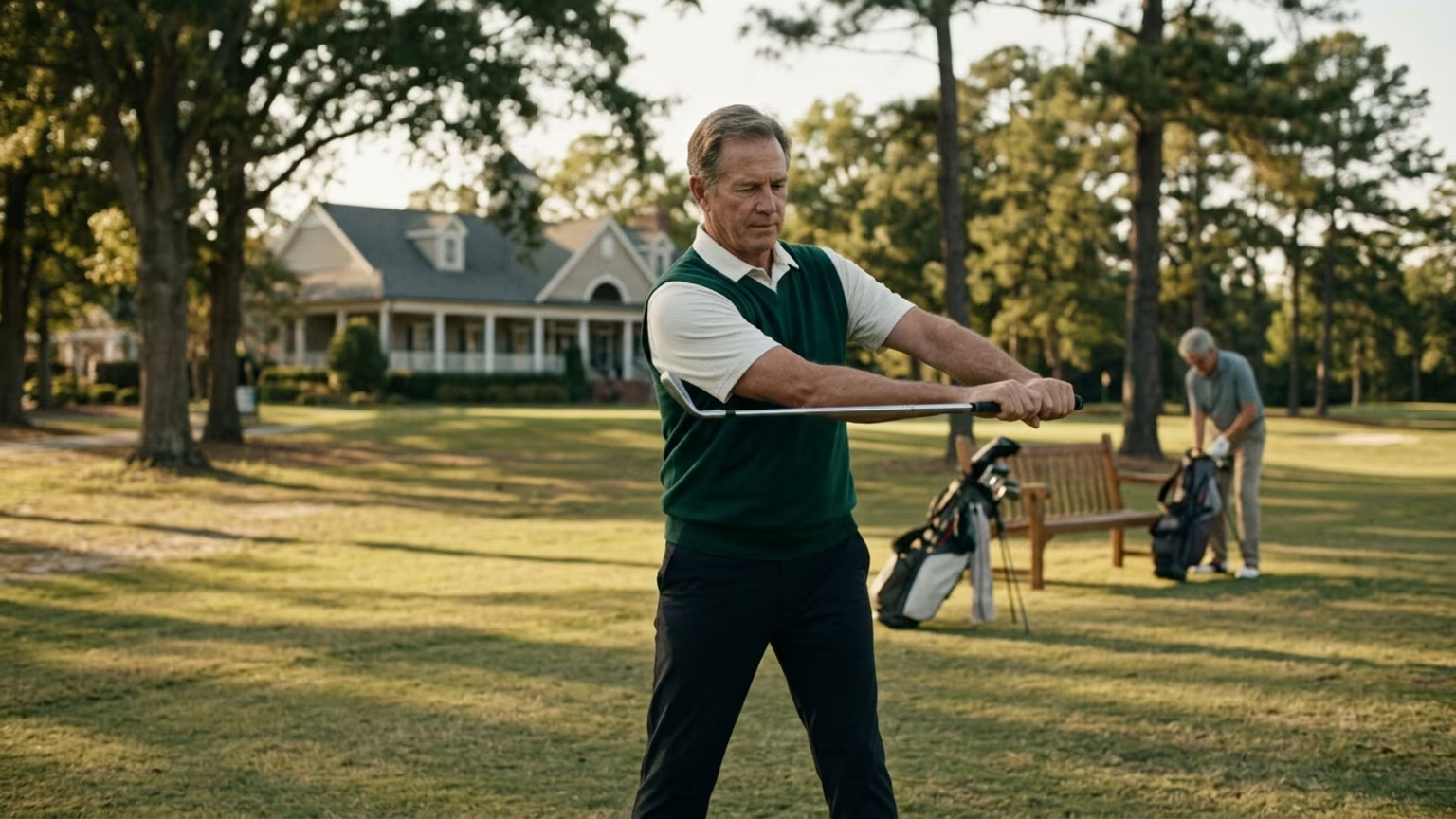

Learn how core stability helps mature golfers resist unwanted movement, improve trunk control, and maintain a consistent swing on the back nine.




Core stability in the golf swing is simply your midsection's ability to resist unwanted movement while transferring force from the ground to the club. It is the main control center for a mature, repeatable golf swing. Many players picture endless crunches when they think of core training. The reality of practical golf conditioning looks much different.
Your trunk must act as a strong bridge to maintain posture and keep your clubhead path consistent. Building a reliable golf swing requires a solid foundation built on true physical stability. When your midsection can hold its ground against the powerful forces of rotation, you gain better control over the club. This physical control translates directly into cleaner contact on the course.
A resilient torso acts as the braking system for your entire swing mechanics. It stops your body from swaying out of position and keeps your swing arc wide. Many older players mistakenly try to fix inconsistent contact by swinging harder. This approach only creates more unwanted motion if the trunk cannot control the force.
Think about standing on the twelfth tee during a standard weekend round. Your legs might feel fine, and your arms are ready to swing the club. Yet your strikes start getting thinner, and your lower back begins to ache. This familiar fading feeling often comes from a breakdown in spinal and lumbopelvic stability.
The core stops resisting unwanted motion and allows your posture to collapse under rotational forces. According to a 2026 systematic review, the core contributes directly to the transfer of force through the golf swing kinetic chain. It acts as a stable transmission system connecting your lower body to your upper body. When your midsection loses that stability, force leaks out before it ever reaches the clubhead.
Your body then compensates by overusing smaller muscles to keep the club moving forward. This creates the inconsistent contact that plagues many recreational players on the back nine. Training for this specific demand requires a complete shift in perspective. Resisting movement and controlling movement are entirely different physical qualities than simply producing rotation.
A steady core allows your lower body to turn while keeping your spine safe from excessive twisting. You do not need extreme flexibility to hit good golf shots on a regular basis. You just need a midsection that can hold its ground while the rest of your body works. Mature players often find that prioritizing a steady base over extreme flexibility protects their posture better during long rounds.
As golfers pass age 40 and 50, natural physical changes alter how the body handles rotational stress. Muscle mass decreases, and the spine naturally loses some of its youthful rotational freedom. The physical ability to brace against powerful forces begins to decline gradually over time. Players often try to force bigger backswings to make up for lost clubhead speed.
This approach puts heavy stress on a trunk that is already losing its natural stability. The 2026 systematic review noted an association between trunk rotational peak power and clubhead speed in elite male golfers. This cross-sectional association showed a strong correlation (r = 0.89), but the authors noted it does not prove causation. Recreational players see this kind of data and often chase aggressive rotational exercises.
Throwing your body through a swing without a stable base is a recipe for poor contact and quick fatigue. The research looked at 220 healthy golfers across nine controlled trials. Eight of these trials were randomized, and one was non-randomized. While the overall mean age of the cohorts was 37.21 years, the evidence included older recreational golfers.
One trial studied older male golfers with a mean age of 70.7 years. Another trial looked at amateur women with a mean age of about 58 years. These older groups required careful programming to build their physical base safely. Older players need a stable center to protect their swing mechanics as their bodies change naturally.
The review describes the core as a key contributor to lumbopelvic stability, providing a biomechanical rationale for training. We cannot claim that core training is proven to prevent golf injuries or extend playing careers. However, maintaining your stability gives you the best chance to handle the physical demands of a full round. Building better functional stability on the course requires steady, progressive physical work.
You can build a more resilient golf body without getting down on the floor for traditional abdominal exercises. The 2026 review found a small, statistically significant pooled improvement in clubhead speed after core-inclusive training. The review rated the overall certainty of evidence as low. Still, it provides a useful framework for mature players looking to improve their physical condition.
Most programs in the trials lasted 6 to 12 weeks. The successful trials rarely relied on isolated core training to get results. They combined core work with other conditioning to build a complete athletic base for the golf swing. For example, the eight-week program used for the 70.7-year-old men progressed carefully through different physical phases.
It started with basic core stabilization and balance work. The players then moved on to resistance work before adding medicine-ball rotations, wood chops, and simulated cable swings. Focus entirely on maintaining your balance during simple resistance exercises to start building your foundation. You might begin by holding a steady posture while pulling a light cable band across your body.
The goal is to keep your torso perfectly still while your arms move the weight. This trains your midsection to resist rotational pull from an outside force. It teaches your body how to brace properly before you ever try swinging a club at full speed.
Once you can hold a steady posture against resistance, you can introduce controlled rotational motion. Six of the trials in the 2026 review examined golf-specific swing-simulated core training. This subgroup showed a significant pooled result for clubhead speed improvements. However, a statistical comparison did not confirm that this approach was more effective than non-swing-simulated core training.
You do not need to mimic the exact golf swing to build a better core. Start by practicing small rotational movements with very light resistance bands. Focus entirely on turning your trail hip while maintaining a firmly braced stomach. Keep your movements slow and deliberate to maintain complete control over your posture.
The review did not pool injury outcomes, and ball speed and carry distance were rarely reported. The primary goal is simply giving your body better control over the forces you generate on the course. Building this kind of rotational trunk control takes time, patience, and consistent practice. Most of the reviewed interventions lasted between one and three months to produce measurable changes.
You should focus on gradual improvement rather than overnight fixes for your swing. Small improvements in trunk control can make a noticeable difference in your ball striking consistency. A steady center helps you finish your round with the same reliable swing you had on the first tee. Adding one structured session each week is often enough to maintain this physical foundation.
A sturdy, well-controlled midsection forms the foundation of a reliable swing, keeping you playing better for longer.
Follow Golfergy for practical insights on performance, mobility, recovery and healthy ageing. Stay connected for new articles, research-led guidance and ideas to help you play better for longer.


A practical look at golf strength after 40, with research on older golfers and simple habits for connecting training goals to a coordinated swing.


How legs, trunk and upper body share the work of a golf swing, with simple planning habits and a measured look at evidence for older golfers.

Understand mobility versus stability in golf, what older-golfer research reports, and two modest habits for comfortable movement control.
Explore practical resources on performance, recovery, mobility and golf longevity.
Read the Blog



