
Keep everyday movement separate from golf preparation, with practical habits for desk and travel days plus a clear look at warm-up evidence.




Mobility is your ability to move comfortably through the positions an activity calls for. For golf, that includes movement at your shoulders and hips, plus your trunk and ankles. Off-course mobility habits are simply ways to give movement a place in a day that contains plenty of sitting.
Desk work, driving and travel make this a useful distinction. An opportunity to move during the day is not the same thing as preparing to swing a golf club. Both can have a place in your routine without being treated as interchangeable.
For Golfergy, the starting point is a practical one: separate everyday movement from golf-specific preparation rather than search for a stretch that fixes your swing.
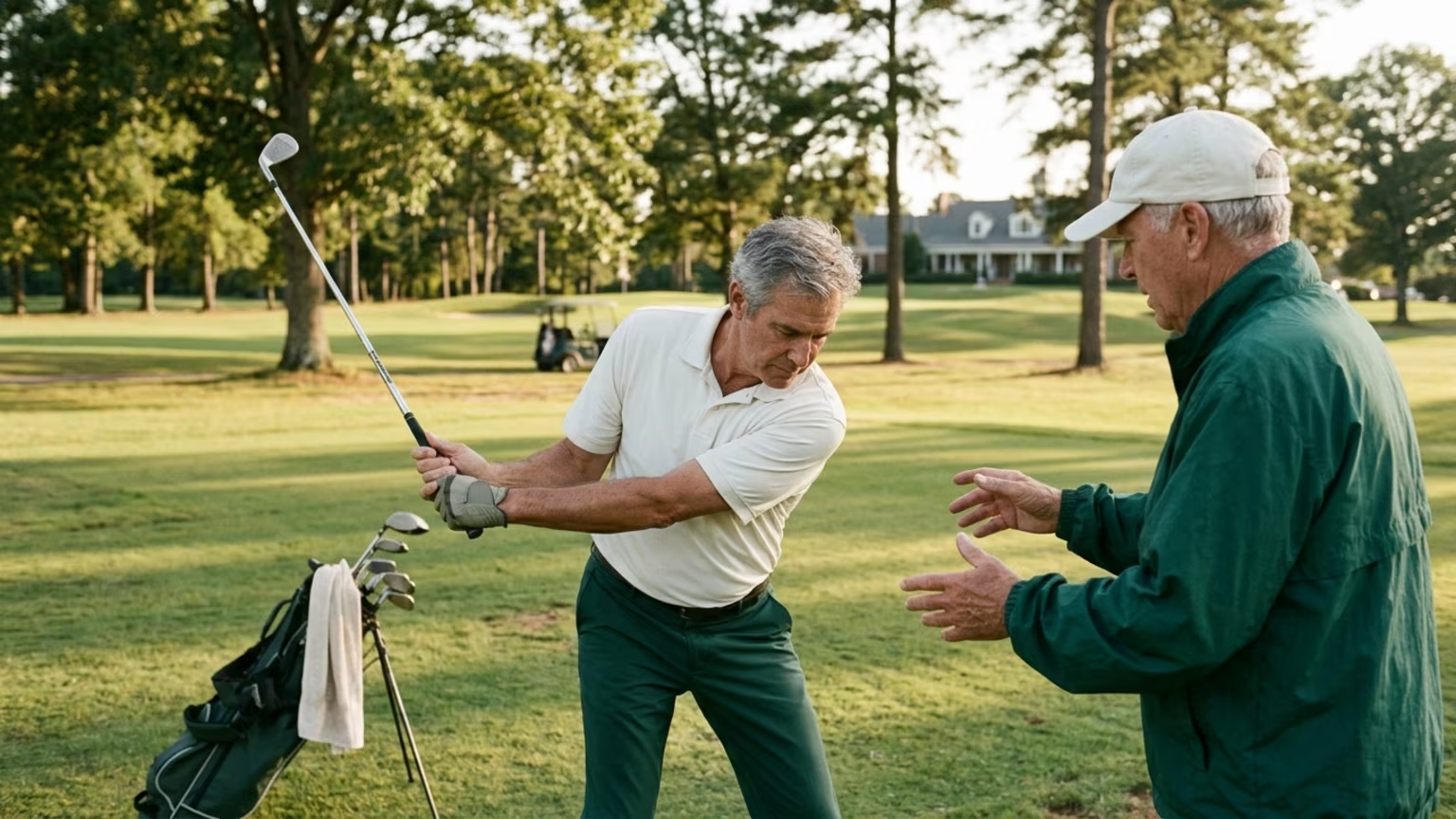
During a standard 18 holes, think about the positions you ask your body to find. There is the setup over the ball, the turn into the backswing and the movement through the finish. That is what gives mobility a golfing purpose.
The shoulder turn is part of that picture, but the warm-up guidance discussed in a golf-and-aging article also includes the hips, trunk and ankles. It is a useful whole-body view. The question is broader than whether one area feels tight.
Think about how a familiar turn feels rather than how large it looks. A movement may feel comfortable and familiar, or more restricted than expected. Trying to reproduce a backswing shape is a different goal from preparing to move comfortably.
The golf-specific evidence is most useful for that preparation question. A golf warm-up review summary describes a systematic review covering 23 studies. It reports that dynamic and resistance-based warm-ups tended to improve performance measures.
For a golfer passing 40 and 50, a less comfortable turn can be easy to label as ageing. That label alone is not an explanation. It does not tell you what changed or what kind of attention would be useful.
The golf-and-aging article reports a randomized trial of older men who completed an eight-week strength-and-flexibility program. The reported improvements included strength, range of motion and golf performance.
For those participants, the findings show that improvement was possible within a planned program. That is a more constructive starting point than assuming every change is permanent. It also keeps the scale of the evidence clear: the reported gains followed a program, not a single stretch.
The trial does not chart natural mobility changes after 40 or 50 or explain why an individual golfer feels restricted. Neither source directly tests movement breaks during desk work, driving or travel. There is no tested break interval or desk-specific movement sequence in this evidence.
Warm-up injury findings are a separate limit. The review summary describes the injury-reduction evidence as mixed and inconclusive. Neither those warm-ups nor the training trial establishes that brief off-course breaks improve the swing, preserve mobility or extend playing years.
The useful takeaway is to keep the jobs separate: everyday movement, golf preparation and longer-term training. For personal questions about pain or a loss of movement, seek advice from a qualified health professional.
Treat an ordinary pause in desk work as an opportunity for everyday movement. This is a practical way to interrupt sitting, not a substitute for a golf warm-up.
Keep the focus on one small choice: make room to move instead of treating every pause as more chair time. During a travel day, carry that idea into time away from the vehicle. Keep movement drills out of driving itself.
The habit does not need to become a complicated project. The aim is to notice opportunities for ordinary movement rather than turn a working day into a series of swing rehearsals.
Our look at workday movement and golf considers that everyday setting. Keep the attention on the opportunity to move, not on finding a perfect posture to hold until tee time.
The practitioner guidance in the golf-and-aging article recommends a gradual pre-round progression. It begins with brisk walking and controlled movements of the shoulders, hips, trunk and ankles. Partial swings come later in that progression.
Keep attention on one movement at a time. When the focus is your shoulders, stay with that movement rather than trying to think about every joint at once. The point is a gradual build-up, not a complicated sequence to memorize.
That also gives the transition from travel to golf a clear purpose. You are moving from an ordinary day into a sporting task. The warm-up is where preparation becomes specific to that task.
Our guide to gradual pre-round preparation addresses the course-side part of this picture. Use the distinction to keep your approach simple: ordinary movement during daily life and a separate progression toward swinging before play.
The measure of the first habit is simple: did a pause create an opportunity to move? For the second, the focus is the gradual progression toward golf. Keeping those aims distinct avoids asking a work break to do a warm-up's job.
Comfortable movement through your hips, shoulders and trunk belongs within thoughtful preparation and the wider goal of Playing Better for Longer.
Follow Golfergy for practical insights on performance, mobility, recovery and healthy ageing. Stay connected for new articles, research-led guidance and ideas to help you play better for longer.


Understand how hips, trunk and shoulders share a golf turn, with gentle ways to notice restrictions and work within a comfortable range.


Understand how hips and spine share your golf turn, why restrictions may change that pattern, and how to focus on comfortable, controlled movement.

Understand how hips, upper back and shoulders share a golf turn, with gentle ways to notice movement differences without chasing a fixed backswing angle.
Explore practical resources on performance, recovery, mobility and golf longevity.
Read the Blog