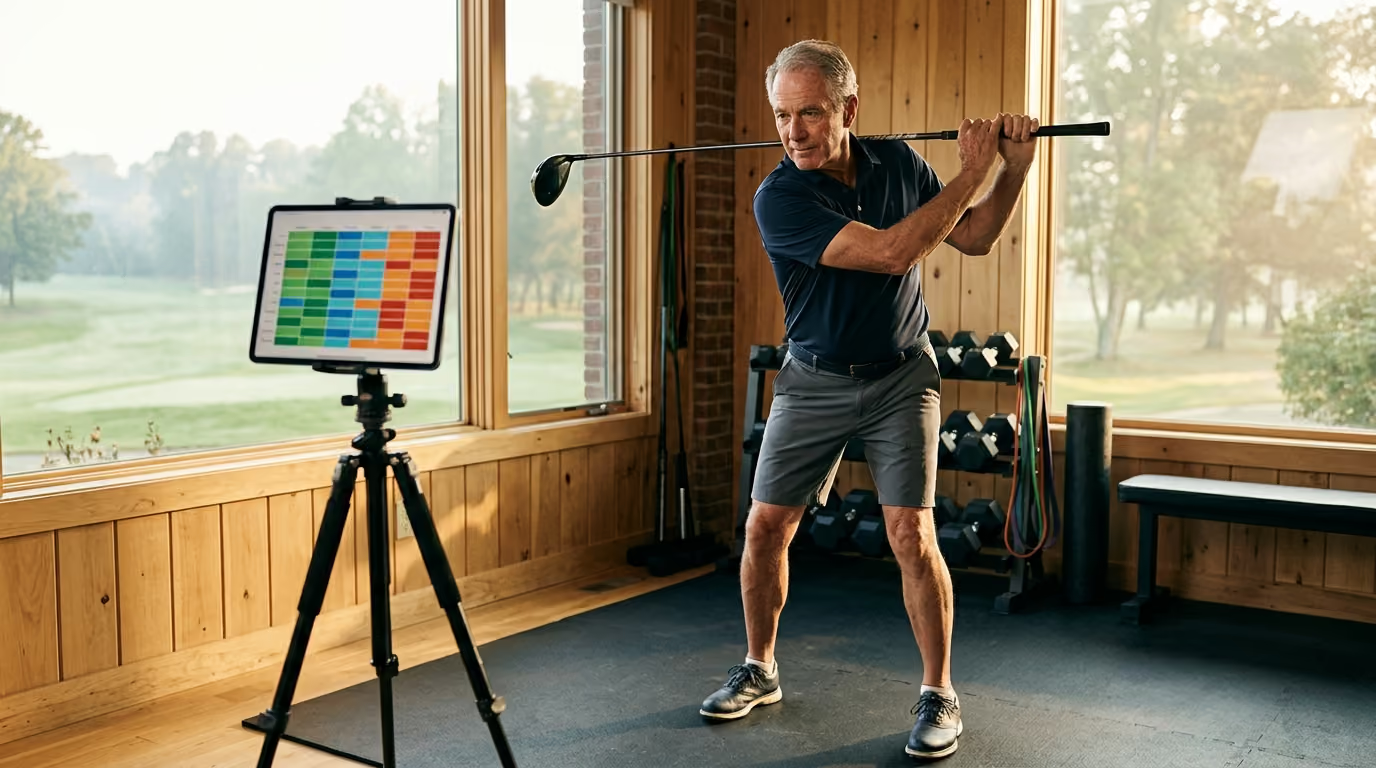

Year-round golf fitness calendars give older golfers the exact training phases needed to maintain driving distance and prevent late-round physical fatigue.




Many experienced golfers search online for ways to stop losing clubhead speed with age. They want to know why their drives are shorter than they were ten years ago. They wonder if they can get that distance back without hurting their back or shoulders.
This guide provides a year-round training plan designed to help you maintain your distance, protect your joints, and play pain-free golf for decades. By organizing your training into structured phases, you can work with your body instead of fighting against it.
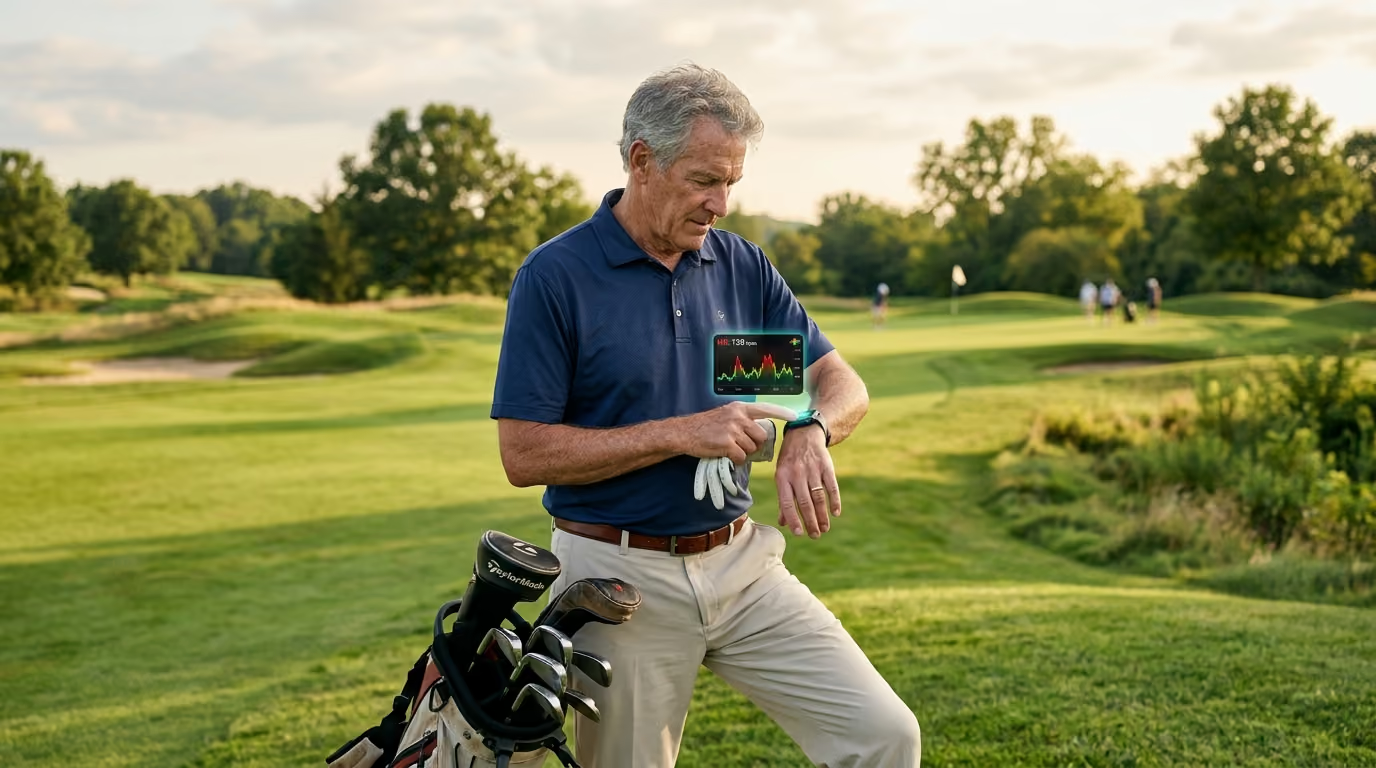
You stand on the fourteenth tee on a cool afternoon. The wind is blowing slightly against you, and you face a carry over water that requires a solid shot. Earlier in the day, this shot would not have bothered you. Now, after walking several miles, you feel a familiar tightness in your lower back. Your hips feel locked, and your shoulders will not turn fully.
You try to swing harder to make up for the stiffness. Instead of a clean strike, you hit the ball thin, and it finishes short of the green. This moment is not just a swing error. It is a physical limitation that happens when your muscles fatigue and your joints lose their range of motion.
Many mature golfers experience this sudden drop in performance during the back nine. They feel fit enough to start the round, but their body cannot maintain the required speed for eighteen holes. This issue is not something you have to accept as a normal part of getting older. It is a sign that your training needs a structured, year-round approach.
To stop the loss of swing speed, you must understand what happens to your body as you age. The natural loss of muscle mass and function is a process called sarcopenia. This decline typically begins around age 40 and accelerates once you pass 50.
According to the Journal of Golf Science, physical capacity drops in a very specific order. You do not lose all your physical traits at the same rate.
Muscle power is your ability to exert force quickly. Because power declines twice as fast as strength, it is the main reason senior golfers lose distance.
This decline creates a pattern known as the 5-5-5 rule of aging. On average, golfers lose about 5 mph of clubhead speed per decade after age 40. This speed reduction means you lose 12 to 15 yards of carry distance every ten years.
To combat this, you must train to use ground reaction forces. This is the force you push into the turf to create speed. Research from the Titleist Performance Institute shows that your vertical jump height is a major predictor of clubhead speed. You do not need to jump high, but you must keep the ability to push hard against the ground.
At the same time, injury risks rise. Research on PubMed reveals that golfers aged 55 and older have a hospital admission rate for golf injuries that is 5.01 times higher than younger players. Most of these injuries are sprains, strains, or issues in the head and neck. A structured training program is your best tool for golf injury prevention techniques to avoid these setbacks.
If you feel stiff on the first tee, you can use a quick movement to prepare your body immediately. Do not stretch your muscles statically by holding a long position. Static stretching before a round can temporarily reduce your muscle power.
Instead, perform the step-out hip turn directly on the tee box. Hold a club across your shoulders behind your neck. Stand with your feet together, then take a wide step forward with your lead foot.
As your foot lands, focus entirely on turning your trail hip backward. This dynamic movement prepares your hip joint to accept weight during your backswing. It also wakes up the glute muscles, which protects your lower back. Perform five repetitions on each side to quickly open up your hips and increase your immediate turn.
To build lasting speed and protect your body, you need a year-round strategy. Periodization is a training method that divides the year into specific phases. This structure helps you build a strong foundation, transition to power, and maintain your performance during the playing season. You can learn more about these concepts in our expert golf performance articles.
November is the start of your training year. The season is ending, and your body needs to heal from the repetitive stress of swinging. The goal of this phase is to correct postural imbalances, restore joint mobility, and improve tissue quality.
During this phase, keep your training intensity low. Use light resistance, matching about 60% of your maximum effort. Focus on smooth movements, core stability, and soft tissue work like foam rolling. This phase prepares your joints for the heavier work ahead.
Research shows that untrained seniors with mobility limits can gain 5 to 10 mph of swing speed in 8 to 12 weeks of focused mobility work. This phase lays that groundwork. It is the perfect time to build a solid routine of golf-specific mobility training.
Once your joints move well, you must build muscle mass and strength. This phase runs through the coldest winter months. The main goal is to reverse sarcopenia by building new muscle tissue, which is also known as hypertrophy.
Focus on basic movements that target your large muscle groups. You will perform exercises like squats, chest presses, and rows. Use moderate weights that allow you to perform 3 sets of 6 to 8 repetitions with good form.
Do not fear lifting heavier weights. Resistance training is safe for older adults when done correctly. It is the only way to build the strength needed to support a fast swing. This phase forms the basis of your strength programs for seniors.
With a strong foundation, you can now transition to speed. Strength is useless on the golf course if you cannot move your body quickly. This phase converts your new muscle strength into explosive rotational force.
Keep the training volume low but make the movement speed high. You will use light medicine balls for rotational throws. You can also use speed training sticks to teach your nervous system to move faster.
Focus entirely on turning your trail hip quickly on the backswing, then driving through your lead heel on the downswing. This phase primes your body to push against the ground. It helps you recover the distance lost to the aging process.
Now that the playing season is here, your goal changes. You must preserve your strength and power gains without making your muscles sore. Overtraining during the summer will ruin your golf swing and cause fatigue on the course.
Reduce your gym sessions to 2 or 3 times per week. Cut the number of sets in half, but keep the weight moderate. This maintains your muscle tissue while saving your energy for the course.
Prioritize recovery, hydration, and gentle mobility. This balance keeps you feeling fresh on the back nine all summer long. You can read more about balancing play and fitness in our guide to healthy ageing for golfers.
To implement this calendar, you need to master a few key movements. These exercises target the specific areas that restrict older players. Perform these exercises with control and focus on one joint at a time.
A stiff upper back forces you to swing with your lower back, which leads to pain. To perform half-kneeling trunk rotations, start on the floor on your knees. Step your left foot forward so your knee is bent at 90 degrees.
Place your hands behind your head with your elbows pointing outward. Slowly turn your chest toward the left side. Focus entirely on turning your upper ribs while keeping your hips pointing forward. Hold the turn for two seconds, return to the start, and complete 10 repetitions before switching sides.
You must have good hip rotation to turn without swaying. Start in the 90/90 position on the floor. Sit down and place your right leg in front of you, bent at a 90-degree angle. Place your left leg behind you, also bent at 90 degrees.
Keep your spine tall and lift your back ankle off the floor without moving your thigh. If this is too difficult, simply sit tall and rotate your torso toward your front leg. This position stretches the deep hip stabilizers. Hold this position for 30 seconds on each side to free up your hip turn.
Controlled Articular Rotations keep your shoulders healthy so you can maintain a wide swing arc. Stand tall with your feet shoulder-width apart. Make a tight fist with your left hand to create tension in your body.
Slowly raise your right arm straight up past your ear, keeping your palm facing inward. Turn your palm outward at the top of the movement and sweep your arm backward. Complete a full circle back to your side without letting your torso twist. Perform 5 slow circles in each direction for both shoulders.
The hip hinge is the most important movement for protecting your lower back during the swing. Stand with your feet shoulder-width apart and hold a light bar across your thighs. Soften your knees slightly, but do not bend them further.
Push your hips straight back toward the wall behind you as you lower the bar down your shins. Keep your back flat and your shoulder blades pulled down. Focus entirely on pushing your hips back until you feel a stretch in your hamstrings. Squeeze your glutes to stand back up, completing 3 sets of 8 repetitions.
The split squat helps your lead leg support your weight and decelerate your swing safely. Step your right foot forward and your left foot back into a wide stance. Keep your heel lifted on your back foot.
Lower your hips straight down toward the floor until your front thigh is parallel to the ground. Press hard through your front heel to return to the starting position. Focus entirely on keeping your front knee aligned over your second toe. Complete 10 repetitions, then switch legs.
Older golfers often make simple errors when starting a fitness program. Correcting these mistakes will help you avoid injury and get better results.
Many seniors avoid lifting weights because they fear injury. They stick to light resistance bands or high-repetition exercises with tiny dumbbells. While bands are great for warming up, they do not build enough force to reverse sarcopenia.
To build bone density and muscle mass, your muscles must experience mechanical tension. Lifting weights that challenge you by the eighth repetition is safe when your form is correct. Do not avoid weight training, because it is the foundation of a stable golf body.
When golfers decide to improve their fitness, they often want immediate results. They start jumping, swinging speed sticks, and lifting heavy weights in November. This sudden stress on cold joints often leads to tendinitis or muscle strains.
The recovery phase in November must remain low in intensity. Your body needs time to build tissue tolerance before you ask it to move fast. Respecting the slow pace of the foundation phase protects your joints for the harder workouts in the spring.
Some golfers lift weights all winter but never train for speed. They enter the spring season feeling stronger, but their clubhead speed remains the same. This happens because strength does not automatically translate into fast movement.
You must teach your nervous system to use your new strength quickly. Transitioning to light, high-velocity movements in the spring is what connects your gym work to the golf course. Skip this phase, and you will have a stronger body that still swings the club slowly.
Your equipment should work with your physical training program to protect your body. Small changes to your gear can reduce the impact on your joints.
Start with your golf shafts. As swing speed decreases, heavy steel shafts can put excess stress on your elbows and shoulders. Switching to lighter graphite shafts helps absorb vibration and maintains clubhead speed. Senior-flex shafts allow you to generate a higher launch without swinging harder.
Next, look at your grips. Arthritic hands often struggle to hold a standard grip tightly, which leads to tension in the forearms. Midsize or oversized grips let you hold the club with lighter finger pressure. This reduction in grip tension helps your wrists release naturally during the swing.
Finally, check your shoes. Traditional spikes can lock your feet into the turf too tightly, which transfers twisting force to your knees and lower back. Spikeless shoes allow for a small amount of natural foot rotation during the swing. This slight movement reduces the rotational stress on your joints without sacrificing stability.
Using these gear strategies alongside your fitness calendar helps protect your body. To learn more about customized physical routines, you can review our comprehensive golf longevity programs.
You can begin your journey toward a stronger, more mobile golf body today. Use this simple checklist to get started this week.
By taking these small steps now, you set yourself up for a lifetime of enjoyable golf. Consistency is more valuable than intensity when building long-term health.
The secret to holding back the clock is preparing your body for the unique demands of the sport.
Follow Golfergy for practical insights on performance, mobility, recovery and healthy ageing. Stay connected for new articles, research-led guidance and ideas to help you play better for longer.


Explore practical resources on performance, recovery, mobility and golf longevity.
Read the Blog