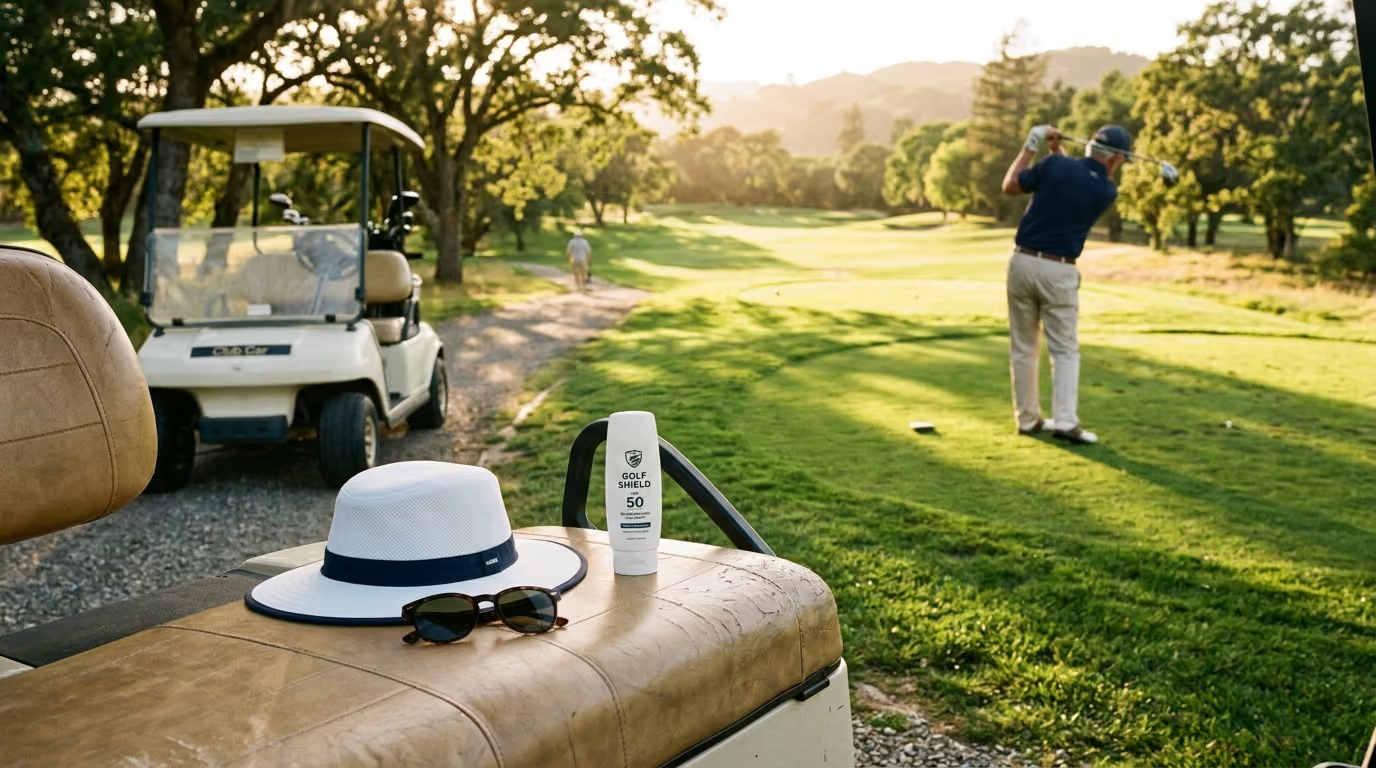

Lifelong golfers face unique ultraviolet radiation risks that directly impact their swing stamina, personal health, and overall performance on the course.




Real sun protection is not about grabbing a cheap bottle of lotion from the bargain bin. It is not about a quick splash of sunscreen before you run out to the first tee. Instead, real sun protection is a systematic plan to defend your body during fifty plus years of direct solar exposure. This field manual provides a clear path to protect your skin without changing your love for the game.
This guide is not designed to scare you off the course or make you feel guilty. It is built to show you how solar radiation interacts with your body and your swing. We will study the science of fabric weaves, the reality of reflected light, and simple habits you can use during a round. These strategies will help you play better and protect your health over the long term.
Many mature players focus entirely on their clubs, their shoes, and their physical conditioning. However, your skin is the largest organ in your body. Protecting it is a vital part of healthy ageing and maintaining your stamina on the course. This manual will show you how to build a defense plan that fits naturally into your pre-round routine.
We will look at why older golfers face a much higher risk of serious skin damage. We will also look at how the course layout can actually multiply the amount of UV light you receive. By the end of this guide, you will have a clear, practical set of tools to stay safe and play your best.
Imagine you are standing on the 14th tee box on a bright afternoon. You have been playing for over three hours in the direct sun. Your arms feel warm, and the skin on your neck feels tight and dry. You feel a sudden wave of fatigue as you bend over to tee up your ball.
You might think this tiredness is just a normal part of playing eighteen holes. However, this physical drain is often the direct result of heat and sun exposure on your skin. When your skin absorbs too much radiation, your body must work twice as hard to cool itself down. This process diverts blood and energy away from your muscles and your brain.
Your ability to focus on your target begins to fade. Your trail hip does not turn as easily as it did on the first tee. You might start to feel a dull headache forming behind your eyes. Your swing speed drops, and your timing begins to slip.
The glare from the sand traps and nearby water makes it hard to track your ball in the air. This is how sun damage impacts your immediate game. It is not just a health concern for twenty years down the road. It is a performance issue that directly hurts your scorecard today.
This physical decline is closely linked to overall injury prevention on the golf course. When you are fatigued by the sun, your core muscles stop supporting your spine. Your swing path changes, which puts extra stress on your lower back and shoulders. Protecting your skin is a direct way to keep your body strong and pain-free through the entire round.
To protect your skin, you must understand how solar radiation builds up over time. Unlike occasional beach-goers, golfers face a unique challenge on the course. This challenge is known as the cumulative UV dose model. It refers to the total amount of radiation your skin absorbs over a lifetime of play.
Golfers experience what doctors call chronic occupational-style exposure. This means you are exposed to the sun for several hours at a time, week after week. Research shows that professional golfers receive up to 217 times the annual UV radiation needed to cause a sunburn. Even recreational players receive 3.5 to 5.4 times the sunburn-inducing dose per hour.
This massive dose of radiation accumulates in your skin cells year after year. Your skin never forgets the UV light it absorbs. Even if you do not get a visible sunburn, the radiation causes microscopic damage to your DNA. Over several decades, this damage can lead to premature aging and skin cancer.
The risk is especially high for players who have spent forty or fifty years on the links. The damage you receive in your fifties builds on top of the damage you received in your twenties. This is why skin issues often appear more frequently as we get older.
Many golfers get confused by the terms used on sun protection products. It is vital to understand the difference between SPF and UPF. SPF stands for Sun Protection Factor, and it is used for topical lotions and sprays. SPF only measures how well a product blocks UVB rays, which are the rays that cause sunburns.
UPF stands for Ultraviolet Protection Factor, and it is the standard used for fabrics and clothing. UPF measures how well a fabric blocks both UVA and UVB rays. UVA rays are the rays that penetrate deep into your skin, causing aging and long-term cellular damage.
A rating of UPF 50+ is the gold standard for sun-protective clothing. This rating means the fabric blocks more than 97.5% to 98% of all UV radiation. Choosing UPF-rated clothing ensures that you are protected from both types of harmful solar rays.
The statistics regarding golfers and skin cancer are alarming. Research shows that golfers have a 250% increased risk of skin cancer compared to the general population. One major study found that 27% of golfers developed skin cancer, compared to just 7% of non-golfers.
This study highlights the danger of playing without a proper defense plan. Another serious issue is actinic keratosis, which affects roughly 40% of lifelong golfers. Actinic keratoses are rough, scaly, pre-cancerous patches of skin. If left untreated, these patches can develop into squamous cell carcinoma.
The risk is highest for male golfers over the age of 40. This demographic has the highest annual exposure to UV radiation and the highest mortality rates from melanoma. Taking steps to protect your skin is a critical part of your golf performance and longevity.
Many golfers believe that the sun only threatens them from directly above. This is a dangerous misconception that leaves many players unprotected. Your total UV dose is actually the sum of direct sky radiation and reflected radiation from the ground. This reflection of solar energy is known as the albedo effect.
When solar rays travel through the sky, they hit the surface of the earth. Some of these rays are absorbed, but many of them bounce back up into the air. This reflected light can hit your body from below, bypassing many of your standard defenses.
This means you are often hit by UV radiation from multiple angles at the exact same time. The light shines down from the sky onto your hat and shoulders. Simultaneously, reflected light bounces up from the ground onto your face, chin, and neck.
This reflected radiation is highly dangerous because it targets areas that are usually shaded. The underside of your jaw, your cheeks, and your throat receive a double dose of UV light. Standard baseball caps do nothing to stop these rising rays.
Different surfaces on the golf course reflect light at different rates. Fairway grass reflects only 2.5% to 5% of UV radiation. While this is a small amount, it still contributes to your overall daily dose.
The real danger comes when you play near sand traps and water hazards. White bunker sand reflects 15% to 18% of UV radiation back up into the air. Water hazards reflect 10% to 30% of UV radiation.
When you stand in a green-side bunker, the white sand acts like a mirror. It focuses the sun's energy directly onto your face and chest. If you spend several minutes trying to hit out of a difficult bunker, you are absorbing a massive amount of reflected light. Knowing where these reflections occur helps you prepare your defense.
When applying sunscreen, most golfers cover their arms and their nose. However, there are several key areas that players consistently miss. These forgotten zones are highly vulnerable to chronic sun damage.
The vertex is the very top of your scalp. During a normal day, this area is somewhat protected by your hair. However, the golf swing changes your physical posture.
When you bend forward at the hips to address the ball, the top of your head points directly at the sun. This posture exposes your vertex to intense, direct radiation. If your hair is thinning, this spot is in constant danger.
Standard baseball caps with mesh backs offer almost no protection for the vertex. The sun passes right through the mesh and bakes your scalp. This is why many bald or thinning golfers develop skin issues on the very top of their head.
Most players wear standard baseball caps on the course. While these caps shade your forehead, they leave your ears and neck completely exposed. The back of the neck is a prime spot for chronic sun damage.
The delicate skin on your ears is also highly susceptible to painful burns. These areas are constantly exposed to direct sunlight and reflected light from the ground. Many skin cancers develop on the tops of the ears because players forget to apply sunscreen there.
Your hands are constantly exposed to the sun while you grip your golf club. Many golfers avoid putting sunscreen on their hands. They worry that the lotion will make their hands slippery, ruining their grip.
This leaves the back of your lead and trail hands completely unprotected for several hours. This constant exposure leads to premature aging, dark spots, and skin cancers on the hands. Finding a way to protect this area without losing your grip is vital.
The elevation of your favorite golf course also impacts your UV risk. For every 1000 feet of elevation gain, UV radiation increases by approximately 4% to 10%. This means mountain courses are significantly more dangerous than coastal courses.
If you play a round in the mountains, the sun's rays are much stronger and more direct. You can easily get a severe sunburn in a fraction of the time it would take at sea level. You must adjust your protection plan when playing at higher altitudes.
For golfers over fifty, the damage from past decades is already present in the skin. This leads to a medical condition known as field cancerization. Understanding this concept is critical for long-term health and injury prevention on the skin level.
Field cancerization means that large areas of your skin have undergone pre-cancerous changes. It is not just about a single spot on your nose or arm. Instead, an entire region of skin has been mutated by decades of UV rays.
The skin in these areas may look normal on the surface, but the underlying cells are damaged. This damaged field is highly likely to develop multiple skin cancers over time. Common fields of damage for golfers include the entire bald scalp, the forearms, and the back of the neck.
This condition is the direct result of chronic, cumulative exposure. It is why you might get one skin cancer removed, only to have another appear nearby a few months later. The entire field of skin is compromised, not just the single spot that was treated.
The most common sign of field cancerization is the appearance of actinic keratosis. These are rough, dry, scaly patches of skin that do not seem to heal. They can feel like sandpaper when you run your fingers over them.
Roughly 40% of lifelong golfers exhibit these pre-cancerous patches. They often appear on the face, ears, hands, and forearms. If left untreated, actinic keratosis can slowly develop into squamous cell carcinoma.
These patches are a clear warning sign from your body. They show that your skin has reached its limit for sun absorption. It is critical to have a dermatologist check these spots during your annual skin exam.
Because the damage covers a wide area, freezing individual spots with liquid nitrogen is often not enough. Dermatologists now use field treatments to target the entire area of damaged skin. These treatments can clear away mutated cells before they turn into cancer.
Common field treatments include special prescription topical creams. These creams stimulate your immune system to find and destroy the damaged cells. Another popular option is Photodynamic Therapy, which uses a special light to activate a topical medicine.
These treatments can be uncomfortable, but they are highly effective. They help restore your skin health and prevent future cancers from growing. Managing field cancerization is a vital part of staying healthy as a lifelong golfer.
Most golfers fail to protect themselves throughout an entire round of golf. Only 4.8% of golfers currently reapply sunscreen during play. This leaves your skin completely defenseless for the second half of your round.
The main reason golfers do not reapply sunscreen is the slippery grip barrier. Research shows that 70.2% of athletes avoid reapplying because they fear getting lotion on their hands. A slippery hand can cause the club to twist during your swing, leading to poor shots.
Nobody wants to lose control of the club on the back nine. However, skipping reapplication puts your health at serious risk. The sweat from playing golf quickly washes away your initial layer of protection.
To solve this problem, you need a method that keeps your palms dry. You do not have to rub thick, greasy lotion all over your hands to stay safe. There are simple, modern tools that solve this issue completely.
The solution to this problem is the nine-hole turn protocol. When you reach the ninth green, take ninety seconds to refresh your sun defense. Instead of using a liquid lotion, grab a sunscreen stick or a continuous spray.
A sunscreen stick looks like a solid stick of deodorant. You can swipe it directly onto your face, nose, ears, and neck without touching the product with your hands. This keeps your palms dry and clean, protecting your grip.
If you use a spray, apply it to the back of your hands and arms. Do not rub it in with your palms; simply let the quick-drying formula air dry. This simple routine guarantees that you are protected for the back nine without ruining your grip on the club.
Protecting your skin requires a consistent routine that extends beyond your time on the course. This long-game routine helps repair past damage and prevents new issues from forming. It is a critical part of your overall recovery routine.
Your defense starts thirty minutes before you hit your first tee shot. You must apply a full shot glass of broad-spectrum SPF 30 to 50 sunscreen. This is about one ounce of product, which is the amount needed to cover your entire body.
Applying the sunscreen early allows it to fully absorb into your skin. If you wait until you are at the course, you will sweat the lotion off before it can protect you. Make this a habit before every single round of golf.
Be sure to use a broad-spectrum formula. This ensures you are protected from both UVB burning rays and UVA aging rays. Keep a bottle of sunscreen in your golf bag so you are never caught without it.
You can also protect your skin by changing when you choose to play. Try to avoid booking tee times between 10:00 AM and 4:00 PM. This is when UVB radiation is at its absolute peak.
If you prefer to play in the middle of the day, take steps to seek out shade. Stand under your golf cart canopy while waiting for other players to hit. Walk in the shade of trees along the fairway whenever possible.
These small changes reduce the amount of direct radiation your body absorbs. They also help keep your core body temperature lower, which reduces physical fatigue. This simple strategy keeps you feeling fresh and playing well on the back nine.
Your skin care does not end when you walk off the 18th green. Mature skin needs extra help to recover from hours of sun and wind exposure. Adding a few simple steps to your evening routine can make a massive difference.
Dermatologists often recommend using topical retinoids like tretinoin at night. These creams help speed up cell turnover, repair sun damage, and improve skin elasticity. They can help fade dark spots and keep your skin looking healthy.
For those with significant past damage, photodynamic therapy using 5-ALA can help clear away pre-cancerous cells. This medical treatment is performed in a doctor's office and target areas of field cancerization. Taking care of your skin after the round is just as important as protecting it during play.
Your clothing is your first line of defense against the sun. Choosing the right high-performance apparel can keep you safe, cool, and comfortable during a long round. You can find more details on performance gear on our golf performance resources page.
Many golfers assume that any long-sleeve shirt will protect them from the sun. However, standard light cotton fabrics often let UV rays pass right through. A typical white cotton t-shirt has a UPF rating of only about 5, which blocks very little radiation.
High-performance sun-wear uses a tight weave density to block radiation physically. This tight weave prevents UV rays from passing through the spaces between the threads. This physical barrier provides permanent protection that will not wash out in the laundry.
Look for shirts that carry a UPF 50+ rating. These garments are specifically designed to block more than 98% of the sun's harmful rays. They offer reliable, all-day protection without the need for constant reapplication of lotion.
The newest golf apparel uses advanced mineral infusions to protect and cool your skin. Manufacturers bond natural cooling minerals like Jade and Copper directly to the fabric yarn. This technology provides multiple benefits for mature golfers.
Jade acts as a natural cooling agent, helping to lower your skin temperature during play. It also helps provide a permanent UPF 50+ rating that never washes out. This keeps you protected and comfortable even on the hottest days of summer.
Copper helps pull moisture away from your body and provides anti-microbial benefits. This prevents the buildup of odor-causing bacteria in your clothing. These mineral-infused fabrics are perfect for players who want to stay fresh and protected.
Some modern golf shirts feature active cooling technologies like brrr. This technology uses a triple chill effect to keep you comfortable. It combines cooling minerals, active moisture wicking, and rapid drying.
This system is scientifically proven to lower your skin temperature by several degrees during play. Keeping your body cool reduces fatigue on the back nine, helping you maintain your swing mechanics. It allows you to focus entirely on turning your trail hip instead of fighting the heat.
Avoid these common errors to keep your skin safe and healthy on the course.
Many golfers believe they do not need sun protection on cloudy days. They assume that if they cannot see the sun, they are safe from damage. This is a highly dangerous mistake that leads to significant stealth damage.
Up to 80% of UV radiation can easily penetrate cloud cover. You can experience severe sun damage on a gray, overcast morning. Always apply your sunscreen and wear your protective gear, regardless of the weather.
Some players think that one application of sunscreen in the morning will last all day. This is simply not true. Sunscreen breaks down when exposed to direct sunlight and sweat.
After two hours of playing golf, your initial layer of protection is mostly gone. If you do not reapply, you are leaving your skin defenseless for the second half of your round. Be sure to use the nine-hole turn protocol to stay safe.
Many mature golfers believe they do not need protection because they tan easily or have darker skin. However, UV radiation still damages skin cells and increases the risk of skin cancer regardless of skin tone. Past safety does not guarantee future health, and damage is cumulative.
Men over the age of 40 have the highest annual exposure to UV radiation. They also have the highest mortality rates from melanoma. You must remain vigilant as you age to protect your health and extend your playing years.
Before your next round, remember that protecting your skin from cumulative solar radiation is just as vital to your longevity and performance on the course as keeping your muscles flexible and your joints mobile.
No, ordinary cotton shirts offer very little protection. A standard white cotton t-shirt has a UPF rating of only about 5. This means it allows a significant amount of harmful UV radiation to pass directly through to your skin. To stay safe, you should wear clothing specifically rated UPF 50+ on the course.
Yes, a wide-brimmed bucket hat is much better for protecting your skin. A standard baseball cap leaves your ears and the back of your neck completely exposed to direct and reflected light. A wide-brimmed hat provides 360-degree shade, protecting your ears, face, and neck from all angles.
Sweat can quickly wash away your sunscreen, especially if you are not using a water-resistant formula. Even water-resistant sunscreens only last for 40 to 80 minutes of heavy sweating. This is why reapplying at the nine-hole turn is so critical to maintaining your defense.
No, you should never use expired sunscreen. The active chemical ingredients in sunscreen break down over time, making the product far less effective. Check the expiration date on your bottle, and replace any sunscreen that is more than three years old or has been exposed to extreme heat in your golf bag.
Follow Golfergy for practical insights on performance, mobility, recovery and healthy ageing. Stay connected for new articles, research-led guidance and ideas to help you play better for longer.


Explore practical resources on performance, recovery, mobility and golf longevity.
Read the Blog