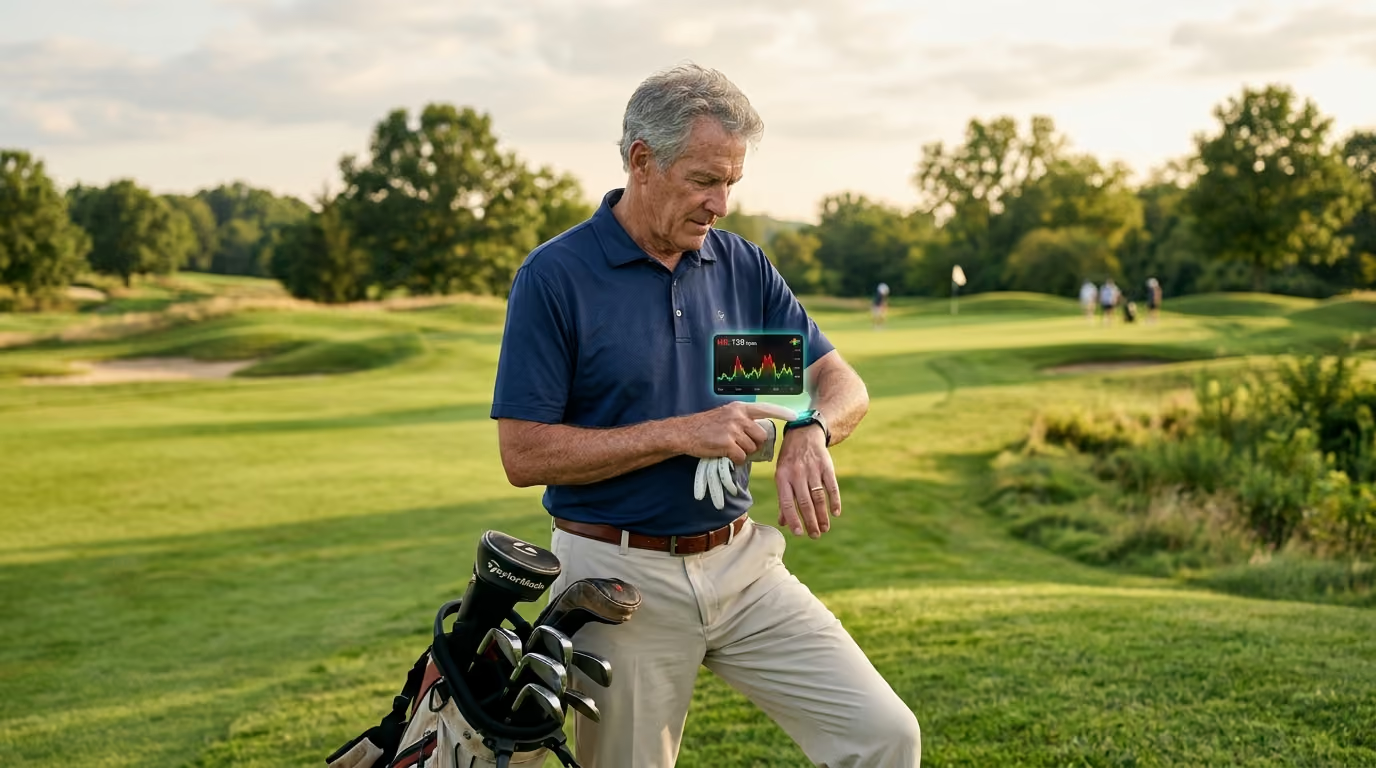
Walking down the fourteenth fairway with a dull ache in your front knee shows how joint fatigue ruins an otherwise great round of golf.




Protecting your knees on the golf course is not about finding a magic cure or wearing a bulky brace. True knee longevity is about understanding how your body moves and distributes stress during a round. It is a commitment to keeping your lower body strong, stable, and mobile so you can walk the fairways without discomfort. This guide is a complete roadmap designed to help you maintain your joints, improve your movement patterns, and walk 18 holes with ease.
This guide is not a medical diagnosis for structural joint damage. If you have a torn ligament or severe joint degeneration, you should consult a doctor. However, for mature golfers who experience dull aches, stiffness, or fatigue during a round, the strategies here offer a sustainable way to play pain-free. We will look at the real biomechanical causes of joint wear and how you can fix them.
Walking the course is one of the best ways to enjoy the game and stay active. Research shows that walking does not make knee arthritis worse if you manage the physical loads correctly. By making smart adjustments to your setup, your walking habits, and your footwear, you can protect your knees and extend your playing years. Let us look at how you can keep your joints healthy for the long term.
Imagine you are walking up the fairway on the fourteenth hole. The sun is starting to set, your legs feel heavy, and you have a long par four ahead of you. You reach your ball, which lies on a slight sidehill slope. As you settle into your stance, a familiar, dull ache starts to bloom on the inside of your lead knee.
You take your swing, but you cannot transfer your weight fully because of the discomfort. Your front leg feels unstable as you turn through the ball, and your shot ends up short of the green. As you walk toward the putting surface, every downward step on the slope causes a sharp pinch under your kneecap. Your focus shifts from making a par to simply surviving the final four holes.
This scenario is incredibly common for golfers over 50. The joint pain does not usually start with a sudden pop or a sharp injury. Instead, it builds slowly over several hours of walking and swinging. By the time you reach the back nine, your supporting muscles are tired, leaving your joints to absorb the full force of your movements.
Understanding this slow buildup of stress is key to preventing it. The pain you feel late in your round is a sign that your body has run out of ways to compensate. When your muscles fatigue, your knee joint takes the impact of every step and every swing.
To protect your knees, you must realize that the knee is a slave joint. It sits directly between your ankle and your hip. The knee is a simple hinge joint designed to move mostly forward and backward. It has very little ability to twist or rotate without suffering damage over time.
When your hips lack mobility or your ankles are stiff, your knee has to twist to make up for the lack of movement. Biomechanical research refers to this as the load-sharing framework. If your ankle cannot flex as you walk or swing, that rotational force travels straight up into your knee joint.
Your glute muscles are your knees' primary protectors. The glutes control the rotation of your thigh bone and keep your leg aligned. When your glutes are weak or inactive, your thigh bone tends to cave inward. This inward collapse puts massive rotational stress on the delicate cartilage of your knee.
Another critical player is a specific quadriceps muscle called the Vastus Medialis Oblique, or VMO. This is the teardrop-shaped muscle located on the inside of your thigh, just above your kneecap. The VMO is responsible for keeping your kneecap tracking smoothly in its groove. In mature golfers, minor joint inflammation can cause this muscle to shut down first, which leads to immediate tracking issues and patellar pain. You can read more about keeping your lower body functional on our joint mobility routines page.
The golf swing is a highly explosive movement that puts intense pressure on your lower body. Studies from PubMed show that a standard swing generates compressive loads on the knee ranging from 100% to 440% of your body weight. These forces are even higher when you play from uneven lies or thick rough.
Your lead knee and your trail knee play very different roles during the swing. Your lead knee, which is the left knee for a right-handed golfer, experiences rapid extension and sharp internal twisting during the downswing. The knee must hold its ground while your entire body rotates around it at high speed.
Your trail knee faces a different kind of stress. It experiences a massive lateral force during the transition from the backswing to the downswing. Biomechanists call this an abduction moment. Research shows that this lateral force is nearly four times greater in the trail knee than in the lead knee during the transition phase.
Knee injuries account for up to 18% of all golf-related injuries. Senior professional golfers over the age of 50 show a knee injury rate of 15%, which is nearly double the rate of younger pros. This statistic highlights the importance of protecting these joints as we age. By understanding these swing forces, we can make smart adjustments to keep our joints safe.
You do not have to wait weeks for gym exercises to take effect to find relief on the course. You can make immediate changes to your setup that reduce joint stress right away. The easiest adjustment involves how you position your feet at address.
Many golfers try to keep their feet perfectly square to the target line because they think it looks proper. However, a square stance increases the twisting force on your front knee during the follow-through. Flaring your lead foot outward by roughly 30 degrees toward the target changes the game. This simple adjustment reduces the rotational force and compression on your front knee by up to 28%.
You can also adjust your distance from the ball to manage specific pain patterns. If you feel pain on the inside of your lead knee, you are experiencing high medial joint stress. To fix this, try standing slightly closer to the ball at setup. This position alters the angle of your legs and reduces the peak twisting force on the inner joint.
Inner Knee Pain? -> Stand closer to the ball
Outer Knee Pain? -> Stand further from the ball
If your pain is on the outer side of your knee, you need the opposite adjustment. Stand slightly further away from the ball. This change reduces the outer joint stress during your swing. These quick setup tweaks act as a mechanical shield for your joints.
To build lasting knee resilience, you must establish a routine that addresses the root causes of joint stress. This means waking up the muscles that support your kneecap and hips. You can do these simple movements at home or even on the range before you play. Incorporating these habits is key to an active lifestyle for healthy ageing.
The first movement is the Terminal Knee Extension, or TKE. This exercise target-activates the VMO muscle to ensure your kneecap tracks correctly.
The second exercise focuses on waking up your glutes to stabilize your hips and knees.
These exercises do not take long, but they make a massive difference in how your knees feel. They prepare your muscles to absorb the forces of walking and swinging. When you activate these key muscles, you take the pressure off your joints. For more ideas on building lower body strength, check out our lower body strength exercises.
Walking up and down hills on a golf course can be highly stressful for your knees if you use poor mechanics. Most golfers walk uphill by driving their knees forward and leaning their chests over their toes. This technique puts a massive shear force on the patellar tendon and squashes the joint.
Instead, use the hinge and drive mechanism when you face an incline.
This simple change in your walking technique shifts the workload from your knees to your hips. Your glutes and hamstrings are much larger and stronger than your quad muscles. They are designed to carry your body weight up slopes without getting worn down.
Uphill: Bend at hips, press through heels, squeeze glutes.
Downhill: Walk in a zig-zag path, keep knees slightly bent.
Walking downhill is actually more stressful for your knees than walking uphill. This is because your quad muscles must work hard to slow your body down with every step. To protect your joints, never walk straight down a steep slope. Instead, walk down in a zig-zag path to reduce the angle of the hill, keeping your knees slightly bent to absorb the impact.
One common mistake is assuming that riding in a golf cart is always better for bad knees. Many golfers think they are protecting their joints by sitting down between shots. In reality, sitting in a cart for several minutes allows your joints to cool down and your muscles to tighten up. When you step out to hit a shot, your knees are cold and unprepared for the force of the swing.
Walking with a push cart keeps your joints moving constantly. This constant, low-impact movement acts like a pump for your joint fluid, which lubricates your cartilage. A study published in the Journal of Applied Sport Science shows that walking does not increase joint damage for golfers with knee osteoarthritis. Continuous movement is often the best medicine for stiff joints.
Another mistake is forcing a static, square setup because you want to copy a professional swing. Golfers over 50 often lack the hip rotation of a twenty-year-old athlete. Trying to hold a square stance forces your knee to twist violently during the downswing. You must allow your body to adapt by flaring your feet and letting your joints move naturally.
Finally, many golfers try to fight knee pain by bracing their legs and keeping them completely stiff during the swing. They restrict their hip turn and try to slide their upper body instead. This stiffness actually increases the twisting force on your knee joint. To keep your knees safe, you must allow your hips and ankles to turn freely. Our injury prevention strategies can guide you in making these adjustments safely.
Your golf gear plays a massive role in how your knees feel after 18 holes. The wrong shoes can send hard shockwaves up your legs with every step you take on firm fairways. Traditional golf shoes with thin, stiff soles offer very little protection from these impact forces.
Look for golf shoes that feature at least 15 millimeters of midsole cushioning. This thick, supportive foam acts as a shock absorber, reducing the impact forces on your knees. Good arch support is also vital because it prevents your foot from rolling inward. When your foot rolls inward, your knee is forced to rotate, which leads to joint pain.
Shoe Checklist for Knee Pain:
The way you transport your clubs also affects your joints. Carrying a heavy golf bag adds an extra 25 to 30 pounds of weight to your frame. This extra weight increases the compressive forces on your spine, hips, and knees with every single step.
Using a push cart is a much better choice for joint health. Research published in the European Journal of Sport Science shows that pushing a cart reduces your oxygen consumption by over 10 percent compared to carrying. This reduction in fatigue means your walking posture and swing mechanics stay strong and safe through the final holes.
Protecting your knees requires a strategic approach from the first tee to the final putt. You can manage your energy and joint stress by dividing your round into three distinct phases. This systematic approach ensures your muscles stay active and your joints stay safe.
Your main goal during the first six holes is to build gentle mobility and activate your supporting muscles.
During the middle of the round, fatigue can begin to creep in, leading to lazy movement patterns.
This is when most knee injuries and pain patterns flare up due to fatigue.
Holes 1-6: Warm up joints, flare feet, walk slowly.
Holes 7-12: Hinge and drive on hills, stay hydrated, maintain setup.
Holes 13-18: Zig-zag downhills, lift lead heel, swing smoothly.
Many golfers wonder if they should wear a knee brace or a compression sleeve to protect their joints. The answer depends on the type of knee issue you are facing. For most golfers, a simple compression sleeve is highly beneficial.
A compression sleeve does not physically lock your joint in place, but it improves your proprioception. Proprioception is your brain's awareness of where your joint is in space. The gentle pressure of a sleeve helps your brain coordinate your leg movements more effectively, which improves muscle activation and stability.
If you have a structural injury, such as a damaged ligament or severe osteoarthritis, you may need a mechanical brace. These braces feature metal or plastic hinges that physically restrict side-to-side movement. They are designed to absorb some of the lateral forces that your knee cannot handle on its own.
However, you should not rely on a brace to replace healthy muscle function. Wearing a heavy brace all the time can cause your supporting muscles to become weak and lazy over time. Use a brace when you need extra stability on the course, but continue to work on your strength and mobility at home to address the root causes of your pain.
Yes, walking with a push cart is often much better for your knees than riding. Sitting in a cart causes your muscles to tighten and your joints to cool down between shots. Walking keeps your legs moving, which constantly pumps lubricating fluid through your joints. This continuous movement keeps your knees warm, active, and better prepared for the forces of the golf swing.
If you feel pain during a round, check your setup immediately. Make sure your lead foot is flared outward by 30 degrees to reduce rotational stress. If the pain is on the inside of your knee, stand a little closer to the ball. If the pain is on the outside, stand slightly further away. You should also focus on lifting your lead heel during the backswing to take the twist off your front knee.
Lifting your lead heel during the backswing allows your hips to turn more freely. When your hips rotate fully, your knee does not have to twist as much to complete your swing. This simple change reduces the shearing forces on your knee cartilage and ligaments. It is a highly effective way for mature golfers to protect their joints while maintaining swing speed.
Yes, worn-out spikes or shoes with poor cushioning can contribute to knee pain. Spikes that do not grip the turf properly can cause your foot to slip during the swing, which puts sudden, violent twisting forces on your knee. Additionally, shoes with stiff, thin soles do not absorb the impact of walking on hard ground. Always wear supportive shoes with good traction and plenty of cushioning.
Flaring your lead foot by 30 degrees and using your hips to drive you up hills will take the pressure off your knees and keep you walking the course pain-free for years.
Follow Golfergy for practical insights on performance, mobility, recovery and healthy ageing. Stay connected for new articles, research-led guidance and ideas to help you play better for longer.


Explore practical resources on performance, recovery, mobility and golf longevity.
Read the Blog