
Learn how strength, power, and mobility form a linked system in the golf swing, and why older golfers should prioritize balance over isolated speed drills.




Physical capacity in the golf swing is simply your body's ability to coordinate strength, mobility, and power into one fluid motion. Many golfers view these physical traits as completely separate tools. The reality is that they operate as a single linked system. You cannot build a repeatable swing if you treat them as isolated parts.
Think about how your body feels during a standard round of 18 holes. When you stand over a crucial approach shot on the back nine, you rely on a linked movement sequence. This sequence is required to generate and control force. It begins with how your feet press into the turf and interact with the ground.
A 2026 pilot study published in Frontiers in Sports and Active Living describes the golf swing precisely this way. The researchers note that foot-ground interaction may contribute to movement and force transfer through the body. If your physical foundation is disconnected, you might lose your balance during the swing. You might also struggle to maintain your spine angle as the round progresses.
This specific study tested 25 male golfers from Italian golf clubs. These participants were highly skilled, carrying a mean handicap index of 0.4. They averaged 29 years old and spent about 16 hours practicing each week. The intervention was a supervised three-minute sequence of foot actions intended to train ground use.
Participants hit five 6-iron shots at baseline, immediately after the foot actions, and three minutes later. From before the intervention to the final test, researchers noted a short-term boost in speed. Mean club speed increased by 0.79 meters per second. Mean ball speed increased by 0.95 meters per second.
It is very tempting to see a jump in club speed and assume it creates a better game. However, speed alone is not the same thing as repeatable contact. The 2026 pilot study recorded significant changes in speed across its test sessions. It did not directly assess impact centeredness or contact consistency.
An immediate response to a drill is not a true training adaptation. The testing ended mere minutes after the intervention. The study did not measure whether these changes lasted or accumulated with repeated practice. True consistency requires a balanced physical approach over time. Players who want to build a foundation for a more consistent swing need a comprehensive, long-term plan.
The authors caution that their study design severely limits causal interpretation. The test had no control or sham group. It evaluated golfers over a span of minutes rather than over several weeks. The researchers could not rule out practice effects or other time-related influences during the session.
A repeatable swing requires physical traits that the study did not directly evaluate. The researchers did not assess baseline strength, power, or mobility in their subjects. They also did not track injury incidence throughout the testing period. Because they excluded participants with current musculoskeletal injuries, their findings offer no direct insight into injury prevention.
You cannot assume that a brief foot-action sequence will keep your lower back safe during a long round. A true training plan requires a balanced progression of joint stability and muscular strength. Older golfers need a routine that builds resilience rather than just chasing peak speed numbers. When you focus solely on raw speed, you often neglect the stabilizing muscles that prevent injury.
To build a consistent swing, you must understand how physical qualities differ. Strength is your absolute ability to produce force against resistance. Power is your ability to produce that force quickly. Mobility allows your joints to move through their full necessary range of motion safely.
The 2026 pilot study focused heavily on a specific element of force generation. The authors propose that foot proprioception and propulsion may contribute to stability. They suggest this helps the movement sequence transfer energy toward the club. However, this is their proposed explanation rather than a mechanism confirmed by their measurements.
Claiming that one physical quality matters most requires different evidence entirely. A young player might have abundant power but poor mobility. An older player might have great stability but lack the strength to drive the ball efficiently. The key is finding a balance that suits your personal physical limitations.
As a golfer passes age 40 and 50, the body naturally alters how it coordinates physical qualities. You might find that your raw strength remains adequate, but your ability to generate rapid power fades. Your joints might not tolerate the same level of rotational stress they did in your twenties. The linked movement sequence becomes much harder to execute smoothly when joint mobility declines.
If your hips and mid-back lose flexibility, your body will look for other ways to generate force. You might try to compensate by swinging harder with your arms or swaying off the ball. These compensations disrupt your strike quality and can increase physical strain. This is why older golfers must prioritize joint health alongside power generation. If you are looking to pursue more swing speed without pain, you have to train the entire system.
The authors of the 2026 study explicitly note their sample's demographic profile as a limitation. They state that the highly skilled, young sample limits how confidently the findings apply to older golfers. A routine that works for a 29-year-old scratch golfer might not suit a 55-year-old weekend player. Relying on an isolated speed drill is a risky strategy for a mature player seeking longevity.
Golf performance research is increasingly looking beyond gym strength alone to understand the swing. The background of the 2026 pilot study cites several reviews covering resistance training, ground-reaction forces, and clubhead speed. The science shows that physical characteristics matter deeply, but it does not prescribe a perfect age-based progression.
A 2026 systematic review and meta-analysis on physical training interventions for golf shot performance exists. It is listed in the journal Sports Medicine, but the retrieved listing does not provide its results. This lack of clear, actionable data highlights an important reality for older recreational players. There is no single, universally proven workout menu that guarantees repeatable contact for everyone.
Building a proper physical foundation requires a sensible approach to your pre-round routine. I used to stand on the first tee doing long, static hamstring stretches because I thought it was the right way to warm up. I would actually feel weaker on my first drive. Research later showed me that dynamic movements, like leg swings and torso twists, prime the nervous system much better. Changing my five minute warmup completely transformed my opening tee shots.
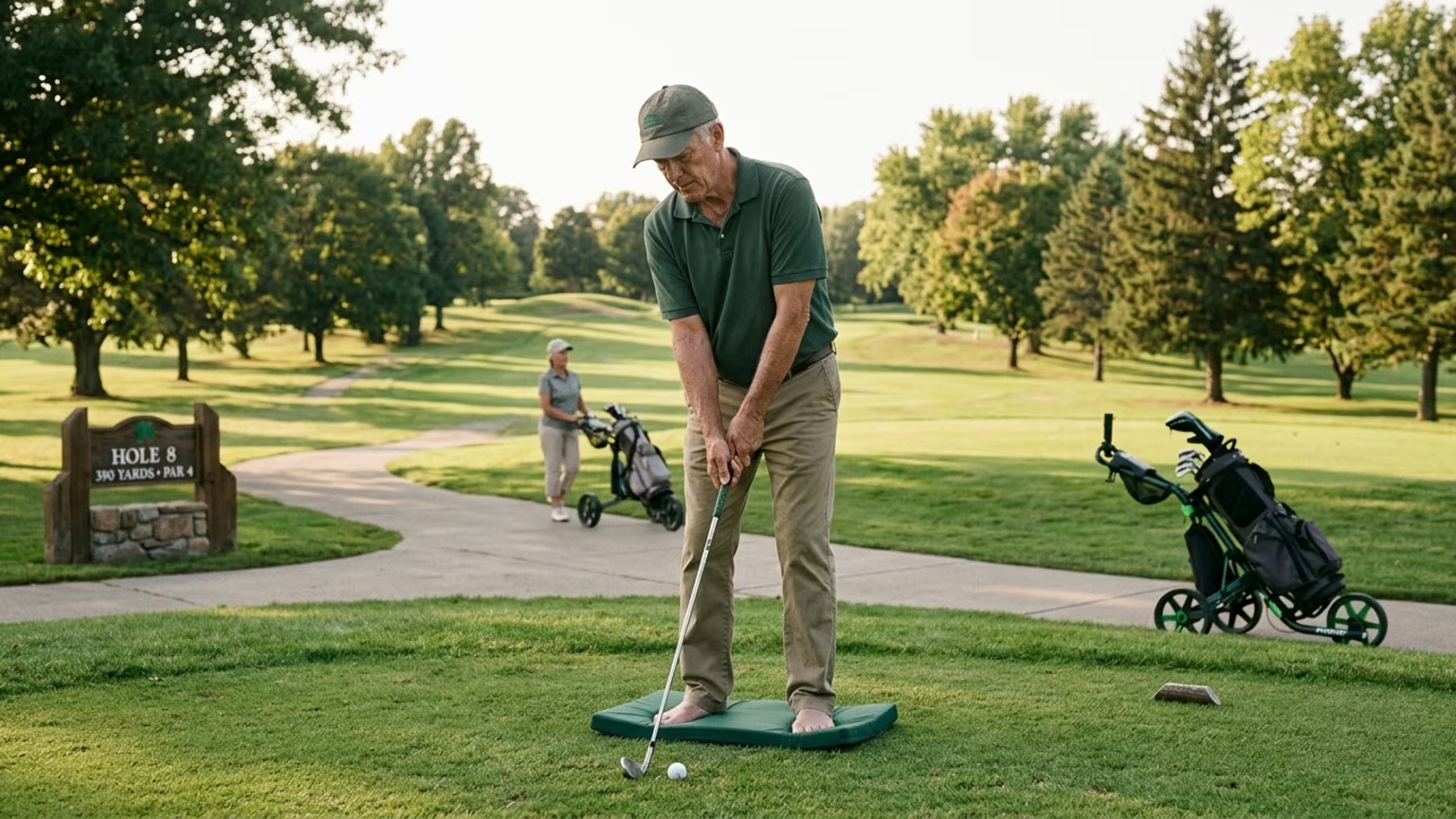
Dynamic movement prepares your muscles and joints for the linked sequence required to hit the ball. Instead of trying to isolate your flexibility, you wake up the entire system. A second practical habit is paying closer attention to your ground interaction. While a three-minute foot drill will not cure your swing flaws overnight, the concept of foot stability remains valid.
You can practice making slow practice swings while paying strict attention to how your feet press into the turf. Focus entirely on maintaining your balance from the start of your swing to the finish. This simple awareness can help you manage the rotational control required for a healthy swing. Ground awareness is a highly accessible habit that requires no special equipment.
Our team has witnessed the consequences of chasing speed without a stable foundation. The saddest thing I have seen in golf is watching lifelong playing partners slowly drop out of our weekend group. It usually starts with a nagging shoulder or knee issue they ignore until it requires surgery. That pattern is exactly why I became obsessed with golf longevity. We do not have to stop playing as we age, provided we do the right maintenance work between rounds.
Prioritizing a balanced, integrated physical foundation over isolated speed drills is the best way to keep playing better for longer.
Follow Golfergy for practical insights on performance, mobility, recovery and healthy ageing. Stay connected for new articles, research-led guidance and ideas to help you play better for longer.



Learn how mature golfers can manage morning stiffness and prepare for the first tee with a practical warm-up sequence focused on controlled mobility.

Discover a practical stability routine for older golfers. Build lower-body strength and trunk control with safe, supported exercises for a steadier golf swing.

Learn how restricted hip and thoracic mobility impacts your golf swing after 40. Review practical daily routines and expert insights to protect your lower back.
Explore practical resources on performance, recovery, mobility and golf longevity.
Read the Blog