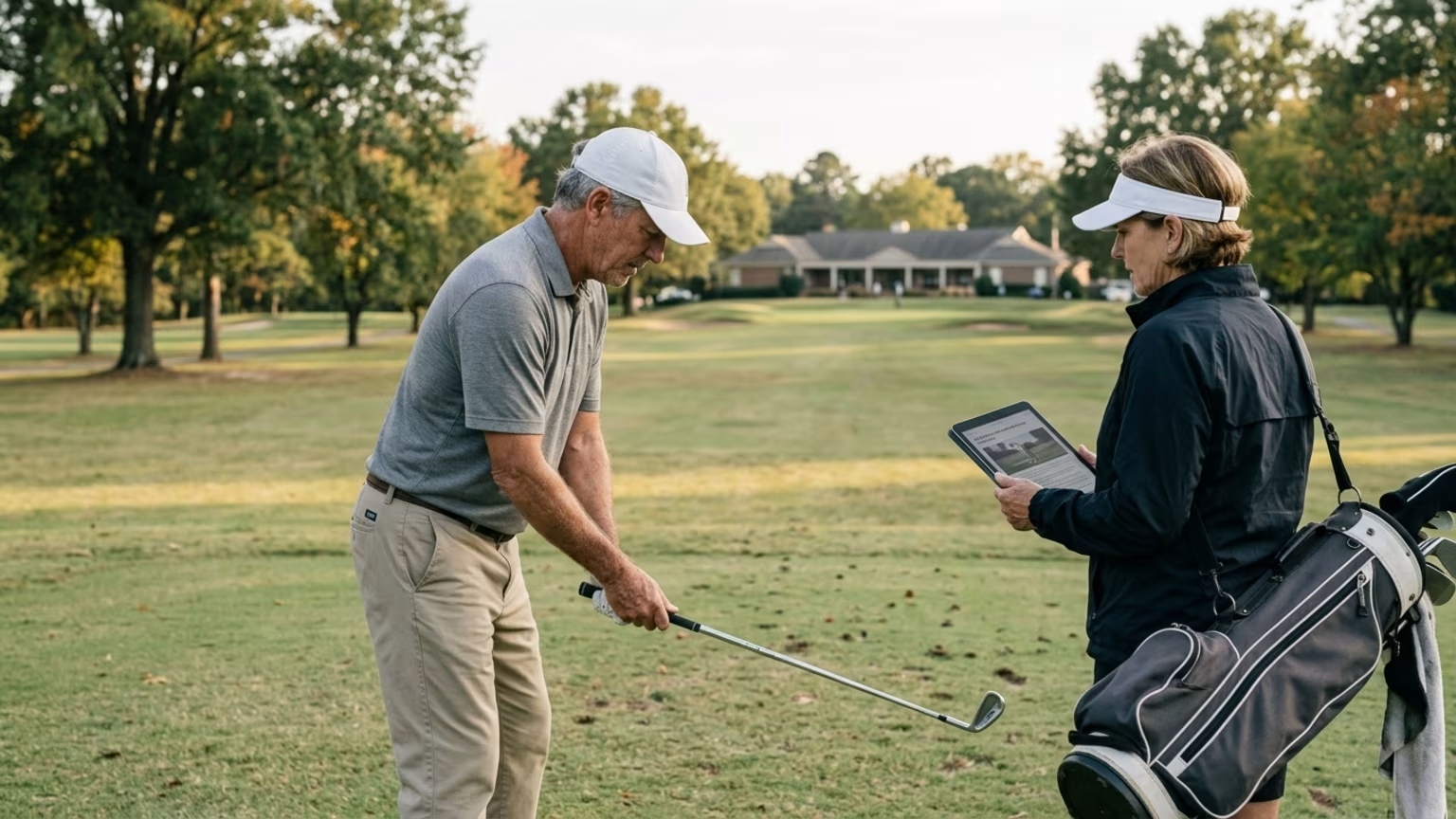

Discover the practical biomechanics behind Jeff Richmond’s Stress-Free Golf Swing. Learn how a one-move system impacts older amateurs and joint health.




In August 2026, a Newswire review broke down Jeff Richmond's The Stress-Free Golf Swing for everyday players. One tired golfer stood on the practice tee with twelve conflicting thoughts. That familiar mental overload is exactly the tension this digital program attempts to resolve. The publication examined a system claiming to simplify mechanics for frustrated players.
The review identified Jeff Richmond as the creator and Director of Instruction at ConsistentGolf.com. His instructional content under this brand dates back to 2012. The brand says the method originated in 2015 after Richmond studied old swing footage. The current version is described as updated and refined for 2026.
The claim that all 2025 major champions used the move should not be repeated as fact. The review found no independent player or analytical confirmation for it. The Hogan narrative should not be presented as established history. The review says it was not confirmed by Ben Hogan or his estate.
It also lacks confirmation from the PGA Tour or any named major champion. The review is itself identified as a paid advertorial, and it states that a commission may be earned if a reader purchases through its links. Buyers should read the product details carefully before making a decision.
The reviewed package reportedly includes a 169-page PDF manual, 21 step-by-step online videos, and a one-page Quick-Start Cheat Sheet delivered digitally through a members’ area. The program is organized into seven distinct modules. These modules cover the method itself, setup, and at-home drills. The remaining sections handle range-to-course transfer, common misses, and a stated implementation plan.
Mechanically, the system promotes one core swing adjustment. The goal is to simplify timing and sequencing during the golf swing. Instead of manually coordinating wrist angles and shoulder tilt, the player focuses on a single cue. This approach allows the body to react naturally without forced tension.
However, a single move does not bypass the body completely. A timing change still interacts with grip, posture, and thoracic rotation. The hips must still clear out of the way on the downswing. The spine must maintain its angle through impact.
A rhythmic approach can certainly support better sequencing on the course. A single swing thought might help a player find a natural rhythmic ratio effortlessly. This prevents the jerky transition that ruins many amateur golf shots. Smooth tempo always wins out over rushed mechanical thoughts.
Published literature on golf injury profiles consistently highlights the risk of low-back pain and joint stress. The available sector context supports discussing swing efficiency and load management as critical concerns for mature golfers. Older players clearly need strategies that protect their joints over time. This reality highlights the physical cost of repetitive swing strain.
The Newswire review found no controlled testing or independently authenticated testimonials supporting the product’s performance claims. The review also found no verified scorecard or handicap records. It lacked proof of distance gains or practice-history improvements. The lack of clinical data means this remains a golf instruction tool rather than a guaranteed scoring fix.
Golfers over 40 face high risks when rebuilding a swing. A stiff body struggles to hit exact positional checkpoints. Trying to force a rigid backswing often leads to unwanted compensations. Muscles tense up, and the club path gets thrown off course.
A minimal-move system appeals directly to this exact vulnerability. Complex mechanical thoughts overwhelm the brain in under two seconds. Older joints simply cannot tolerate the torque required by modern tour swings. A single timing cue provides an alternative to endless technical reconstruction.
The brand positions the method for less-flexible golfers. The program specifically emphasizes practice without a range. The short at-home exercises might appeal to players managing time and limited mobility. These practical considerations matter just as much as pure swing mechanics.
We know that true golf performance drops when players feel overwhelmed by technique. Mental fatigue creates physical tension. A simpler instructional framework reduces that cognitive load significantly. This helps older amateurs swing freely without worrying about endless mechanical rules.
Any swing change requires a patient and grounded approach. Golfers should test one single variable at a time. Adding multiple grip and posture changes at once makes progress impossible to track. Players should document a baseline over several practice sessions first.
Before trying the one-move cue, record your common misses and strike quality. Note your perceived effort and balance at the finish. This makes it easier to distinguish genuine improvement from normal shot-to-shot variation. Only then should you take the adjustment to the actual course.
In our experience, a simpler swing thought works best when paired with functional mobility. A few years ago, I noticed my swing falling apart around the 14th hole. My lower back would tighten up, and I started compensating with my arms. I spent months thinking it was a swing flaw.
It was not until I started a simple evening hip mobility routine that I realized my glutes were just turning off from fatigue. Fixing that one physical limitation brought my back nine scores down drastically. You might consider checking our sustainable injury prevention system to build a solid foundation. You can also implement a post-round recovery routine to keep your joints healthy.
Some players might think a single move acts as a medical cure. The Newswire review explicitly says the product makes no medical or therapeutic claim. It is not a substitute for a physician or physical therapist. A swing cue is merely an instructional experiment.
Golfers should never swing through active pain. Testimonials mentioning reduced physical strain do not constitute verified medical evidence. If a new movement causes worsening back or shoulder pain, that is a stop signal. Players should always seek qualified clinical guidance for persistent discomfort.
A single move cannot repair tissue damage or reverse arthritis. It will not magically fix profound limitations in rotational flexibility. The program’s stated 30-day practice recommendation should not override your body's physical limits. The article explicitly says that it did not independently test the manual or videos because the detailed content was behind the paywall.
The review says the product was listed at a standard price of $67 during the August 2026 review, with a displayed exit-intent offer of $47 in some checkout circumstances. The offer reportedly includes a stated 60-day money-back guarantee. The review says the materials did not clearly establish when the refund period begins, how long processing takes, or what happens if an email request goes unanswered.
The product’s stated 30-day practice recommendation and 60-day refund window are not the same thing. The review says the 30-day recommendation was not presented as a contractual condition overriding the stated guarantee. Buyers should judge the product by transparent criteria like repeatable contact. An instructional package provides ideas, but you must do the physical work.
What adjustments will you make to your mobility routine this season to steer clear of this hazard?
Follow Golfergy for practical insights on performance, mobility, recovery and healthy ageing. Stay connected for new articles, research-led guidance and ideas to help you play better for longer.


Build a practical golf warm-up from walking to comfortable mobility and fuller swings, while keeping preparation separate from long-term conditioning.


Shot Scope’s LM1 data offers age and handicap benchmarks for driver speed and carry. Here’s how golfers over 40 can read the figures.

A grounded look at balance after 40, with supported single-leg practice and a clear place for strength training and golf practice.
Explore practical resources on performance, recovery, mobility and golf longevity.
Read the Blog


