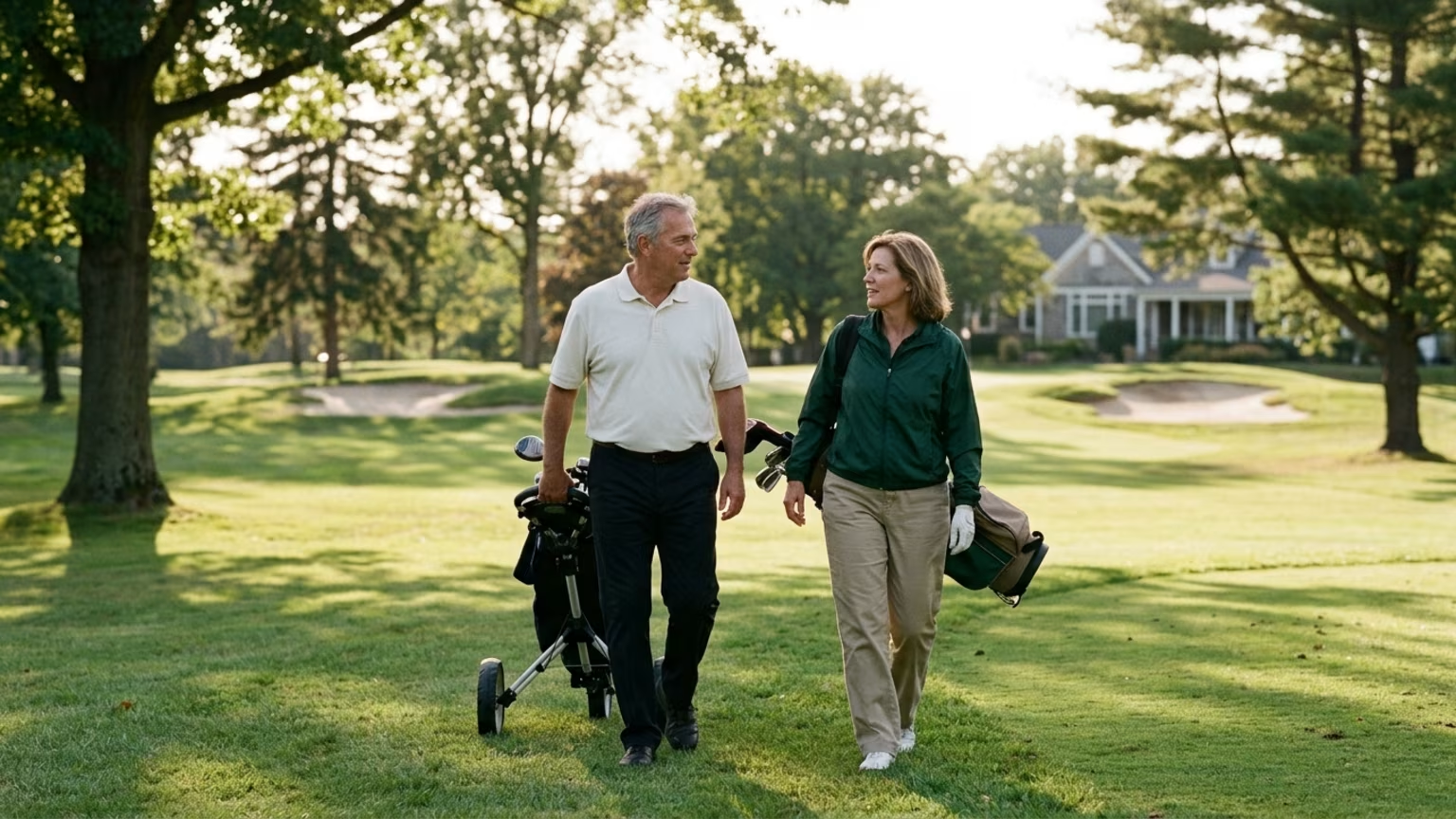
Plan a simpler evening after golf with regular sleep times, a relaxing wind-down, and realistic next-day commitments.




Why do I feel tired after 18 holes but still struggle to settle down for bed? That gap between finishing a round and feeling ready for sleep can be frustrating. You want a useful plan, not another set of recovery rules to get right.
Start with a steady evening rather than an elaborate golf recovery ritual. The National Institutes of Health recommends regular sleep times and relaxing before bed. Those habits offer a practical starting point for planning the night after golf without turning recovery into another performance test.
Walking can add physical work to your round. That helps explain why the way you travel around the course matters, but it does not identify the cause of back tightness.
A reported controlled comparison of 16 skilled male golfers found an average of 17,007 steps when walking versus 6,274 when riding. Heart rate rose progressively during the walking round. Reported exertion was also higher after walking.
These findings need a clear boundary. The participants averaged 20.9 years old, so their figures are not estimates for recreational golfers over 40. The research also does not explain an individual golfer's tightness or establish a special post-round sleep routine that prevents injury or speeds recovery.
The useful takeaway is simpler: count the round itself when thinking about your day's activity. Walking and riding did not create the same measured physical load in this comparison. There is no need to turn its step counts into a personal target or a calculation of how much sleep you have earned.
Feeling more tired does not automatically mean you have lost swing speed or distance. In the walking-versus-cart comparison, researchers found no significant overall difference in clubhead speed or ball speed between conditions.
The report also cautioned against treating a carry-distance difference on a single hole as proof that walking reduced performance across the whole round. That distinction matters when you review a disappointing finish.
A tired feeling and a poor shot can happen together without proving why the shot went wrong. The study did not establish that fatigue caused a particular swing path or contact problem. Avoid building a technical explanation from the scorecard alone.
For the evening ahead, separate two questions: how did your body feel and how did you play? A satisfying score does not have to dictate your bedtime. A disappointing score does not create a need for a special recovery ritual. Keep the sleep plan tied to a regular routine rather than the quality of your last few holes.
The supplied evidence does not identify a safest on-course stretch. It would be misleading to prescribe a bend or rotation as the answer to an unexplained symptom.
The immediate planning adjustment is to avoid turning tightness into a self-designed stretching test. A sleep routine is not a treatment for it either. For a personal decision about recurring tightness or pain, a qualified clinician is the right person to assess the problem.
Keep the broader question of where mobility work fits around a round separate from choosing a treatment for pain. For tonight's sleep plan, focus on the supported habits: regular timing and relaxation. You do not need to add an untested stretch sequence to make the evening count as recovery.
The practical foundation is general adult sleep guidance. NIH recommends 7 to 9 hours of sleep for adults and advises a consistent bedtime and wake time, including on weekends. Individual sleep needs vary, so that range is guidance rather than a golf-specific prescription.
Build the evening around a few repeatable decisions. Each should make the plan easier to follow rather than add another task to complete.
Use your normal bedtime and wake time as the starting point after a round. A late finish does not need to become a reason to redesign the whole night. The daily habit is consistency rather than chasing a perfect post-golf schedule.
The same principle applies across the week. NIH includes weekends in its advice about keeping regular hours. Keep sleep timing steady around golf as the focus instead of treating golf nights as a separate category with their own rules.
Look at the time between your evening commitments and your planned wake time. Does that schedule leave a reasonable opportunity for your usual sleep requirement? This is a planning question, not a demand to fall asleep at an exact moment.
The useful distinction is between making room for sleep and trying to control the entire night. Give the schedule some attention before bedtime arrives. Avoid treating the adult sleep range as a score you must hit precisely after every round.
NIH recommends relaxing before bed. Choose a wind-down that feels relaxing and is manageable enough to repeat. There is no need to assemble a long sequence of recovery tasks around that advice.
Keep the focus on one decision at a time. Settle on a repeatable way to wind down before adding more to the evening. A routine that becomes another demanding project misses the practical point of keeping things simple.
NIH also advises regular exercise but not within a few hours of bedtime. That does not mean every movement after an evening round is forbidden. It does mean that extra late-night training is not a required step in this sleep plan.
Choose manageable next-day commitments rather than building a demanding schedule to prove that you have recovered. Leave room to review how you feel instead of deciding tonight that every planned task must happen.
If another round is on the calendar, keep the next-round readiness decision separate from tonight's bedtime target. A regular evening is a useful habit, not a guarantee about how tomorrow will feel. Golfergy's approach favors steady habits over quick fixes.
Your next practice session is a chance to connect the evening plan with your own observations. Before you begin, assess how rested you feel and whether the tightness you noticed on the course is present.
During practice, focus on one movement at a time. Pay attention to how comfortable your turn feels rather than trying to explain every missed shot through fatigue. Keep that observation separate from judging the quality of your contact.
At your next practice session, assess your body before chasing a swing change. Use what you notice to inform a manageable plan for the next round while keeping your evening routine steady.
Follow Golfergy for practical insights on performance, mobility, recovery and healthy ageing. Stay connected for new articles, research-led guidance and ideas to help you play better for longer.


Rest or move the day after 18 holes? Use fatigue, soreness, symptoms and your playing schedule to guide a flexible recovery day.


Compare foam rolling, massage, compression, heat and cold for golfers, with comfort benefits kept separate from performance and injury claims.
A measured guide to stiffness during and after golf, with gentle movement options, sustainable habits and NHS-backed back-pain warning signs.
Explore practical resources on performance, recovery, mobility and golf longevity.
Read the Blog