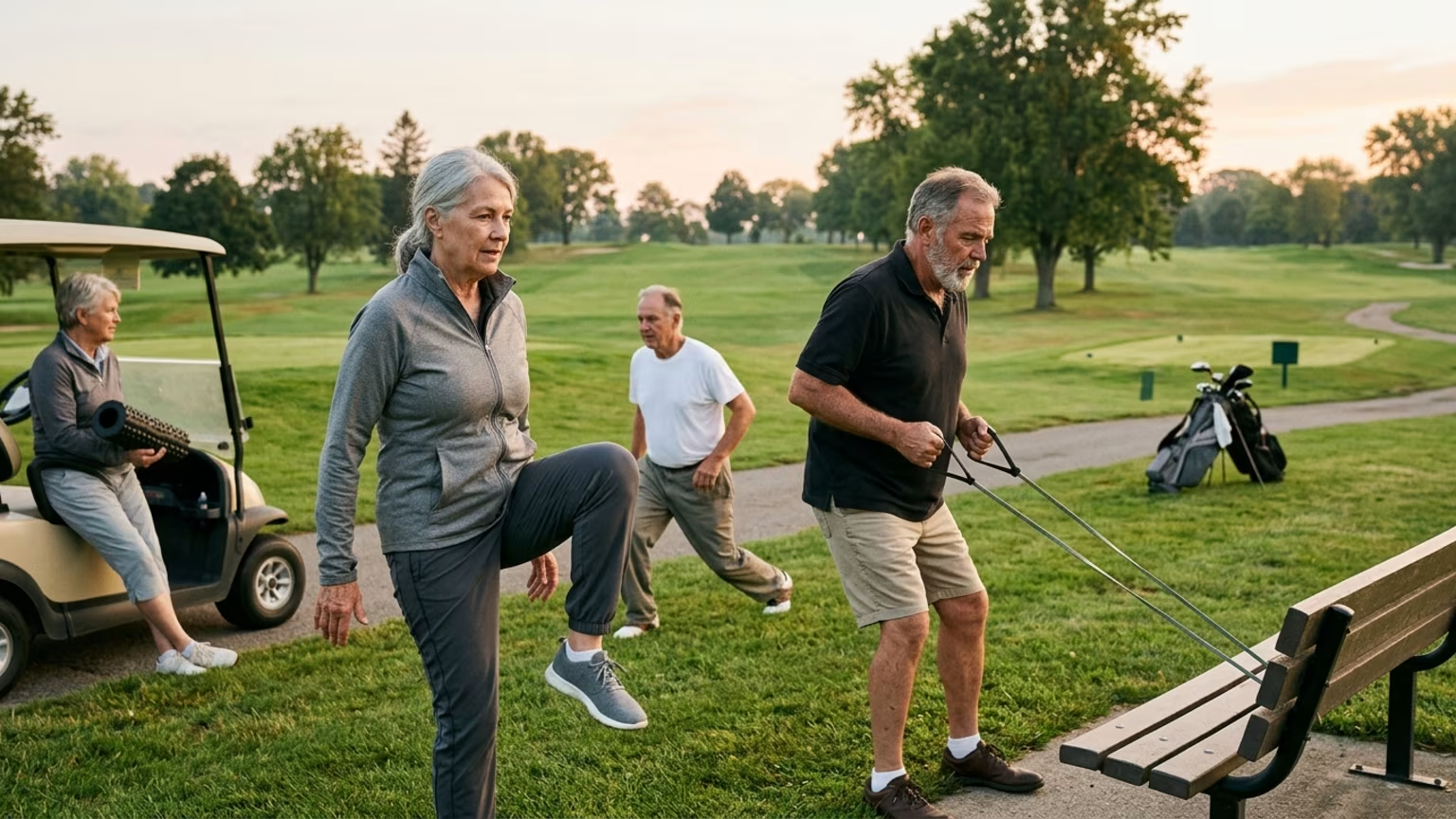

Learn why walking 18 holes falls short. See how golfers over 40 can combine aerobic, strength, and mobility training to prevent joint injuries.




In 2025, 112.2 million adults and juniors played golf worldwide outside the United States and Mexico. That figure represents a massive 4.2 million increase from 2024. This growth means more older adults are walking the fairways for their weekly exercise. Many players mistakenly treat a weekend round as a complete physical conditioning program.
Walking eighteen holes is a variable-intensity activity. A British Journal of Sports Medicine scoping review found that golf involves energy expenditures ranging from 2.5 to 8.0 metabolic equivalents. Some rounds are relatively light walks in the park. Other rounds on hilly terrain can be genuinely demanding on the cardiovascular system.
This aerobic benefit is wonderful for general health. A Swedish observational study comparing 300,818 golfers with non-golfers found a 40% lower mortality rate among the playing group. Researchers warned that causation could not be established directly from this observation. Healthier and more active people might simply be more likely to play the sport.
The same review found limited evidence that golf alone supplies sufficient muscle-strengthening and balance work. You cannot rely entirely on your time on the grass to build a resilient body. Playing the game will not automatically protect your joints from the repetitive strain of the swing.
The golf swing is a violent mechanical action. The body must rapidly accelerate a clubhead before abruptly slowing it down. This cycle places massive rotational stress on the joints. The trailing arm and the lower back absorb the brunt of this repeated force.
During the downswing, your trail arm transfers immense pressure into the inner elbow. The surrounding muscles must act as shock absorbers for the joint. If these tissues lack strength, the tendons take the full impact of the deceleration. The tissue slowly breaks down after thousands of repetitive strikes.
This mechanical reality leads to common joint complaints among players. The scoping review reported that injury proportions for the lower back ranged from 18.3% to 36.4% among players. Reported elbow figures ranged from 8.0% to 33.0% across the studied populations. Wrist and hand issues affected between 10.0% and 32% of players.
Shoulder symptoms also appeared in 4.0% to 18.6% of reported cases. These figures highlight a clear physical deficit. The body breaks down when it lacks the physical armor required to manage repetitive rotational loading. A player cannot simply push through the pain without addressing the underlying weakness.
Recreational players over forty face a severe risk for these injuries. They might swing with less speed than the professionals on television. Aging naturally reduces muscle mass and tendon elasticity over time. A slower swing can still easily overwhelm a weakened joint.
Recent evidence summaries describe functional training as potentially improving strength and flexibility in older adults with sarcopenia. This age-related muscle loss dramatically reduces physical capacity over time. Research shows that combinations of resistance and balance training are also necessary to protect older adults with osteopenia. A younger player might get away with poor mobility.
Their younger tissues possess enough elasticity to handle extreme ranges of motion. An older body reacts differently to the exact same physical demands. The tendons become less compliant and require more time to recover from heavy loading. Older adults naturally lose physical capacity without dedicated resistance training.
The body becomes less capable of producing force and maintaining posture. A player who lacks thoracic motion might force their lower back to rotate past its safe limits. This compensation pattern is a direct path to an injury. Older golfers must recognize that building resilience happens in the gym.
You must treat fitness and skill practice as distinct categories. The World Health Organization recommends 150 to 300 minutes of moderate aerobic activity weekly. This framework also suggests muscle-strengthening work on at least two days. For adults aged 65 and older, the guidance adds multicomponent activity focusing on functional balance on at least three days.
Aerobic work supports your ability to walk the course comfortably. Resistance training develops the physical capacity required to hit the ball with authority. Mobility work helps you access useful ranges of motion without forcing your joints. You should use a structured weekly healthy ageing routine to organize these different elements.
A dedicated gym routine provides the precise resistance your body desperately needs. You can isolate weak muscle groups without the complex coordination of the golf swing. This isolation allows you to strengthen your lower back safely. Building isolated strength creates a buffer against the chaotic forces experienced on the course.
Start with basic movements like the goblet squat or split squat. Add cable rows and controlled dead-bug variations to build trunk stability. Leave a few good repetitions in reserve to avoid total exhaustion. You want to leave the gym feeling capable and energized for your next round.
Skill practice should involve low-fatigue technical work. Use half-swings and three-quarter swings to rehearse sequencing. Reserve repeated full-speed driver swings for targeted blocks. Stop your practice session immediately when your contact or sequencing deteriorates.
Focus entirely on turning your trail hip during specific practice swings. Keep instructions focused on one small movement at a time. This targeted approach prevents you from overwhelming your nervous system with too many thoughts. Skill practice should reinforce your physical training rather than compete with it.
Many players completely misunderstand how to handle joint pain. Complete inactivity is rarely the correct solution for a persistent ache. When I developed medial epicondylitis, commonly known as golfer's elbow, I thought I needed complete rest. Six weeks off the course did nothing to help.
I finally learned that active recovery with a flexbar was the actual solution. It taught me that treating golf injuries requires loading the tissue properly, not just sitting on the couch and hoping for the best. Tissues heal and strengthen when they are exposed to measured resistance. Complete rest often leaves the tendon weaker and more vulnerable to future damage.
Warm-up habits also need a massive overhaul. A physiotherapy summary noted that long static stretches immediately before play reduced driving distance and swing speed in several trials. Prolonged holding of a stretch can temporarily weaken the muscle fibers. Players need strength and control instead of stretching to stay safe.
Dynamic preparation provides a much safer alternative. Easy walking and progressive trunk rotations prepare the body for high-speed action. Practice swings that build from half speed to your intended velocity will prime your nervous system. Smarter routines focus on dynamic movement rather than passive stretching.
Another major error involves forcing extreme range of motion during practice. Golfers should seek controlled, usable movement rather than chase extreme flexibility. A player who lacks hip motion will often compensate by twisting their lower spine. The correct solution is building strength for the long game rather than forcing joints past their limits.
You do not need to train like an elite athlete. A balanced weekly schedule might include two dedicated strength sessions. You can add several short mobility exposures and multiple aerobic opportunities. This structure keeps high-speed swing practice limited enough to preserve your recovery.
Adjust your weekly workload based on your soreness and sleep quality. You should replace high-intensity work with light putting if you feel exhausted. Reduce your total volume if your joints feel unusually stiff. Smart players know when to push hard and when to back off.
You must view golf as just one component of an active lifestyle. The sport delivers incredible mental benefits and variable cardiovascular exercise. The true longevity formula requires external work to protect your joints. Only a balanced approach will keep you swinging freely into your later decades.
The global community of 112.2 million players will continue to grow. Many of those players will unfortunately end up sidelined by preventable injuries. You now understand the mechanics of tissue breakdown and the importance of active recovery. What adjustments will you make to your mobility routine this season to steer clear of this hazard?
Follow Golfergy for practical insights on performance, mobility, recovery and healthy ageing. Stay connected for new articles, research-led guidance and ideas to help you play better for longer.


A practical strength framework for golfers over 40, built around everyday goals, sensible progression and a careful look at limited golf research.


A research-led look at strength, balance, mobility and trunk control, with a flexible planning framework for golfers over 40.
Understand golf mobility after 40 with a comfortable-turn self-check, hip and shoulder guidance, and a clear look at flexibility and swing speed.
Explore practical resources on performance, recovery, mobility and golf longevity.
Read the Blog


