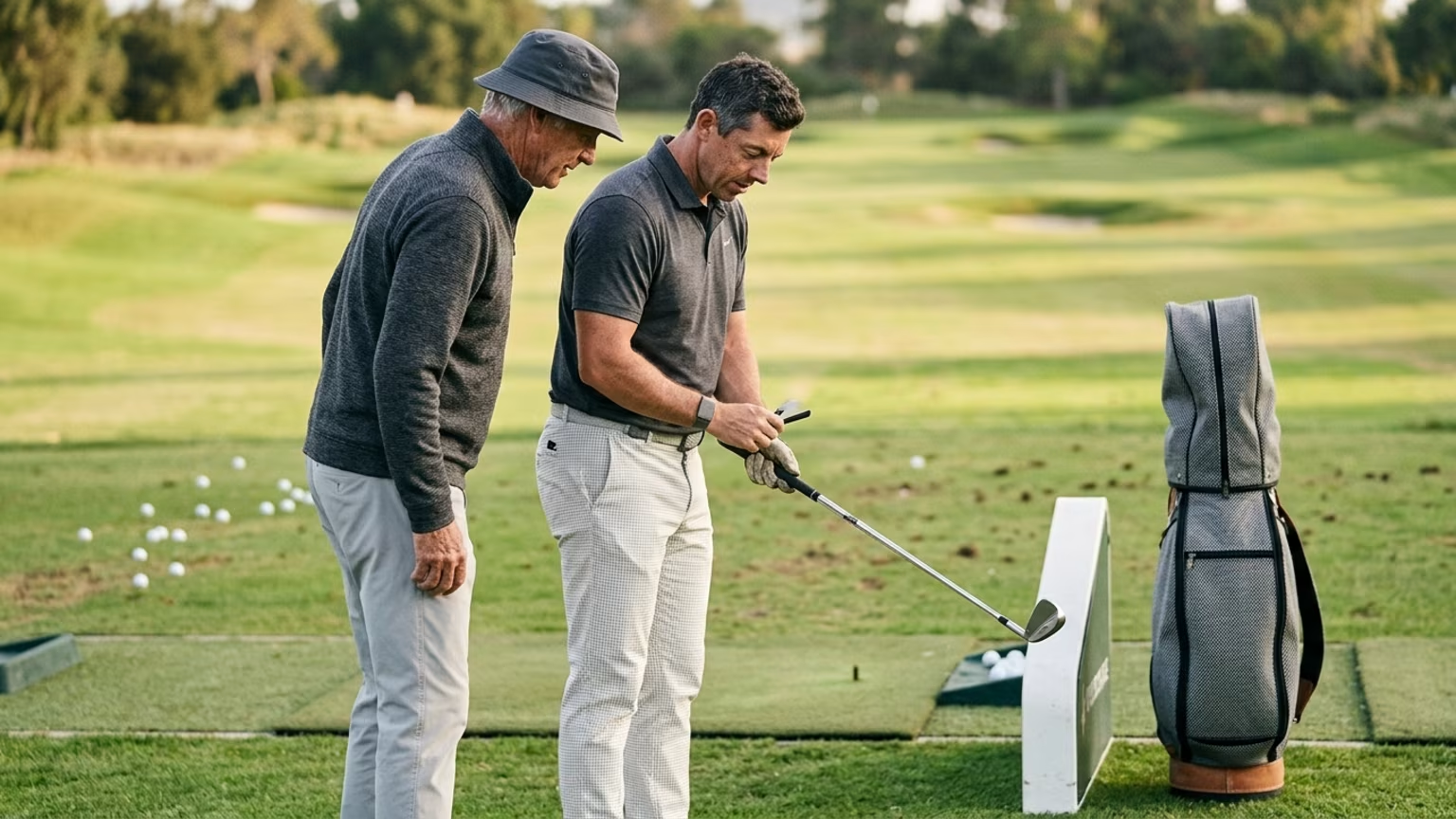

Learn how Rory McIlroy used custom training clubs to rebuild his swing consistency at the BMW Championship, and how older golfers can adapt this practice method.




The most reliable golf swings are built through rigid constraints rather than total freedom. Elite players create physical boundaries that force their bodies back into functional positions. In August 2026, when Rory McIlroy experienced a severe ball-striking slump at the FedEx St. Jude Championship, he did not just hit more golf balls. He worked with his coach to build entirely new feedback tools.
The PGA TOUR reported that McIlroy experienced one of the worst ball-striking performances of his recent career in Memphis. He finished 15 strokes behind Scottie Scheffler over the first two days of the tournament. He struggled to control his clubface and consistently missed his targets. This left him searching for answers as the playoff events intensified.
Instead of grinding on the range in Memphis, he took a step back. The PGA TOUR noted that he flew home to Florida for a single day. He spent that time working closely with coach Michael Bannon to diagnose the root cause of his ball-striking woes. They determined that his takeaway mechanics were breaking down under tournament pressure.
The PGA TOUR reported that McIlroy arrived at the 2026 BMW Championship with two highly unusual practice tools. He carried an extra lob wedge and a 7-iron fitted with jumbo Flat Cat putting grips. These grips were mounted 45 degrees off-center to create a highly specific sensation in his hands. He and Bannon developed these "Frankenstein clubs" to force his hands into a more efficient takeaway position.
McIlroy needed to fix the structural integrity of his right arm during the initial phase of the swing. When a golfer takes the club back, the trail arm must fold in a highly specific way. It needs to provide support for the club at the top of the backswing. If the right hand rolls underneath the grip too early, the clubface opens.
This structural breakdown forces the golfer to rely on rapid hand timing at impact. The jumbo putting grips mounted at an angle changed how McIlroy felt the handle. McIlroy said the modification helped his right arm work much better. It encouraged his right hand to stay more on top of the grip during the takeaway.
This kept the clubface stable and removed the need for complex compensations later in the swing. It allowed him to find a repeatable feel without obsessing over technical thoughts. The extra lob wedge and 7-iron were not designed for on-course competition. They were built purely to give McIlroy a new sensory experience.
The creation of these specific tools highlights a crucial concept for amateur players. A training aid should exist to provide immediate physical feedback during your practice sessions. The modified grips were incredibly large and awkwardly positioned on the shafts. They forced McIlroy to use different muscles to support the heavy club weight.
By changing the shape of the handle, the clubs made improper hand positions feel physically uncomfortable. This physical feedback loop is far more effective than trying to memorize swing thoughts. The PGA TOUR noted that McIlroy typically practices with very few training aids. He usually relies almost exclusively on a TrackMan launch monitor.
Recreational golfers over 40 face a massive risk of this exact takeaway breakdown. As spinal mobility decreases with age, players often struggle to turn their shoulders fully. To complete the backswing, they bend their trail arm too much and let their hands collapse inward. This destroys the structural support of the trail arm at the top of the swing.
The resulting compensations lead to inconsistent contact and severe swing fatigue. Older players frequently rely on their hands and wrists to manufacture power when their core rotation slows down. This makes them highly vulnerable to an unstable clubface during the initial takeaway. A younger player might have the hand speed to save a poor takeaway position before impact.
An experienced golfer over 40 will almost always struggle to recover from that early structural loss. When a golfer loses the structural support of their trail arm, their balance immediately suffers. The weight of the club pulls their torso off center. This causes them to sway away from the target instead of turning smoothly.
Older players almost always fail to recover from this sway. Incorporating balance training for a stable swing is a critical step for longevity. Without good balance, a collapsed takeaway forces the upper body to lunge at the golf ball. The resulting impact is weak and places immense strain on the lower back.
McIlroy did not just swing these heavy clubs aimlessly on the practice tee. He paired the training aid with a highly specific pre-shot rehearsal. He took the club back to approximately waist height and checked the position visually. He then absorbed that physical sensation before attempting to hit a real golf shot.
The PGA TOUR reported that this specific routine helped him shoot a bogey-free 64 in the opening round. He stood 7 under par through 36 holes and tied for seventh place. He was five strokes behind leader Wyndham Clark going into the weekend. McIlroy ranked 14th in Strokes Gained: Tee-to-Green through the first two rounds.
This placed him four spots ahead of Scottie Scheffler on the leaderboard. Still, McIlroy described his swing as a work in progress with substantial work left to do. His performance showed immediate improvement, but the mechanical changes still required conscious effort. You can learn a lot from this constrained approach to practice.
When your swing feels lost, trying to fix it during a round rarely works. You need to use the practice range to isolate the specific issue. Experiment with a simple feedback aid like an alignment stick or a visual checkpoint. Your focus should be entirely on feeling the correct motion rather than hitting perfect shots.
I used to stand on the first tee doing long, static hamstring stretches because I thought it was the right way to warm up. I would actually feel weaker on my first drive. Research later showed me that dynamic movements, like leg swings and torso twists, prime the nervous system much better. Changing my five minute warmup completely transformed my opening tee shots.
Start your range session with incredibly slow rehearsals to build that same physical awareness. Keep instructions focused on one small movement at a time, such as turning your trail hip away from the target. Bring the club back to waist height and visually verify that your right hand is still on top. Do not advance to full speed until you can comfortably repeat that exact position.
Focusing on adapting your mechanics for longevity means finding sustainable movement patterns. Use this waist-high rehearsal as a bridge between the practice tee and the golf course. When you step onto the course, stop thinking about complex mechanics. Rehearse the motion, check the position visually, and then make your swing.
Maintaining a low-stress swing for longevity requires reducing mental clutter over the ball. A clear mind and a simple physical checkpoint will always outperform technical anxiety. Trust the sensations you built on the practice tee. Play the golf course with the swing you have that day.
Progress in golf rarely moves in a straight line. Even the most skilled professionals in the world constantly search for a reliable feeling. True consistency comes from recognizing your faults and applying simple constraints to correct them. What adjustments will you make to your practice routines this season to steer clear of inconsistent habits?
Follow Golfergy for practical insights on performance, mobility, recovery and healthy ageing. Stay connected for new articles, research-led guidance and ideas to help you play better for longer.


Build a practical golf warm-up from walking to comfortable mobility and fuller swings, while keeping preparation separate from long-term conditioning.


Shot Scope’s LM1 data offers age and handicap benchmarks for driver speed and carry. Here’s how golfers over 40 can read the figures.

A grounded look at balance after 40, with supported single-leg practice and a clear place for strength training and golf practice.
Explore practical resources on performance, recovery, mobility and golf longevity.
Read the Blog


