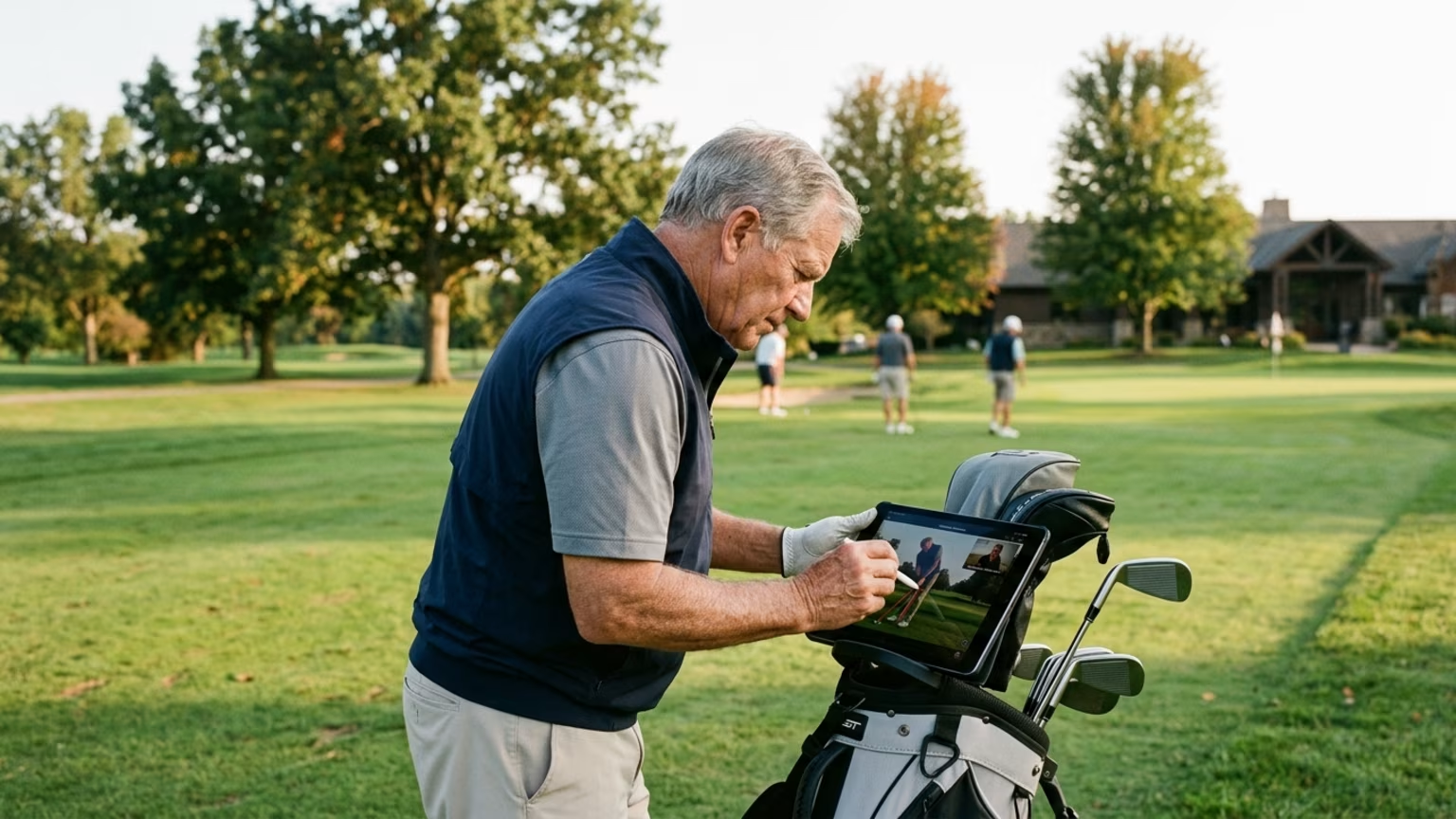

Learn how Miyu Yamashita’s remote coaching and low-volume technical adjustments at the FM Championship help older golfers protect joints and recover faster.




Technical practice efficiency is simply the ability to isolate and fix a specific swing fault without hitting hundreds of golf balls. At the FM Championship at TPC Boston, 25-year-old LPGA professional Miyu Yamashita demonstrated exactly what this looks like in practice. She had recently won the CPKC Women’s Open by nine strokes, matching the lowest 72-hole score on the tour. Golf Digest Japan reports that the FM Championship represented a chance for a second consecutive victory.
The tournament was played over a par-72, 6,533-yard course. Yamashita shot a 75 in the third round and fell six strokes behind the tournament leader. She went to the practice area after 7 p.m. to address a specific tendency for approach shots to miss left. She did not start a marathon range session to overhaul her swing mechanics.
Instead, she connected by smartphone video with her Japan-based father and coach, Katsunori Yamashita. Golf Digest Japan reported that she used this visual feedback to review her technique. This focused diagnostic session allowed her to grasp a targeted correction for those leftward misses. By narrowing the focus to one directional problem, she avoided unnecessary physical exhaustion before the final round.
This approach highlights a crucial difference between technical practice and physical conditioning. Hitting countless golf balls without a clear objective only increases joint stress. Using video to guide a small number of swings makes practice highly specific. It allows a golfer to solve movement problems without logging heavy physical repetitions.
For a professional golfer, this targeted mechanical correction translates directly into immediate scoring opportunities. Golf Digest Japan says her short-iron accuracy returned the following day. Her spin control also improved significantly during the final round. She made four birdies and one bogey on the front nine alone.
The final round provided several examples of this technical correction working under competitive pressure. A six-iron approach on the third hole finished roughly 20 centimeters from the pin. On the fourth hole, her 48-degree gap-wedge approach reached the hole at the correct distance. These precise shots helped her briefly move to within three strokes of the lead.
Yamashita responded to her third-round 75 with a final-round 69. She closed with a birdie on the par-five 18th hole. Golf Digest Japan noted she reached the green in two shots from 196 yards using a 5-utility club. She finished the hole with two putts.
She ended the tournament in sixth place with a cumulative score of 9 under par. The Asia Business Daily also recorded this ninth-under-par result for her sixth-place finish. This performance shows how identifying a single mechanical issue can change the trajectory of an entire round. A golfer does not need to reinvent their swing to find fairways again.
Yamashita could then look ahead to her next event with confidence. Golf Digest Japan listed the Sony Japan Women’s Professional Championship beginning September 10 at Katayamazu Golf Club in Ishikawa as her next tournament. The report also noted the family connection to Ishikawa through her mother Yuki Yamashita. Maintaining physical freshness is critical for competing in back-to-back tournaments.
While Yamashita is an elite professional, her focused diagnostic approach holds a crucial lesson for recreational players over 40. As golfers age, connective tissues require much more time to recover from repetitive stress. The standard method of hitting bucket after bucket to find a swing thought often causes joint inflammation. Managing practice volume becomes absolutely critical for long-term physical health.
Tendons and ligaments naturally lose elasticity and blood supply after age 50. This means tissues cannot tolerate the same sheer volume of repetitive rotational forces they could twenty years earlier. A high-volume range session can easily overload a vulnerable tendon. Joint wear accumulates rapidly when swing mechanics break down late in a practice session.
When I developed medial epicondylitis, commonly known as golfer's elbow, I thought I needed complete rest. Six weeks off the course did nothing to help. I finally learned that active recovery with a flexbar was the actual solution. It taught me that treating golf injuries requires loading the tissue properly, not just sitting on the couch and hoping for the best.
You have to learn why total rest often fails when dealing with chronic tendon issues. Finding the right balance of tissue loading is critical for healthy joints. This is why a lower-volume practice strategy is so valuable for older players. If you hit 100 balls trying to fix a slice, you might solve the slice but aggravate your lower back.
Using video feedback to make practice specific helps you manage practice load highly efficiently. It allows you to protect your joints while still moving your technique in a better direction. You avoid the trap of mindless repetition. This preserves your physical energy for actually playing the game on the course.
You can apply this low-load diagnostic approach to your own game to protect your aging joints. The first foundational habit is to use video to narrow the question. Instead of recording a full hour of practice, film three consecutive swings with your smartphone. Ask yourself one specific question about your initial ball-start direction.
Look only at whether the clubface is pointing left or right at impact. Do not analyze your entire posture or weight shift at the same time. This isolates the mechanical issue just like Yamashita did with her leftward approach misses. Once you identify the visual pattern, you can prioritize one single correction.
If you notice a leftward tendency, focus entirely on turning your trail hip through the impact zone. Do not change your grip or your backswing simultaneously. Take five slow-motion practice swings focusing only on that trail hip movement. This limits your physical repetition while increasing your technical body awareness.
Combining this remote video feedback with in-person assessment is also a smart strategy. Video can help maintain continuity between lessons with your local professional. However, a video cannot tell you if a movement is medically safe for your specific joint limitations. Always prioritize physical comfort over hitting a perfect visual position on camera.
Finally, you must track your physical recovery signals the following day. Note any grip fatigue or joint soreness after your practice session. If your elbows or lower back feel sensitive, you must reduce your swing volume immediately. Incorporating proper active recovery strategies will help keep your tissues resilient.
Remember that the goal of practice is to prepare for the course. Treat your range time as a brief diagnostic session rather than a test of physical endurance. Stop hitting balls once you feel a mechanical adjustment working. Save those extra swings for your next tee time.
Efficient, low-volume technical adjustments protect your joints from unnecessary wear, helping you spend your physical energy on the course playing better for longer.
Follow Golfergy for practical insights on performance, mobility, recovery and healthy ageing. Stay connected for new articles, research-led guidance and ideas to help you play better for longer.


Rest or move the day after 18 holes? Use fatigue, soreness, symptoms and your playing schedule to guide a flexible recovery day.


Compare foam rolling, massage, compression, heat and cold for golfers, with comfort benefits kept separate from performance and injury claims.
A measured guide to stiffness during and after golf, with gentle movement options, sustainable habits and NHS-backed back-pain warning signs.
Explore practical resources on performance, recovery, mobility and golf longevity.
Read the Blog