
Discover how isometric training can help older golfers build strength and avoid injuries without heavy lifting, based on a recent Golf Digest fitness protocol.




John stood on the practice tee and gripped his favorite seven iron. His lower back screamed before he even started his backswing. He suddenly realized traditional weightlifting was wearing him down faster than the game itself. On August 21, 2026, Golf Digest published a practical strength piece offering a potential solution to this exact problem.
The article is titled "Get stronger and hit it farther without moving? Yep, here's a great way to power up your golf game and avoid injuries". It was later updated on August 22. It presents isometric training as a way for golfers to build strength with limited movement. The central idea focuses on creating intense muscular tension without moving heavy loads through space.
To understand this method, you need to look closely at how muscle fibers behave. In a traditional dynamic lift, your joints bend and extend repeatedly. This causes the muscle to lengthen and shorten under heavy resistance. Isometric exercise forces the muscle to contract and produce force while the body stays relatively still.
Jonathan Avalos is a Golf Digest Best Fitness Trainer in America and a certified fitness trainer. He also works as a trainer at Athletic Golf Fitness in Charlotte. Avalos notes that isometrics allow golfers to produce immense force with fewer moving parts. This limits the chances of your form breaking down when you get tired during a workout.
Skipping the dangerous ranges of motion often protects older joints from unwanted friction. You can bypass the most vulnerable parts of a lift entirely. This targeted tension builds stability precisely where you need it most for your swing. Muscles act as both brakes and accelerators during a fast golf swing.
Training your muscles to hold a static position improves their ability to act as brakes. You need this braking power to stop your body rotation safely on the follow-through. Isometric holds train your nervous system to fire muscle fibers at maximum capacity. This happens without the added stress of moving a heavy barbell up and down.
Clinical evidence heavily backs resistance training for improving general physical capacity. A 2026 search result covering older adults found noticeable improvements across several key fitness categories. The review reported standardized effects of g = 0.16 for muscle mass and g = 0.55 for strength. It also showed a g = 0.76 improvement for functional performance compared to control groups.
Research specifically targeting isometric methods also shows strong promise for strength development. A 2025 review summarized in the available research included 32 different studies. These studies looked at healthy adults and found that isometric resistance training improved strength compared to doing no exercise. The researchers cautioned that those participants were 18 to 45 years old.
You should not automatically assume these exact results apply perfectly to older golfers. The available evidence summary cautions that isometric strength gains are highly angle-specific. The strength increases are especially concentrated near the exact joint angle trained during the exercise. Getting stronger in a static hold will not magically add thirty yards to your drive overnight.
Golfers over 40 face a serious and frustrating dilemma in the gym. You need physical strength to protect your body from the violent rotation of the golf swing. At the same time, heavy dynamic weightlifting can severely aggravate age-related joint wear. Many amateur players simply stop training because the gym soreness ruins their next round.
This creates a tricky balance if you want to train golf power safely after 40. Your lower back, hips, and shoulders take a massive beating over a long season. Adding heavy squats or deadlifts on top of that fatigue often leads to injury. Isometrics offer a way to keep building tissue resilience without adding unnecessary mileage to your joints.
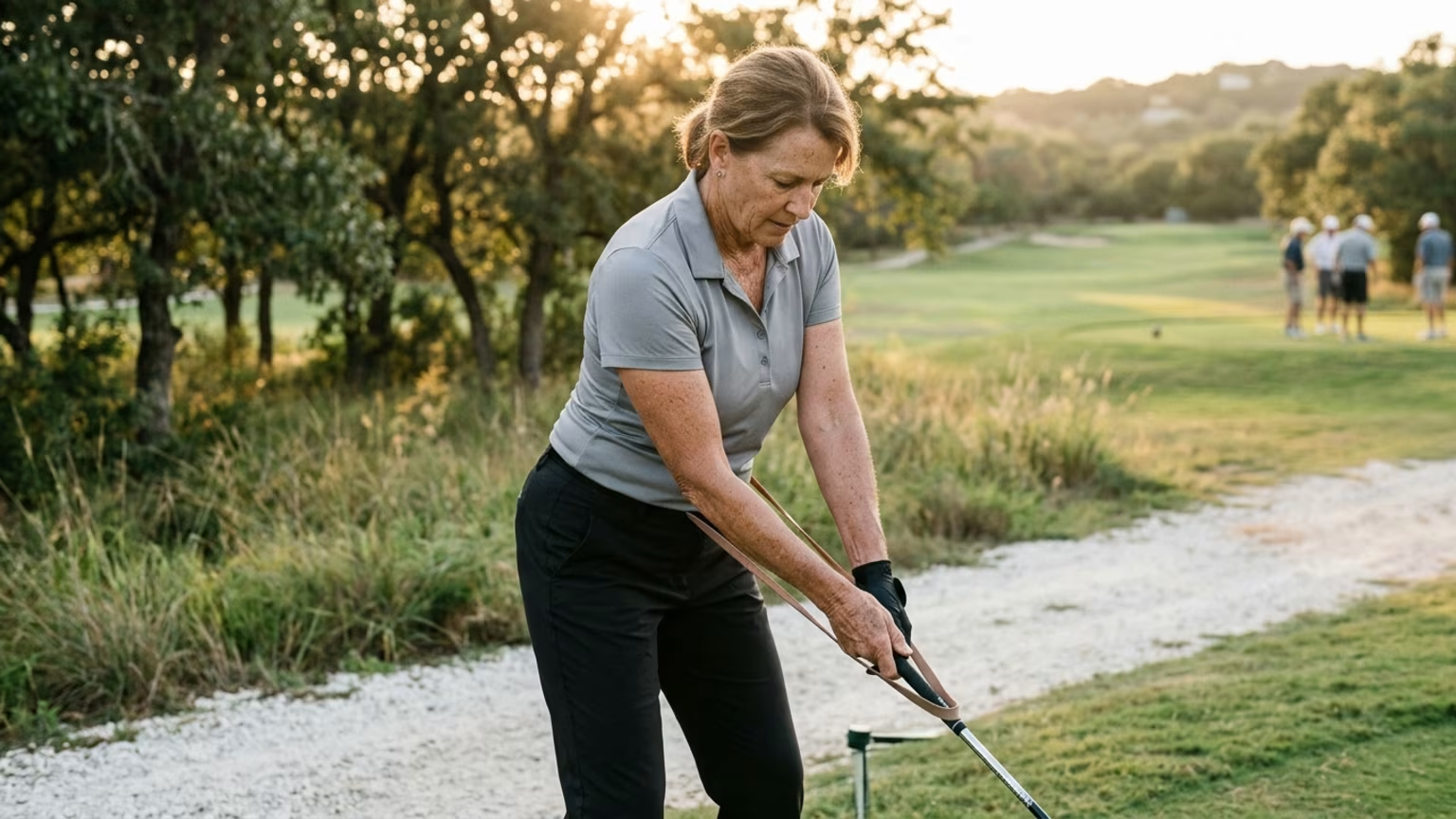
It is very easy to assume that avoiding movement entirely is the best way to heal. When I developed medial epicondylitis, commonly known as golfer's elbow, I thought I needed complete rest. Six weeks off the course did nothing to help. I finally learned that active recovery with a flexbar was the actual solution.
It taught me that treating golf injuries requires loading the tissue properly, not just sitting on the couch and hoping for the best. Isometrics provide a safe way to load tissue without creating excessive joint friction. You must remember that holding still does not mean a lack of effort or load. A maximal push against a solid wall creates very high cardiovascular demand.
Older golfers should not interpret static exercises as automatically low-risk movements. Pushing at maximum effort can cause your blood pressure to spike rapidly. You should never train through unexplained pain or hold your breath during these intense efforts. Always start slowly and consult a professional if you have underlying heart conditions or active injuries.
The Golf Digest article divides this specific training into two distinct categories. Overcoming isometrics require you to push or pull violently against an immovable object. The article recommends maximum efforts lasting approximately 5 to 10 seconds per set. You should perform these intense pushes for three to five repetitions per session.
Yielding isometrics involve holding a demanding body position steady against gravity. Golf Digest describes holding these postures for approximately 30 to 60 seconds per set. You can complete up to five repetitions of these longer endurance holds. The routine outlines three specific examples to try at home or in the gym.
The first example is an isometric wall squat with a roughly 90-degree knee position. You brace your full body and press one forearm into the wall using external rotation. Your opposite hand holds a dumbbell during this intense squat hold. This movement challenges your lower body while heavily taxing your core and shoulder stability.
The second movement is a hip thrust variation that requires a 60-second hold at the top. During that hip thrust, your body must form a straight line from your shoulders to your heels. The final example is a dumbbell fly variation using a 30 to 60-second hold near the bottom. These exercises target physical positions highly relevant to the golf swing.
These static positions offer a practical way to build useful rotation without forcing your back into dangerous extremes. You do not need to start at the maximum recommended times. Beginners can easily scale these exercises by trying much shorter holds initially. A ten-second wall squat is a perfect starting point for most recreational players over forty.
Avalos mentions that yielding isometrics may help golfers control awkward physical positions. He notes they are useful for people rehabbing an injury or traveling without a gym. They are also great for players feeling stiff after working long hours at a desk. These controlled holds remind your nervous system how to activate dormant muscles effectively.
Adding static tension to your weekly routine could extend your playing years significantly. You do not need heavy barbells to build functional resilience for the golf course. What adjustments will you make to your mobility routine this season to steer clear of this hazard? Start by adding one 30-second yielding wall squat to your daily warm-up this week.
Follow Golfergy for practical insights on performance, mobility, recovery and healthy ageing. Stay connected for new articles, research-led guidance and ideas to help you play better for longer.


A practical look at golf strength after 40, with research on older golfers and simple habits for connecting training goals to a coordinated swing.


How legs, trunk and upper body share the work of a golf swing, with simple planning habits and a measured look at evidence for older golfers.

Understand mobility versus stability in golf, what older-golfer research reports, and two modest habits for comfortable movement control.
Explore practical resources on performance, recovery, mobility and golf longevity.
Read the Blog


