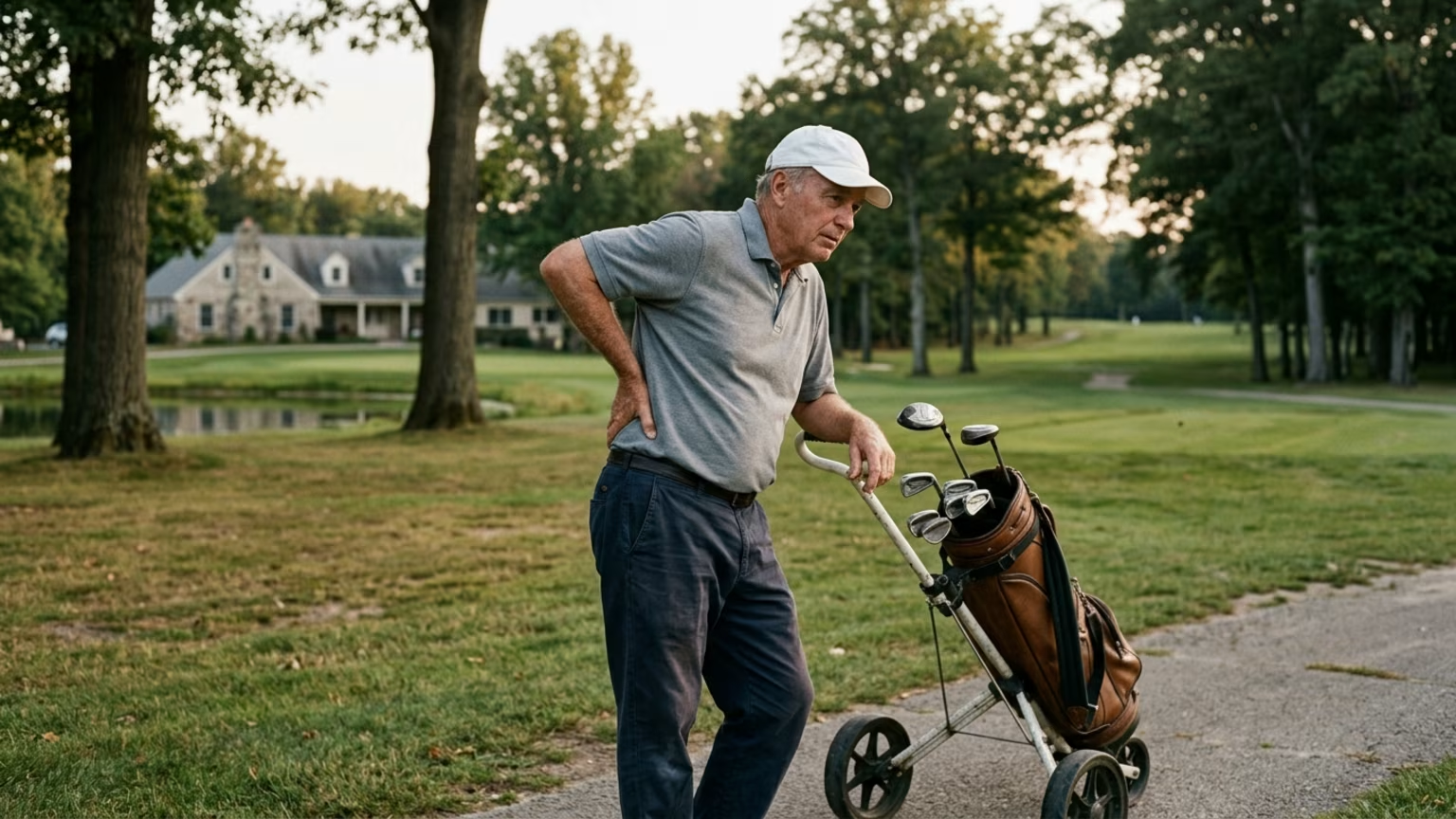

A four-year study reveals physical activity declines significantly with age, proving golfers over 40 must build deliberate maintenance habits to stay on course.




Assuming that your lifelong fitness habits will automatically protect your golf game from age-related decline is a statistical mistake. In a four-year University of Jyväskylä study, physical-activity energy expenditure fell by approximately 17% among 299 independently living older adults. These participants started the observation period in relatively healthy condition, yet their daily movement volume still dropped significantly. This data proves that maintaining an active lifestyle requires continuous physical effort over time.
The University of Jyväskylä researchers tracked physical activity using wearable technology in free-living conditions. They combined a thigh-worn accelerometer with continuous heart-rate monitoring rather than relying only on movement counts. Joona Neuvonen, a doctoral researcher at the university, said heart-rate monitoring identifies physically demanding activities that produce little body movement. These less obvious activities include lifting and carrying heavy objects around the house.
This precise measurement approach provides a clearer picture of how functional movement changes over time. The study recorded a clear fall in mean physical-activity energy expenditure from 31.0 to 25.7 kJ·kg⁻¹·day⁻¹ over four years. This detailed tracking method prevents participants from simply overestimating their daily movement habits on a questionnaire. The research was longitudinal, but it had only two main measurement points, four years apart.
Of the 495 people who initially consented, 299 ultimately provided valid monitoring data at both time points. This attrition means the final sample might have been healthier than the broader older population. The participants were initially aged 75, 80, or 85 during the baseline assessments in 2017 and 2018. Follow-up assessments took place in 2021 and 2022.
The researchers warned that a two-point design could not fully describe nonlinear changes in activity over time. They noted that physical decline rarely happens in a perfectly straight or predictable line.
The saddest thing I have seen in golf is watching lifelong playing partners slowly drop out of our weekend group. It usually starts with a nagging shoulder or knee issue they ignore until it requires surgery. That pattern is exactly why I became obsessed with golf longevity. We do not have to stop playing as we age, provided we do the right maintenance work between rounds.
For golfers over 40, this University of Jyväskylä study serves as a clear warning about physical decline. The researchers followed older adults from the AGNES cohort. We cannot directly apply the 17% drop to a 45-year-old golfer. The research clearly indicates that maintaining your physical capacity requires deliberate off-course habits.
A single round of golf simply cannot replicate the daily movement volume needed for healthy ageing. A player who plays once a week but remains otherwise sedentary misses crucial movement exposure. Golf should be treated as one component of an active lifestyle. Playing a weekly round is simply not enough to offset the natural physical changes associated with ageing.
You must commit to a structured physical maintenance plan if you want to keep playing comfortably. This means prioritizing consistent walking, lower-body strength, trunk control, and overall balance. These exercises directly complement your general resistance training. When developing your plan, focus entirely on the hip hinge.
The hip hinge represents a vital movement pattern for addressing the golf ball and picking up equipment. Practicing this single motion regularly helps preserve the specific capacity needed for a comfortable golf swing. Adding this movement to your weekly activity strategy provides a baseline defense against back stiffness. It also supports your ability to safely restore mid-round mobility when fatigue begins to set in.
Incorporate simple strength work consistently rather than waiting for a noticeable performance decline. Useful patterns for recreational golfers include squat variations, step-ups, calf raises, and controlled anti-rotation exercises. Exercise selection and loading should always be individualized. This customization matters most for players dealing with back, hip, knee, or shoulder symptoms.
Training your balance and single-leg control is incredibly beneficial for golf performance. The sport involves constant weight transfer, uneven lies, and walking over variable terrain. A short mobility routine can address your hips, thoracic rotation, ankles, and shoulders between rounds.
Many players make the mistake of measuring their current fitness against their physical prime. A smarter approach involves monitoring your everyday functional capacity and everyday movement comfort. The University of Jyväskylä study assessed preferred walking speed with a laboratory-based modified six-minute walk test. Average preferred walking speed declined from 4.39 km/h to 3.88 km/h over the four-year period.
The researchers estimated approximately 4.7 kJ·kg⁻¹·day⁻¹ higher physical-activity energy expenditure for each 1 km/h higher preferred walking speed. Neuvonen noted that participants with faster walking speeds were more physically active in daily life. You can use your own walking capacity as a simple self-monitoring signal on the course. A noticeable reduction in your comfortable walking pace might mean your injury prevention routines need immediate attention.
Function often declines well before your golf scores show any noticeable drop. The researchers noted that self-rated health shifted toward less favorable categories during the follow-up period. The proportion of participants describing their health as "very good" or "good" fell from 59% to 42%. Meanwhile, the proportion reporting "average" health rose from 38% to 54%.
Short Physical Performance Battery scores also declined by 0.6 points over the follow-up period. The researchers reported that laboratory walking speed might not perfectly represent everyday mobility outside the laboratory. Environmental barriers, opportunities, motivation, and pacing can deeply affect how you move through the real world.
The findings from this study confirm that an active past cannot secure a functional future on its own. The loss of physical capacity happens slowly, quietly, and continuously over the years. Golfers who commit to small, deliberate movement practices will likely enjoy more pain-free seasons on the course. Numbers do not lie: preserving your mobility is the ultimate equipment upgrade.
Follow Golfergy for practical insights on performance, mobility, recovery and healthy ageing. Stay connected for new articles, research-led guidance and ideas to help you play better for longer.


A practical strength framework for golfers over 40, built around everyday goals, sensible progression and a careful look at limited golf research.


A research-led look at strength, balance, mobility and trunk control, with a flexible planning framework for golfers over 40.
Understand golf mobility after 40 with a comfortable-turn self-check, hip and shoulder guidance, and a clear look at flexibility and swing speed.
Explore practical resources on performance, recovery, mobility and golf longevity.
Read the Blog


