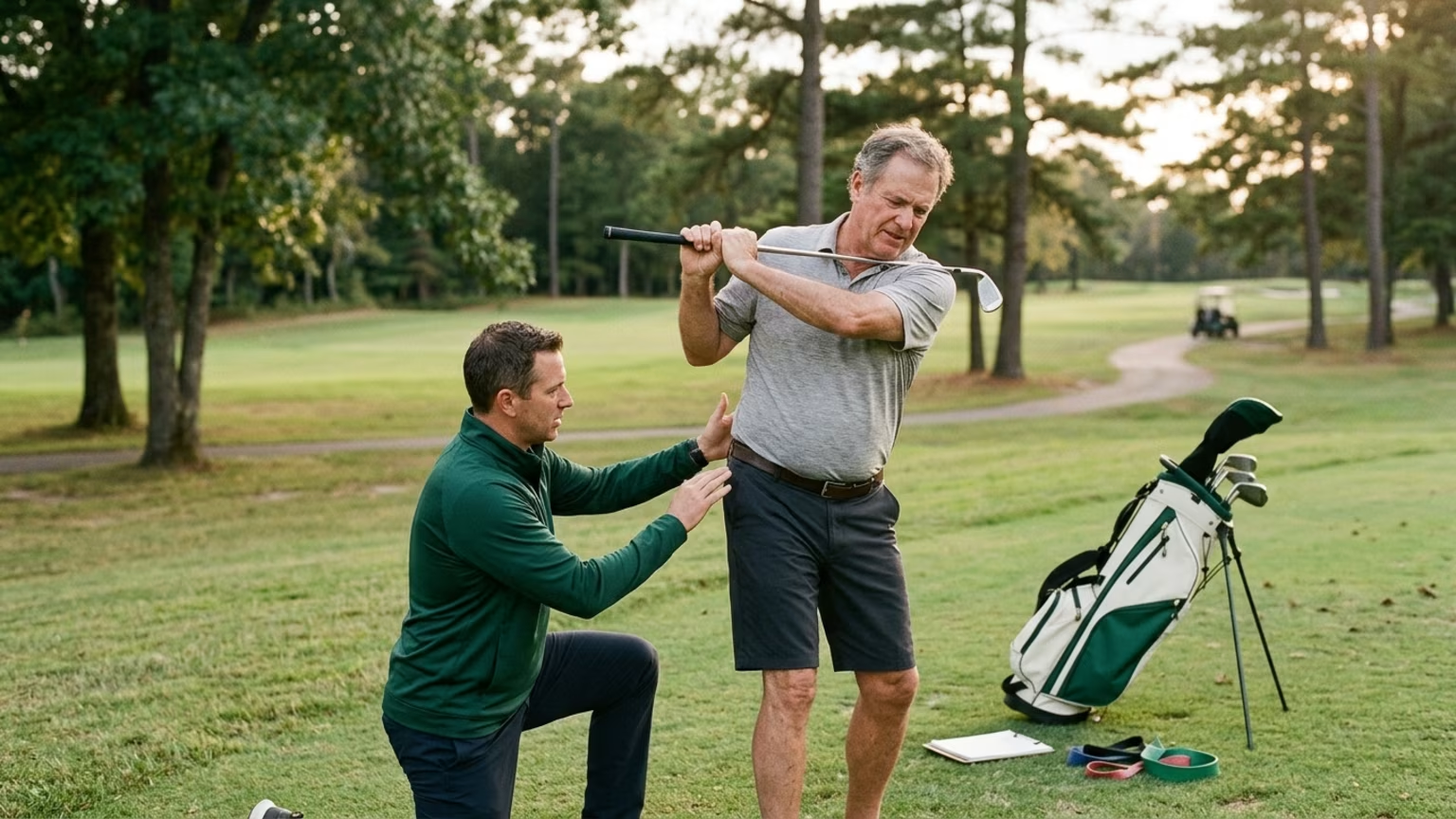

Review four practical screens for balance, hip strength, and pelvic control to help identify physical swing limitations and manage golf-related back pain.




On October 9, 2026, Golf Digest outlined four practical screens intended to help golfers identify physical contributors to back pain and swing faults. The article details tests for lead-leg balance, single-leg glute strength, pelvic dissociation, and lead-hip internal rotation. Golf fitness trainer Andrew Dulak designed the screens and corresponding exercises to help players evaluate their physical capabilities. Instructor Mike LaBella provided swing demonstrations to show how these physical limitations might present themselves on the course.
While Golf Digest labels this guidance as new research, the publication does not identify a formal study or provide validation statistics for the four screens.
Dulak notes that these four screens assess physical capacities that map directly to common swing patterns. The body needs baseline stability and joint control to swing a golf club without putting undue stress on the spine. When a golfer lacks lead-leg balance, they might have difficulty shifting their weight to the target side during the downswing. This poor weight transfer forces the upper body to compensate during the release.
Limited hip control also changes the path of the club through impact. The article explains that limited lead-hip rotation may accompany a steep, out-to-in swing path. If the lead hip cannot turn out of the way, the arms must chop downward to reach the golf ball. Over time, these mechanical compensations put heavy strain on the muscles and joints of the lower back.
Golf Digest acknowledges that the relationship between pain and mechanics is quite complicated. Pain might alter your swing mechanics, poor mechanics might contribute to pain, or both elements might influence one another. These four screens cover different physical capacities rather than relying on one single measure of fitness. They test balance and stability, glute and hip control, pelvic-shoulder separation, and lead-hip rotation.
That distinction matters for everyday players trying to stay healthy. A limitation in one specific area does not establish the exact source of an individual’s back symptoms. Identifying multiple restricted areas can point you toward the right physical conditioning strategy.
Golfers over 40 often lose rotational flexibility and muscle strength as a normal part of aging. This physical decline makes the mature recreational golfer highly vulnerable to lower back issues. When hip mobility decreases, the lumbar spine is often forced to twist more than its natural design allows. You can learn more about how physical limits create stress by reading our breakdown of why the lower back takes the hit in the golf swing.
Attempting to mimic the massive rotation of younger professionals can lead directly to injury for experienced players. Older players swing with less clubhead speed, yet their joints often lack the tolerance for poor movement patterns. If you cannot stabilize your pelvis, your lower back will bear the brunt of the rotational forces during the swing. These four simple screens offer a grounded way to check your baseline movement before your body fails on the back nine.
Improving your understanding of hip and upper back mobility is critical for longevity.
The Golf Digest article pairs each of the four screens with a specific corrective drill. You should treat these tests as awareness checks rather than a medical diagnosis. If you fail a screen, you can use that information to start a useful conversation with a qualified golf-fitness professional. Note which movements feel restricted and whether you experience any symptoms during the tests.
Using the article’s stated quantities as baseline recommendations can guide your home practice sessions. The physical capacities that map to swing patterns require steady repetition to improve. Do not view the repetitions and hold times as medically validated prescriptions. Treat them as a starting point to build basic joint awareness instead.
The first test evaluates your lead-leg balance. You must balance on your lead leg for at least 10 seconds without excessive wobbling or putting your trail foot down. If you struggle with this screen, the suggested corrective drill involves practicing the movement safely. The balance drill calls for five repetitions with 10-second holds on the lead leg.
Focus entirely on staying stable and tall through the balancing hip.
The second screen checks single-leg glute strength and hip stability. You need to hold a single-leg glute bridge for at least 10 seconds per side. You must perform this hold without your hips sagging, your pelvis rotating, or your lower back arching excessively. The accompanying bridge variation drill calls for up to 10-second holds and five repetitions per side.
Press firmly into the ground with your heel to activate the glute muscle.
The third test looks at pelvic dissociation. You need to perform pelvic rotation independently of your upper body. Unlike the other tests, this screen uses a qualitative movement check without a specific numerical time or angle cutoff. To practice this physical control, the corrective drill calls for two or three sets of 10 rotations each way.
It can be incredibly helpful to separate mid-back rotation from lumbar movement to protect your spine.
The final screen assesses your lead-hip internal rotation. To pass this test, you must rotate your hips more than 60 degrees in the lead-hip screen. The corresponding lead-hip drill calls for two or three sets of 10 repetitions to build mobility over time. Keep your focus on one small movement at a time during the exercise.
Take your time with these joint movements and stop if you feel any sharp pain.
Changing a swing pattern alone will not always resolve back pain on the course. You have to evaluate the physical limitations that force your body into poor mechanical patterns. These four screens give you a practical way to monitor your physical readiness without needing expensive equipment. What adjustments will you make to your mobility routine this season to steer clear of this hazard?
Follow Golfergy for practical insights on performance, mobility, recovery and healthy ageing. Stay connected for new articles, research-led guidance and ideas to help you play better for longer.



Understand how your hips and mid-back contribute to a golf turn, with practical habits that put comfort ahead of extra backswing length.


A progressive golf warm-up for players over 40, moving from easy activity to fuller practice swings without treating preparation as a flexibility test.
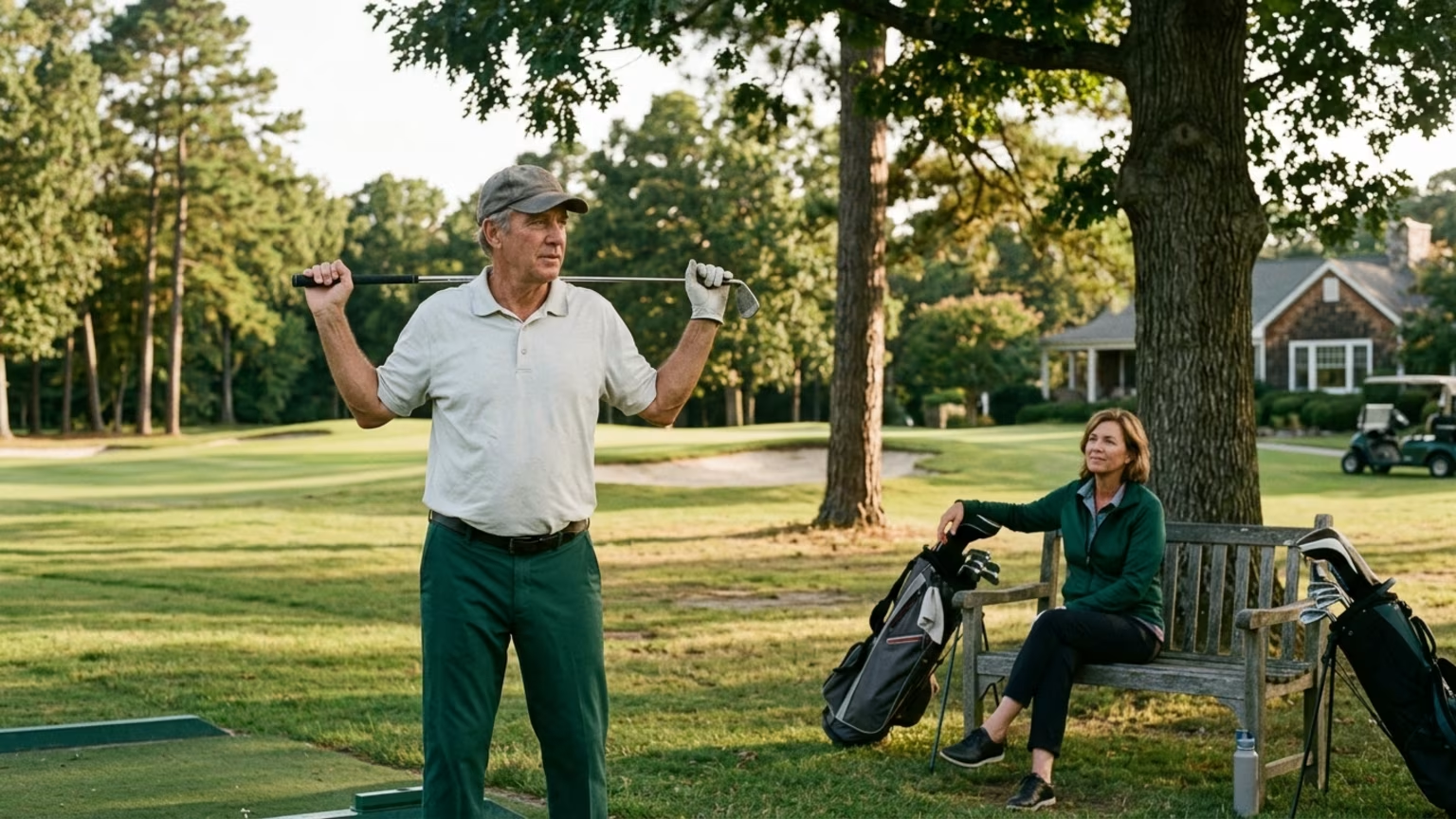
Observe comfortable movement and control to frame better questions about your golf swing, with guidance on when pain needs professional assessment.
Explore practical resources on performance, recovery, mobility and golf longevity.
Read the Blog


