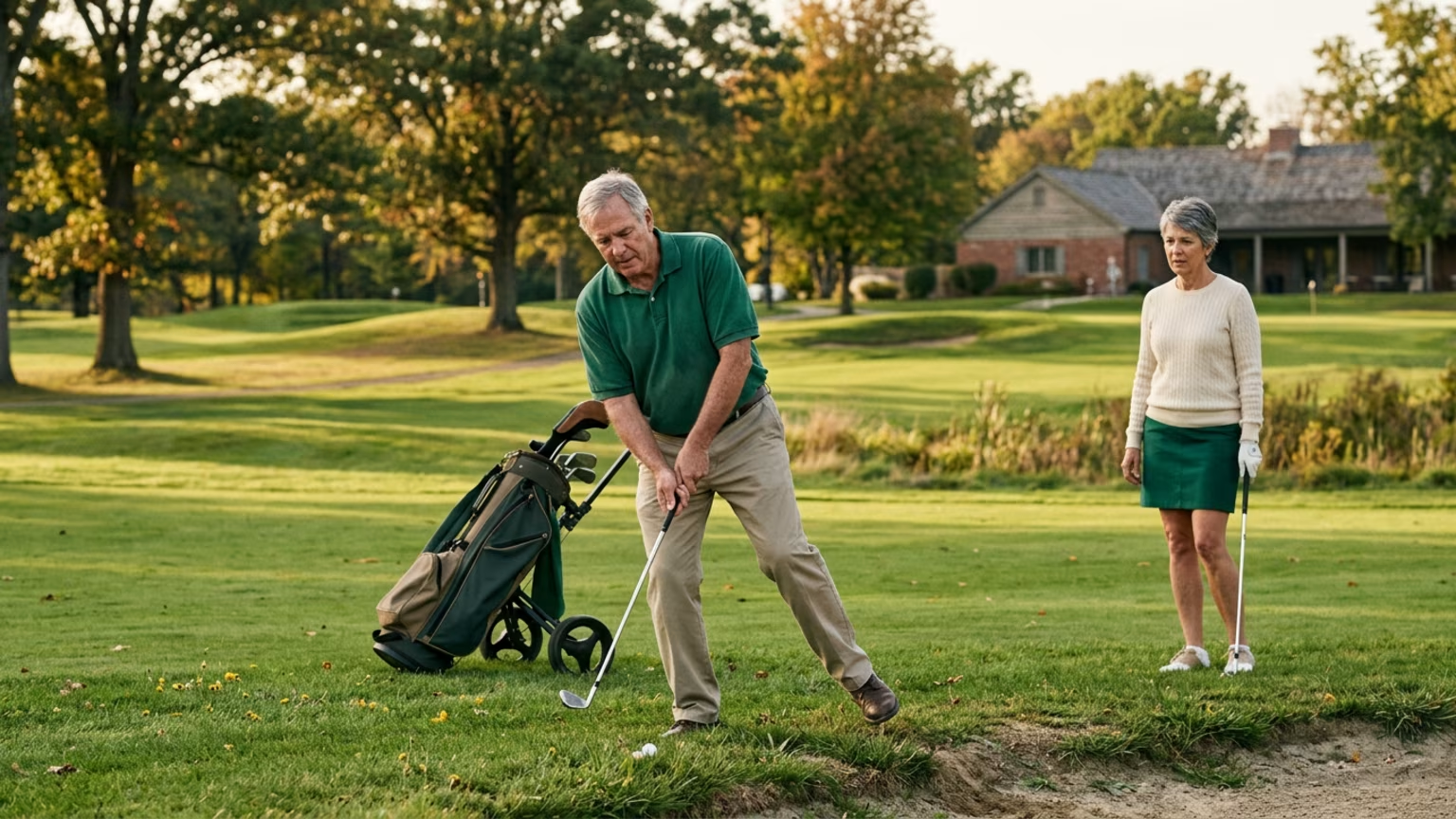

Learn how older golfers can adapt the Fall Prevention Foundation's new exercise guidance to build balance, leg strength and stability for the course.




On September 10, 2026, the Fall Prevention Foundation published new Parkinson’s exercise and fall-prevention guidance. This detailed page, updated on September 11, 2026, outlines practical methods for building physical confidence at home. The article was reviewed by Steve Kerr, identified as the foundation’s founder and a licensed physical therapist. Kerr brings more than 30 years of experience working with older adults on mobility, fall-risk reduction and safe independence at home.
While this guidance focuses primarily on people living with Parkinson’s disease, its structured approach to physical conditioning provides a helpful template. The core framework covers balance, strength, gait practice and aerobic activity.
The saddest thing our team at Golfergy has seen in the sport is watching lifelong playing partners slowly drop out of our weekend group. It usually starts with a nagging joint issue or a quiet loss of balance that they ignore until it becomes a serious fall risk. This frequent pattern is exactly why we became so focused on golf longevity. We do not have to stop playing as we age, provided we do the right maintenance work between rounds.
The physical mechanics of staying upright during a golf swing require constant communication between your muscles and your nervous system. When you swing a golf club on an uneven fairway, your lower body must absorb significant rotational force. If the muscles in your legs and core cannot fire quickly, your trunk will fail to support that twisting motion. This loss of biomechanical control limits your ability to transfer force from the ground up.
When your foot strikes an uneven patch of grass, proprioceptors in your joints send rapid signals to your brain. If the communication pathway is slow, your body cannot brace itself in time. This slight delay often forces the lower back to absorb sudden jolts. Over the span of a four hour round, these tiny compensations exhaust your stabilizing muscles.
A 2026 systematic review covering 23 studies found that exercise improves mobility, physical function and quality of life in Parkinson’s disease. However, the researchers specifically noted no evidence that exercise reduces levodopa-related motor complications. While these specific findings originate from specialized interventions, they highlight how targeted movement practices can influence physical stability. The broader principles of maintaining physical function apply universally to athletic aging.
The Fall Prevention Foundation guidance shows that multi-component training provides a strong defense against physical decline. Their article clearly advises against relying on a single type of exercise for stability. Building a robust physical foundation requires consistent effort across multiple training domains. Treating these guidelines as an educational framework helps players target their weakest movement patterns.
Recreational golfers over 40 face a surprising risk of balance-related issues, yet they swing with far less speed than the professionals. Amateurs are highly vulnerable because everyday tasks rarely challenge multidirectional balance. Over time, the nervous system becomes less efficient at catching subtle shifts in body weight. Stepping onto an uneven tee box or walking down a slippery slope requires immediate muscular reactions.
When older players lack this responsive strength, their risk of stumbling increases dramatically. Integrating a mixed training routine can prepare your joints for these unpredictable course conditions. Maintaining this structural stability is critical for those who want to develop controlled rotational power safely.
The foundation’s central recommendation is a multi-component program combining several training domains. These include balance, strength, gait practice, flexibility and aerobic activity. We can treat these recommendations as a movement checklist for maintaining physical readiness.
Strength examples include sit-to-stands from a firm chair, supported mini-squats and supported heel raises. The program also features seated leg extensions and standing hip movements while holding a stable surface. These exercises directly support the muscles used for standing, walking and transferring weight during your swing. Supported mini-squats teach the lower body how to handle gravity smoothly.
Balance practice should feature controlled weight shifts, multidirectional stepping, reaching and practicing safe responses to changes in position. When practicing at home, focus entirely on turning your trail hip or executing one small step at a time. Breaking the movement into distinct pieces prevents you from relying on bad postural habits.
Gait practice may address shuffling, small steps and difficulty starting. It also helps those struggling with turning and freezing. Professional cues for these issues include "big step" commands, marching in place, stepping over a visible line or using a steady rhythm. Mobility and flexibility examples include gentle trunk rotation, stretching, posture work and large-amplitude movements.
The foundation advises people to clear rugs, cords, toys and low furniture to create a safe practice area. They also recommend using a firm surface, wearing secure footwear and improving lighting. Practitioners should also avoid multitasking and schedule rest breaks. These precautions are practical for anyone setting up a space for lower body power exercises.
A widespread mistake is assuming that cardiovascular activity covers all physical requirements. Aerobic options listed by the foundation include walking, cycling, treadmill exercise and seated cardio. The article highlights that walking alone does not replace strength, flexibility, balance or gait-specific practice. Pounding the pavement will build endurance, but it will not train your body to recover from a sudden misstep.
Another frequent error involves pre-round routines. I used to stand on the first tee doing long, static hamstring stretches because I thought it was the best way to prepare. My legs would actually feel weaker on the first hole. Research eventually showed me that dynamic movements prime the nervous system much better than holding a stretch.
Swapping static poses for active weight shifts completely transformed my stability on uneven lies. Finally, never ignore physical warning signs during a workout. The guidance says people should stop and seek professional advice for new or significant dizziness, chest discomfort or unusual shortness of breath. You should also pause if you experience pain, confusion or repeated loss of balance.
Recognizing when you need expert help is a crucial part of healthy aging. The article recommends professional assessment when a person has fallen, experienced repeated near-falls or feels unsteady rising from a chair or bed. You should also seek input if you have difficulty with turning or stairs, or if you are unsure whether a mobility aid is appropriate.
The foundation’s most important clinical caveat is that a personalized plan is preferable to copying an internet routine. They recommend that exercises and progression should be selected with a qualified professional. Taking a proactive approach to your leg strength and balance will keep you walking the fairways for years to come. What adjustments will you make to your mobility routine this season to steer clear of this hazard?
Follow Golfergy for practical insights on performance, mobility, recovery and healthy ageing. Stay connected for new articles, research-led guidance and ideas to help you play better for longer.


Learn how a new NIH-funded clinical trial on ketone esters highlights the importance of strength and mobility routines for protecting your golf longevity.

We examine a 2026 Cell Metabolism report on protein restriction and explain why older golfers must prioritize muscle retention and adequate protein intake.
A review of a Cell Reports Medicine study showing how brief, high-intensity exercise impacts blood proteins, and what this means for older golfers' routines.
Explore practical resources on performance, recovery, mobility and golf longevity.
Read the Blog

