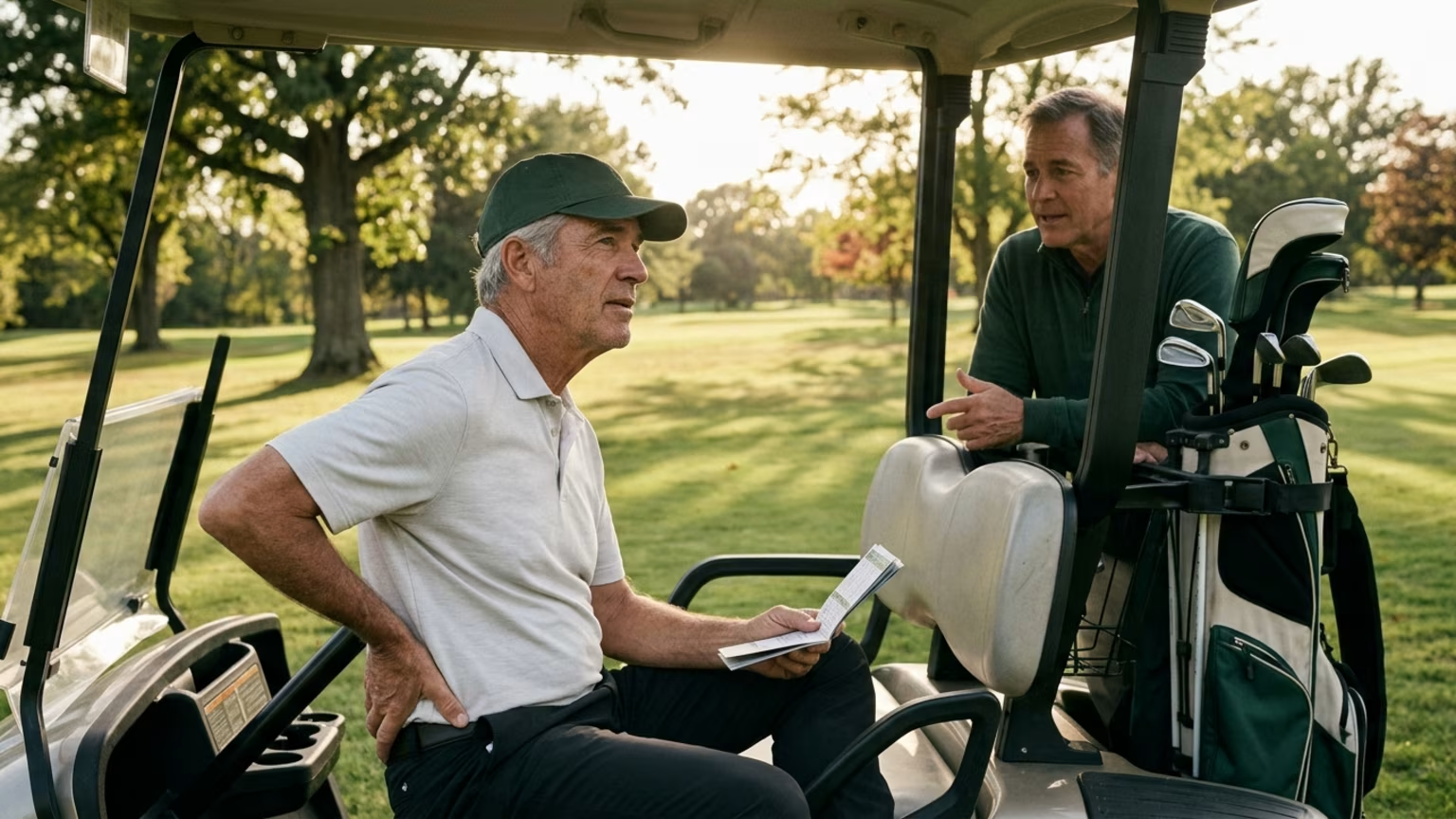
A review of the Cobra OPTM hybrid highlights its forgiveness and consistency, offering aging golfers practical solutions for declining swing speeds and long irons.




On August 25, 2026, when Plugged In Golf published its Cobra OPTM hybrid review, the equipment conversation shifted toward accuracy and playable misses. The provided research contains no record of a professional player withdrawing from a tournament. Instead, the review outlines a verifiable release designed to bridge the distance gap between woods and irons. The Cobra OPTM is positioned as a compact utility option for older players who need a reliable long game.
The new $329 club is available in four distinct lofts from 18 to 28 degrees. Cobra offers the hybrid only in a standard core model. The manufacturer decided against releasing separate MAX or low-spin versions for this specific lineup. This singular design makes fitting the shaft and adjustable weighting highly important for individual players.
The OPTM head is slightly larger from heel to toe than the prior Cobra DS-Adapt hybrid. The new profile is shallower and sits much lower to the ground at address. Plugged In Golf states the longer footprint is intended to balance the head and reduce twisting. The compact oval shape maintains versatility from difficult lies.
The review reflects a broader trend toward making long clubs easier to launch. Manufacturers are focusing on predictable performance over maximum raw distance. The 2026 Cobra woods and hybrids shifted their emphasis toward accuracy through careful reshaping. This specific weight distribution helps players find the center of the face more often.
The provided research does not detail a specific tour professional's injury or a related biomechanical flaw. It does highlight the underlying mechanical and muscular changes older adults face. A 2026 systematic review covered 41 randomized controlled trials involving 3,141 older adults. The data showed that resistance exercise significantly improved muscle-specific strength.
The analysis reported a standardized mean difference of 0.61 for muscle strength improvements. The researchers documented a 95% confidence interval ranging from 0.27 to 0.94. This muscle strength benefit is a core component of healthy physical maintenance. Stronger muscles support the joints and connective tissues during the rapid acceleration of a golf swing.
Declining physical capacity directly changes how a player delivers the golf club to the ball. When lower body stability and torso strength drop off, the clubhead speed plummets. This loss of speed makes it exceptionally difficult to launch a long iron into the air. The player often reacts by altering their swing mechanics to lift the ball artificially.
Proper resistance training helps manage physical strain over the long term. Maintaining foundational strength allows the golfer to swing naturally without relying on forced compensations. The research confirms that targeted exercise yields measurable strength improvements in older populations.
Recreational golfers over 40 face a severe risk of performance drop-offs as their clubhead speed fades. MyGolfSpy notes that speed loss often becomes noticeable first in the longer irons. A 5-iron or 6-iron might begin flying too low or overlapping in carry distance. Amateurs lack the elite clubhead speed required to elevate these low-lofted clubs properly.
The Cobra OPTM hybrid produced approximately 4,000 rpm of spin during the reviewer's launch monitor testing. The club delivered a launch angle of roughly 14 to 15 degrees. The Plugged In Golf reviewer characterized this spin as low enough to preserve overall distance. The combination of spin and launch generated a steep landing angle to hold almost any green.
A high landing angle is vital for players who prioritize stopping the ball predictably. MyGolfSpy recommends blending more forgiving clubs into the longer end of the set. Their 2026 hybrid testing illustrates why accuracy matters immensely on the course. The leading hybrid testers in their separate review kept 95.97% and 95.3% of shots in playable positions.
The Plugged In Golf tester found the Cobra OPTM exceptionally easy to square at impact. Shots the tester considered slices finished only 10 to 15 yards right of the intended target. The club provided relatively mild feedback on poor strikes and felt more like an iron. This forgiveness profile helps older amateurs keep the ball in play when their swing timing falters.
You can make a practical preventative adjustment by matching your equipment to your current swing speed. Start by testing the distance gap between your fairway woods and your irons. The 18 degree version of the Cobra OPTM might overlap with a strong 5-wood. The 24 degree and 28 degree versions may overlap with standard 5-irons or 6-irons.
Cobra utilizes the adjustable FutureFit33 hosel for this specific release. This system is the company's second hybrid generation to feature the technology. FutureFit33 provides 33 independent combinations for loft and lie. Both of these settings are adjustable within a two degree range.
This adjustability allows a fitter to address a specific launch issue without an immediate swing overhaul. The club features an interchangeable rear sole weight to alter trajectory and spin. The available rear weights come in four options. Players can choose 3, 7, 11, or 14 grams. The 11 gram weight serves as the stock setup.
Focus entirely on changing one setting at a time during your testing sessions. Verify the results with carry distance, peak height, and descent angle data. The compact oval shape is highly effective from difficult rough. An iron or wedge sometimes produces dead contact from heavy grass. A fairway wood is often too large to use cleanly from those exact lies.
Combining this equipment strategy with a shift in physical capacity plan will yield the best results. Older golfers should never treat equipment as a direct substitute for strength work. Engage in consistent resistance training to maintain your stability on the course. This dual approach will help you reduce rotation strain during long rounds.
Smart equipment choices and consistent resistance work form a highly effective longevity strategy. By bridging the gap between woods and irons, you can maintain your scoring potential for years to come. What adjustments will you make to your mobility routine this season to steer clear of this hazard?
Follow Golfergy for practical insights on performance, mobility, recovery and healthy ageing. Stay connected for new articles, research-led guidance and ideas to help you play better for longer.


Look beyond flexibility with a practical golf fitness priority check and a clear guide to what studies in older golfers actually measured.


Build a practical golf warm-up from walking to comfortable mobility and fuller swings, while keeping preparation separate from long-term conditioning.

Shot Scope’s LM1 data offers age and handicap benchmarks for driver speed and carry. Here’s how golfers over 40 can read the figures.
Explore practical resources on performance, recovery, mobility and golf longevity.
Read the Blog