
Learn how recreational golfers over 50 can use the glute bridge, cat-cow, and chair squat to maintain mobility and build lower back capacity between rounds.




On September 17, 2026, when Infobae published its guidance on equipment-free lumbar protection exercises for adults over 50, it highlighted a reality that many recreational players know well. Back pain remains a persistent threat to a long playing career. The health-news explainer outlined three movements designed to support the lower back and joints. It served as a timely reminder that playing the game you love requires dedicated physical maintenance between rounds.
The saddest thing I have seen in golf is watching lifelong playing partners slowly drop out of our weekend group. It usually starts with a nagging lower back issue they ignore until it requires surgery. That pattern is exactly why our team became obsessed with golf longevity. We do not have to stop playing as we age, provided we do the right maintenance work between rounds.
The lower back takes the brunt of the force during a golf swing because it must rotate and extend rapidly. If the hips and mid-back lack mobility, the lumbar spine tries to compensate by twisting further than it should. This compensation places severe stress on the tissue and joints over a full round of golf. The repetitive motion of striking a golf ball requires immense trunk endurance to protect the spine.
A loss of rotational flexibility forces the body to create power using improper mechanics. When you can no longer turn your mid-back freely, the lower back accepts the violent rotational forces of the swing. This mechanical failure leads directly to fatigue on the back nine and noticeable stiffness the next morning. It is a frustrating cycle that many mature players simply accept as a normal part of getting older.
The numbers clearly illustrate how common this physical tension is for older players. A report summarizing a 2023 study of 1,170 male golfers in the United States showed the scale of the issue. The researchers noted that 37.3% reported a lower-back complaint during the preceding seven days. This finding made the lower back the most frequently reported complaint in that specific sample.
The same report gave the golfers a mean age of 55.0 years, with a standard deviation of 13.3 years. This data makes the study population highly relevant to experienced recreational golfers in midlife and older age. These statistics provide a clear reason to take trunk and hip conditioning seriously. Ignoring lower back pain after a round often leads to longer periods away from the course.
Older golfers face a distinct risk of lower back complaints despite swinging with less speed than professional athletes. As we age, our bodies naturally lose muscle mass and joint resilience without dedicated strength training. Golf can provide moderate-intensity physical activity and offers well-documented physical health benefits. However, walking the course does not provide the progressive resistance training necessary for all major muscle groups.
The World Health Organization recommends that adults complete 150 to 300 minutes of moderate-intensity aerobic activity per week. They also recommend muscle-strengthening activity involving the major muscle groups on at least two days weekly. WHO guidance emphasizes multicomponent activity for older adults, combining functional balance and strength work with aerobic activity. Implementing consistent balance training is particularly relevant for people with reduced mobility or elevated fall risk.
Many players mistakenly assume that playing golf covers all their fitness needs. A 2017 scoping review summary reported that causal evidence for specific health outcomes remains limited. One review summary states that most adults still need progressive strengthening in addition to golf. Relying on your golf swings for physical exercise leaves the lumbar region vulnerable to serious overuse.
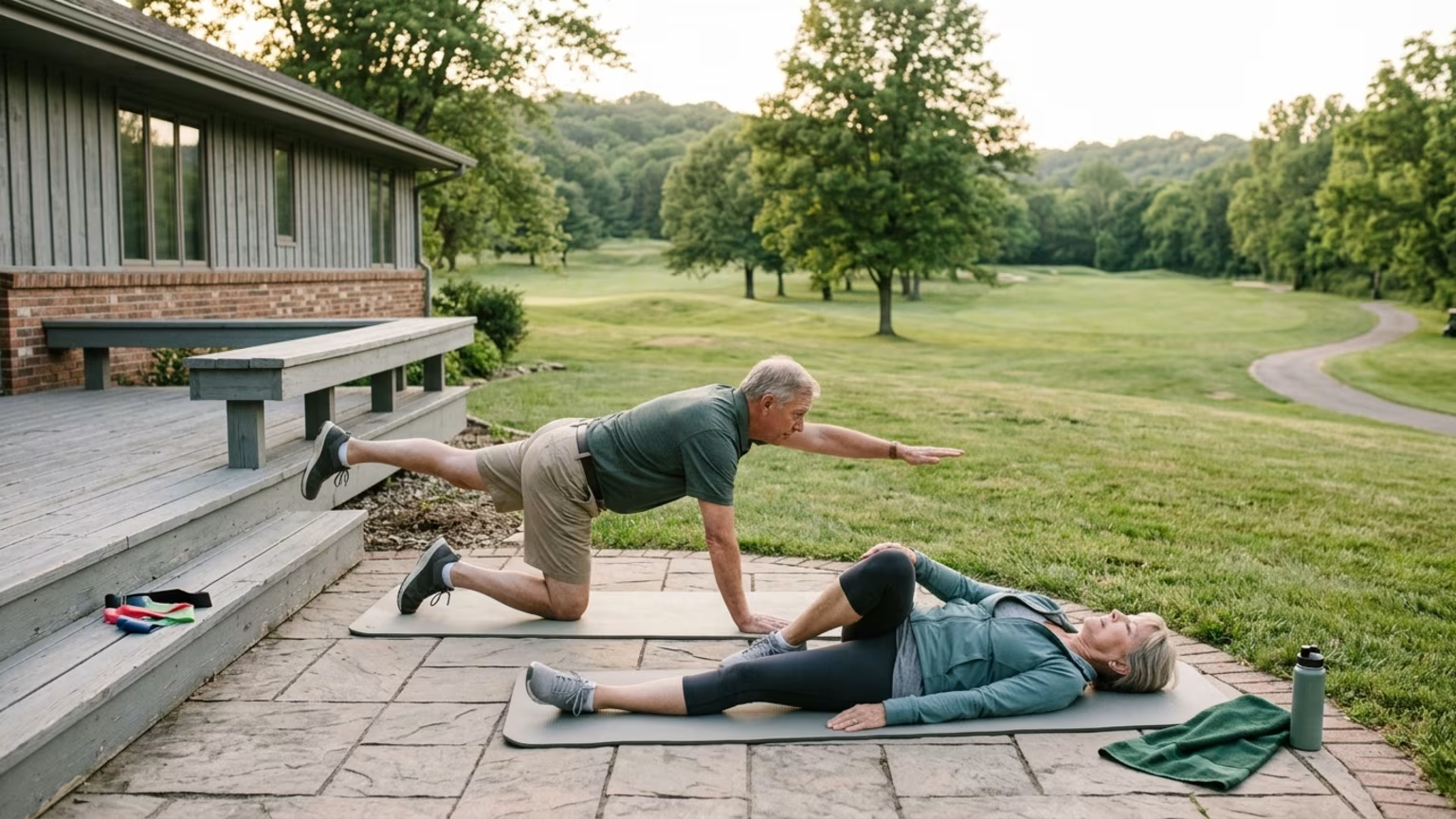
Infobae recommends three equipment-free movements for adults over 50: the glute bridge, the cat-cow, and the chair squat. These movements offer simple ways to maintain movement capacity between rounds when performed comfortably. I used to stand on the first tee doing long, static hamstring stretches because I thought it was right. I would actually feel weaker on my first drive after holding those rigid positions.
Research later showed me that dynamic movements prime the nervous system much better than static stretching. Changing my five minute warmup completely transformed my opening tee shots on weekend mornings. The cat-cow movement takes the spine through controlled flexion and extension without adding vertical load. You should focus entirely on moving your mid-back slowly while keeping your breathing steady.
The glute bridge is presented as a way to strengthen the posterior chain and support the lumbar region. Building strength in your glutes takes the pressure off your lower back during the downswing. A strong posterior chain provides the stability required to swing safely from the ground up. This targeted strength work allows older players to maintain posture through the impact zone.
Finally, the chair squat uses a firm chair as a helpful movement reference. The exerciser sends the hips backward as if sitting, lightly approaches the seat, and returns to standing. Keep your abdominal muscles controlled during the entire chair squat motion. Maintain a stable chair and clear space to perform these movements safely at home.
These simple drills can act as a short between-round routine to build trunk endurance. Schedule this strength work at least twice weekly to align with global health recommendations. You can use these movements to prepare your body before engaging in strenuous dynamic warm-ups. A 50-year-old golfer with no symptoms may use the movements purely as foundational maintenance work.
It is easy to misinterpret healthy ageing statistics and treat golf as a perfect cure. A summary of golf-health research reported that regular golfers had a death rate 40% lower than otherwise comparable people. The researchers described this association as roughly five additional years of life expectancy. That longevity finding is purely observational and cannot establish that golf independently extends lifespan.
Observational research can be affected by differences in income, baseline health, and general activity levels. Another misconception is treating these three specific exercises as an absolute insurance policy against injuries. The available source supports these movements as recommended exercises for older adults. It does not establish a quantified reduction in spinal degeneration or guarantee a pain-free season.
Treat the exercises as preparation and capacity-building rather than a perfect medical shield. If a routine consistently leaves your back more painful, you must stop and obtain clinical advice. You should never try to push past early warning signs of distress during your workouts. Golf is a wonderful part of an active lifestyle, but it requires sensible supplemental training.
Maintaining your physical capacity allows you to enjoy the golf course well into your later years. Implementing a brief routine with the glute bridge, cat-cow, and chair squat provides a strong foundation. You do not need complicated gym equipment to protect your lower back from the demands of the game. What adjustments will you make to your mobility routine this season to steer clear of this hazard?
Follow Golfergy for practical insights on performance, mobility, recovery and healthy ageing. Stay connected for new articles, research-led guidance and ideas to help you play better for longer.


A recent analysis reveals older adults see greater absolute health benefits from increased physical activity. Learn how to protect your golf longevity.

A new study of over 64,000 adults shows that brisk walking can improve longevity. Learn how golfers over 40 can use stepping intensity to build endurance.
A clinical trial examines how HMB and whey protein impact muscle turnover in adults over 65. Read why older golfers need a multi-component recovery plan.
Explore practical resources on performance, recovery, mobility and golf longevity.
Read the Blog