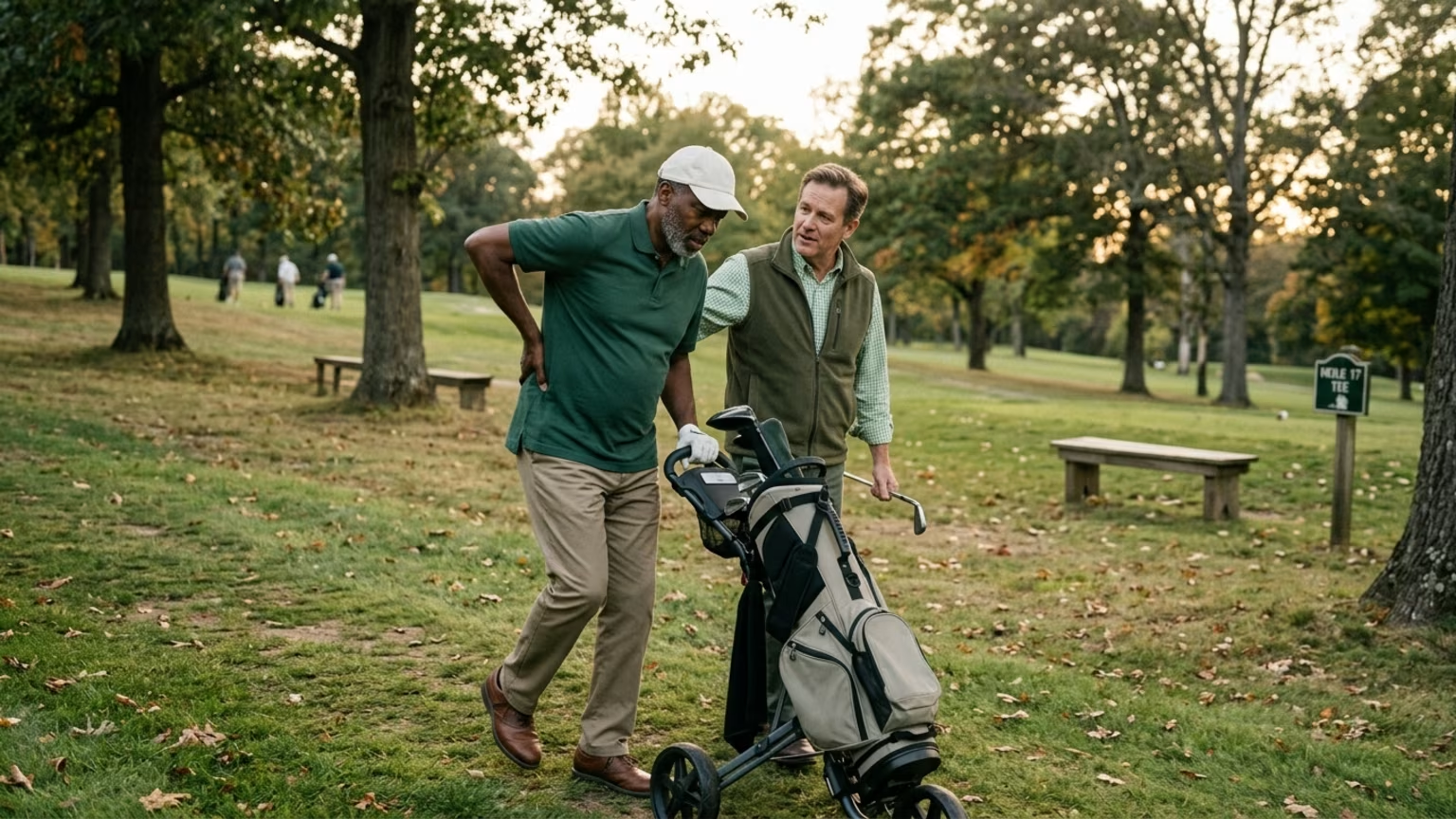

Learn why the lower back often compensates for restricted hips and mid-back in the golf swing, plus practical mobility habits for older players.




Compensatory movement in the golf swing is simply your body finding a way to complete a motion when its primary joints are restricted. For many older players, the lower back becomes the ultimate backup mover. The golf swing combines spinal flexion, rotation, speed, and repetition. When other body parts lack mobility, the lumbar spine is often forced to absorb more mechanical demand.
The golf swing relies heavily on a kinetic-chain movement. Your legs and feet interact with the ground while your hips rotate your pelvis. The thoracic spine turns your upper trunk, and your arms deliver the club to the ball. If one region cannot contribute adequately, another region often has to provide more motion or stabilization.
Think about how a swing feels on the first tee compared to the eighteenth fairway. A golf swing requires you to transfer force between the ground, your pelvis, and your upper body. The thoracic spine is the middle segment of your back. This area can rotate substantially and is an important source of your upper-body turn.
If your mid-back is stiff, you still need to complete your backswing and follow-through. Your brain will find that missing motion somewhere else. Golf clinicians explain that restricted hip or thoracic movement may shift more motion toward the lower back. This redistribution of motion places additional workload on the lumbar region.
For example, a golfer with restricted trail-hip rotation may sway or tilt the pelvis to create the appearance of a full backswing. A golfer with limited thoracic rotation may extend, side-bend, or rotate more through the lumbar region. These are possible compensations rather than medical diagnoses. The exact same visible movement can arise from completely different physical limitations in different players.
I used to stand on the first tee doing long, static hamstring stretches because I thought it was the right way to warm up. I would actually feel weaker on my first drive. Research later showed me that dynamic movements, like leg swings and torso twists, prime the nervous system much better. Changing my five minute warmup completely transformed my opening tee shots.
The American Academy of Orthopaedic Surgeons notes that rotational stresses from the swing can place considerable pressure on the spine and back muscles. This explains why you might feel fine during practice swings but experience stiffness after a full round. The issue is often accumulated exposure and fatigue rather than one single bad movement. This is often the real reason your lower back aches after a round of golf.
How your body tolerates these rotational demands changes as you pass age 40 and 50. Natural age-related shifts in strength and mobility influence your physical tolerance over 18 holes. Previous episodes of back pain and prolonged periods of sitting also play a significant role. These factors change the context of your swing without meaning your playing days are numbered.
Age alone does not establish that a golfer’s pain is caused by spinal degeneration. A recurring problem should always be assessed in context. This is especially true when symptoms are escalating or limiting your everyday activities. When your trunk muscles tire out on the back nine, your lower back becomes the easiest place to find extra movement.
As a round progresses, fatigue can reduce your ability to maintain posture and coordinate your pelvis. A golf-specific clinical explanation suggests that inadequate trunk control can increase the stabilizing workload placed on the spine. Understanding your physical baseline through a golf fitness assessment framework can help you identify these fading physical capacities.
We often want to blame a specific swing flaw for every ache and pain. A recent review summary cautions that inconsistent methods make the relationship between measured swing posture and injury risk difficult to establish. You should avoid assuming that one visible technical flaw explains all recurring back pain. The underlying issue is often a lack of coordinated movement rather than poor technique alone.
A lesson with a qualified golf professional may help identify excessive sway, early extension, or a loss of posture. However, technique alone should not be used to diagnose pain. For recurring symptoms, the most useful approach may combine a clinical assessment with a swing evaluation. The clinician can assess your physical capacity, and the golf professional can help modify the movement task.
The American Academy of Orthopaedic Surgeons points out that poor flexibility and strength may contribute to strains that become more serious injuries. Golf clinicians commonly explain that restricted hip movement can encourage additional lumbar rotation during the backswing and transition. This does not mean stiffness automatically causes injury, but it changes how your body distributes the physical demand.
You can protect your lower back by improving how the rest of your body moves. A basic warm-up should gradually raise your activity level rather than demanding full-speed swings immediately. Start by walking for a few minutes before moving through comfortable hip and shoulder ranges. From there, you can progress to easy half-swings and slowly build your speed. Start your round only when the movement feels coordinated and your symptoms remain stable.
Restoring motion in your mid-back is another practical step. Sheddon Physiotherapy demonstrates a quadruped thoracic-rotation drill that you can perform through a comfortable range. You begin on your hands and knees and slide one arm underneath your body toward the opposite side. Return and rotate that arm upward while following your hand with your eyes. Focus entirely on turning your upper body while keeping your pelvis steady.
Hip mobility work should focus on comfortable internal and external rotation. You should practice rotating your hips while maintaining a stable pelvis. If a drill reproduces familiar back or leg symptoms, you should stop and seek a professional assessment. This is why protecting the lower back without chasing more rotation is a sensible strategy.
The available rehabilitation literature includes trunk-muscle activation, strengthening, and movement-control exercises among approaches used for low-back pain. The goal is to build trunk endurance rather than learning how to brace your stomach forcefully. Appropriate starting options might include controlled bridges, side-plank variations, or opposite-arm-and-leg reaches from a quadruped position. These exercises should be progressed gradually and should never produce increasing symptoms.
If you are coming back from a painful flare-up, you must manage your dosage of golf. A golf rehabilitation guide recommends returning gradually by starting with comfortable walking and short swings. You can then add more holes and full effort only while your symptoms remain stable. A reduction in your swing volume is simply a smart way to keep your training within your current capacity.
You should also monitor whether a driving range session is followed by next-day symptoms. Pay close attention to whether speed or volume is being increased too quickly for your body to handle. When fatigue changes your swing late in the session, it is often a sign to stop. The goal is to build volume over weeks rather than testing your absolute limits in a single afternoon.
You must also recognize when conservative habits are not enough. New bladder or bowel problems, saddle-area numbness, or rapidly worsening leg weakness warrant emergency assessment. You should arrange a formal assessment with a qualified clinician when your pain keeps returning, limits daily activities, or travels into your leg. These symptoms are uncommon but should not be managed by continuing to stretch or waiting for a golf lesson.
Training your primary joints to do their own jobs is the foundation of playing better for longer.
Follow Golfergy for practical insights on performance, mobility, recovery and healthy ageing. Stay connected for new articles, research-led guidance and ideas to help you play better for longer.


A practical golf warm-up built around walking, controlled mobility and gradual swings, with clear limits on what the injury research shows.


A look at PGA.com’s ground-inspection warning and its conditional recovery-shot options for trees, thick collars and shallow bunkers.

Club Champion’s AOSSM partnership raises a post-injury question: do your clubs still fit your swing? Equipment assessment remains separate from medical care.
Explore practical resources on performance, recovery, mobility and golf longevity.
Read the Blog