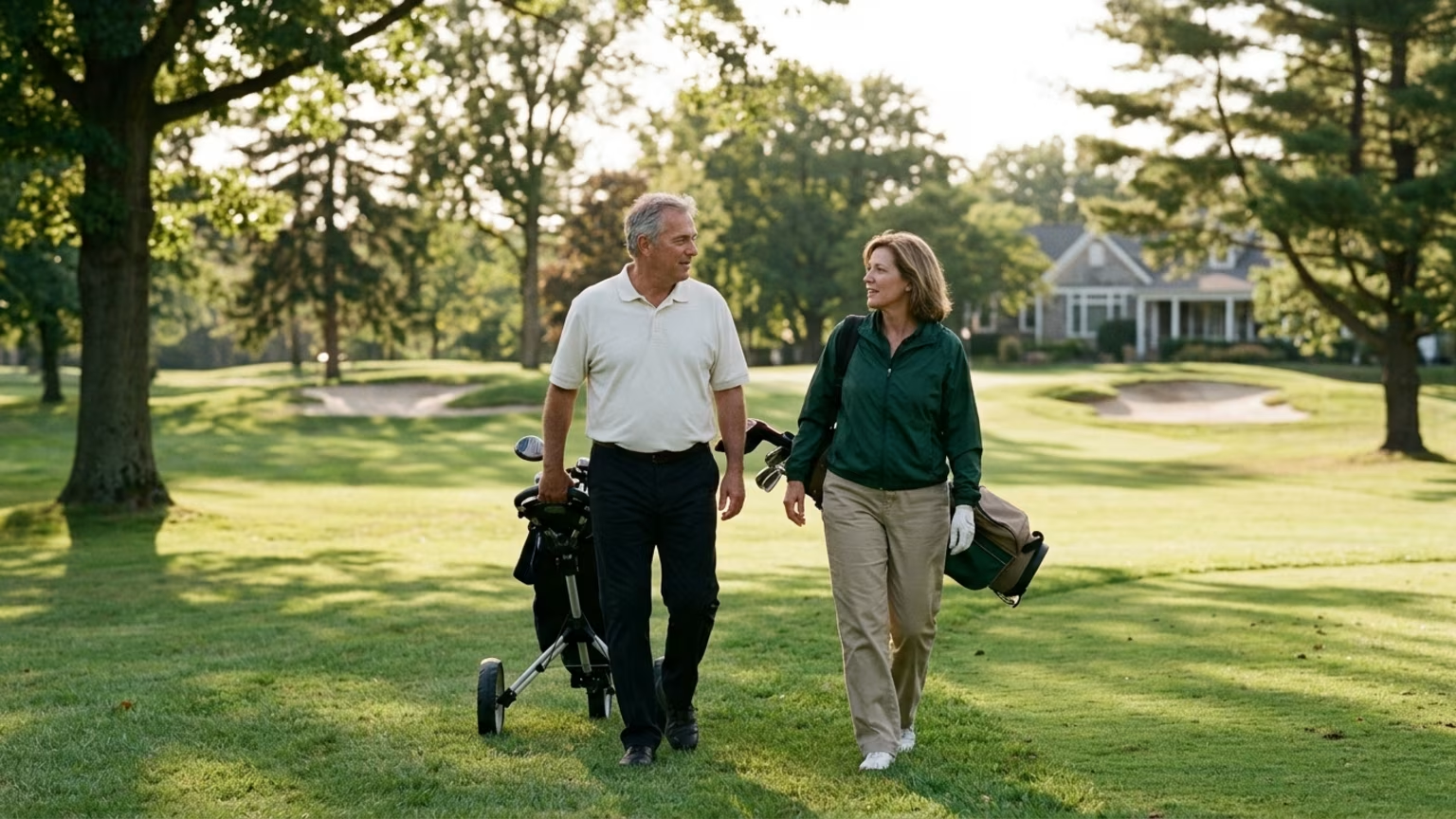
Struggling with mid-round fatigue? Learn why golf recovery over 40 depends on physical workload variability rather than a fixed resting schedule.




'Why does my lower back tighten up rigidly around the 14th hole, and how many days should I rest?' It is the most common question we hear from experienced golfers over 40. You want to maintain your mobility and extend your playing years without constant soreness. The physical reality is that an aging body responds differently to the repeated rotational stresses of the game.
Our goal at Golfergy is to provide practical guidance that translates sports science into plain English. We promise to provide evidence-based, practical advice that helps you play the game you love for as long as possible without getting bogged down in medical jargon. Your ideal recovery timeline depends entirely on the specific physical workload of your most recent round.
The direct answer is that the physical workload of golf changes drastically depending on how you navigate the course. Many players assume that playing 18 holes requires the exact same physical effort every time. A study summary from MyGolfMedia.com demonstrates why this assumption is incorrect. The researchers observed 16 skilled male golfers averaging 20.9 years old to measure the specific demands of the game.
The study compared the physical toll of walking the course against riding in a golf cart. The results showed a massive difference in physical output between the two conditions. During the walking condition, the players averaged 17,007 steps over the course of the round. They also burned 880 ± 279 kcal while walking.
In stark comparison, the golf cart condition required only 6,274 steps. Energy expenditure dropped significantly to 456 ± 155 kcal when riding. The study summary also reported that heart rate and perceived exertion were much higher while walking.
While this data comes from young and skilled participants, the underlying principle applies directly to older recreational golfers. You cannot treat a walking round and a cart round as the same physical stressor. Walking asks your body to endure hours of cardiovascular work on top of the golf swing. Riding reduces your step count by more than half, which drastically lowers the immediate physical cost.
Many older golfers worry that the heavy cardiovascular workload of walking will inevitably destroy their swing path and distance. The same MyGolfMedia.com study summary investigated the impact of walking on physical performance. The researchers found no significant overall difference in clubhead speed between the walking and riding conditions. Ball speed also remained consistent throughout the round regardless of the players' mode of transportation.
The authors did note a possible carry-distance difference at one specific measurement point. However, the researchers issued a clear caution regarding this data. They warned that a single-hole result does not establish an 18-hole performance effect. The evidence suggests that walking the course does not automatically ruin your clubhead speed over a full round.
If your ball striking gets worse late in the round, you must look at your own individual fatigue levels. We will state plainly that the current research does not map out how fatigue changes swing paths in older populations. Managing your overall energy is the most practical way to protect your contact. Protecting your contact when tired is directly linked to how well you manage mid-round physical exhaustion on the back nine.
The safest immediate step you can take without leaving the course is to monitor your perceived exertion carefully. The available research does not validate a specific on-course stretch or quick movement fix. We cannot offer a magical adjustment that instantly removes fatigue for everyone over 40. Instead, you must pay attention to your own physical response during the round.
Notice whether your ordinary movement or dynamic balance feels different from your usual baseline. If you feel your perceived exertion climbing rapidly, slow down your pace of play. Take extra time walking to your ball and give yourself a moment to breathe before setting up. Recognizing your own fatigue level is the most effective way to prevent mid-round stiffness from worsening.
The sources reviewed here do not establish a universal rule or a proven on-course intervention for sudden tightness. Taking a moment to assess your body is much safer than forcing an aggressive swing. This cautious approach helps you finish the round without unnecessary strain. It also provides valuable information for planning your recovery in the days to follow.
It is normal to experience some temporary soreness after walking 17,000 steps on a golf course. However, there are clear signs that indicate you should step away from the game temporarily. The research dictates that you should seek appropriate clinical advice for individualized guidance when pain or a health condition affects your play.
The sources assembled here do not provide a diagnostic protocol or a rehabilitation blueprint. Never try to push through sharp pain, shooting sensations, or severe joint restriction. If your stiffness does not resolve with standard rest, you need a proper medical evaluation. A healthcare professional can help you separate normal muscle fatigue from a more serious structural problem.
The best way to prevent severe tightness is to manage your weekly golf workload dynamically. The results returned here do not establish a validated rest interval for golfers over 40. Claims that older players need 48 to 72 hours of rest after every round are entirely unsupported by the sources assembled here. Furthermore, you should avoid presenting age 40 as a strict cutoff that automatically determines recovery time.
The available study data do not compare recovery across age groups or establish an age-based timetable. The search results simply do not provide a robust basis for a single best schedule for alternating rounds. Therefore, you should adopt a flexible pattern to manage your physical resources. Treat a round as a workload that varies heavily depending on whether you walk or ride.
After a demanding walking round, consider making your next golf-related session significantly lighter. Try an easier practice session or lower-demand physical activity the following day. Reserve your next demanding 18-hole walking session for when you feel fully recovered. Taking a smarter approach to post-round active recovery routines will help you stay mobile without overloading your system.
The next time you visit the driving range, use your warm-up to evaluate your physical readiness. Start by taking a few slow practice swings without a golf ball. Focus entirely on turning your trail hip. Pay attention to how your body responds to the initial movement.
Notice if your rotation feels tight or if your balance wavers at the end of your swing. These simple checks help you gauge if you have adequately recovered from your previous round. If you feel restricted, keep your practice session brief and focus on light wedge work. Let your body dictate your schedule rather than forcing a heavy practice session on tired muscles.
Follow Golfergy for practical insights on performance, mobility, recovery and healthy ageing. Stay connected for new articles, research-led guidance and ideas to help you play better for longer.


Rest or move the day after 18 holes? Use fatigue, soreness, symptoms and your playing schedule to guide a flexible recovery day.


Compare foam rolling, massage, compression, heat and cold for golfers, with comfort benefits kept separate from performance and injury claims.
A measured guide to stiffness during and after golf, with gentle movement options, sustainable habits and NHS-backed back-pain warning signs.
Explore practical resources on performance, recovery, mobility and golf longevity.
Read the Blog