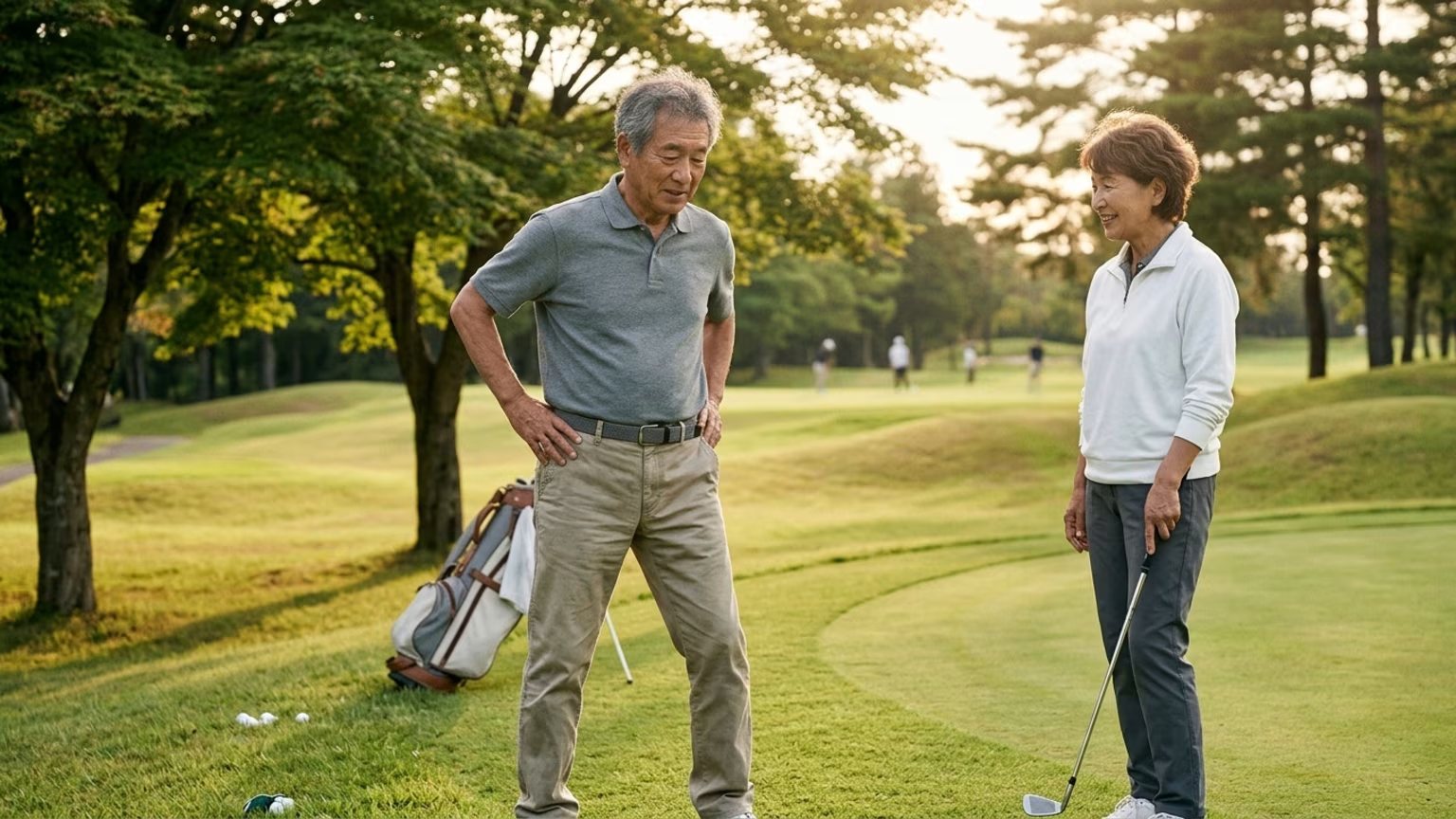

Golf Digest Japan shares a gentle hip wiggle exercise following the 2026 CPKC Women’s Open. Learn how to loosen stiff hips without aggressive stretching.




Bob stands on the first tee box at dawn on a chilly morning. He aggressively forces his knees toward the turf to stretch his hips before his opening drive. You have heard a million times that deep static stretching is required for a full swing, but the truth according to sports science is completely different. According to a recent training feature from Golf Digest Japan released alongside coverage of the 2026 CPKC Women’s Open, gentle and controlled joint movements provide a much safer way to prepare for a round.
It makes perfect sense why older players try to replicate the extreme flexibility seen on television. The 2026 CPKC Women’s Open took place August 20 to August 23 at the Royal Mayfair Golf Club in Edmonton. Golf Channel reported that 30 of the world’s top 50-ranked players competed in the highly anticipated field. Watching these elite athletes swing can easily convince a recreational player that aggressive stretching is the absolute secret to a better game.
Defending champion Brooke Henderson was among those announced for the 52nd playing of the event. Everyday amateurs see the massive hip turns produced by such professionals and immediately notice their own physical limitations. You naturally want to maintain your ability to turn completely through the ball as you age. When your hips feel stiff after a long car ride, forcing a deep stretch feels like the most logical fix to the problem.
Many amateur golfers firmly believe they must push through stiffness to reclaim the range of motion they had in their twenties. The persistent frustration of a shortened backswing drives players to stretch way past their point of comfort. They mistakenly assume that pulling a muscle into a longer position will permanently solve their rotation problems on the course. Unfortunately, forcing range of motion on an aging body often leads to protective tension rather than true mechanical freedom.
Your hip joints require careful and deliberate management as you get progressively older. Aggressive stretching can trigger a protective reflex in your muscles if the joint feels unstable or threatened. A 2026 Cochrane review looked closely at land-based exercise for adults diagnosed with hip osteoarthritis. The rigorous review found that exercise probably improves pain and physical function slightly compared to no treatment, usual care, or limited education.
The exact same review noted that the evidence regarding adverse events remained very uncertain. This research highlights why scaling your physical movements is much safer than forcing flexibility on a tight joint. A wider range of motion is not automatically a better outcome for every golfer on the course. The primary goal of mobility work is comfortable and controlled movement rather than a painful test of your physical limits.
When you keep your joints moving actively, your nervous system naturally allows for better rotation. The recent Golf Digest Japan article linked to its third-round pairing page shares this exact philosophy. Their comprehensive flexibility improvement plan focuses on moving the joint smoothly instead of demanding a 180-degree split. Small, gentle movements help lubricate the joint capsule and signal safety directly to your brain.
This gradual approach properly prepares your body for the rotational forces of a golf swing without causing microscopic muscle damage. A smaller range that remains smooth and pain-free is consistent with smart coaching guidance for older adults. You absolutely do not need to reach the flexibility standards of touring professionals to enjoy a comfortable round. Proper joint management requires patience and a willingness to work within your current structural capacity.
Golfers with hip or groin pain, recent surgery, or a history of impingement should always seek advice from a medical professional before adding new exercises to a routine. The cited Golf Digest Japan article gives practical coaching guidance but does not provide condition-specific medical clearance. The simple goal is to find a range of motion that feels entirely comfortable for your specific body. Forcing your hips into positions they cannot tolerate will only ruin your ability to swing the club effectively the next day.
Instead of performing extreme stretching routines before your next round, try the gradual routine highlighted by Golf Digest Japan. This simple hip wiggle drill can be done at home while you relax in the evening. The 2026 tournament featured a par 70 course spanning 6,452 yards and offered a massive $2.75 million purse. While the winner took home a reported $412,500, everyday players can gain their own victories by adopting smarter physical preparation habits.
Start the exercise by sitting down on the floor with your feet opened in a comfortable V shape. Place both hands firmly on the ground behind your torso to support your upper body. Slowly drop one knee inward to gently internally rotate that specific leg. At the exact same time, let your opposite knee open outward in a relaxed external rotation.
Alternate this specific motion slowly from side to side in a highly controlled manner. The most critical key is to initiate the action directly from your hip joint rather than just turning your feet. Golf Digest Japan officially recommends performing 15 back-and-forth repetitions for three total sets. Beginners should absolutely start with a very small range of motion and progress slowly over time.
For older players with greater mobility capacity, the article suggests moving your hands in front of your body for an added challenge. Focus entirely on turning your hip slowly and strictly avoid lifting your buttocks excessively off the floor. The publication specifically suggests practicing this gentle movement during spare moments such as watching television. It serves as an excellent low-impact way to loosen stiff hips before practicing your short game.
If you experience any sharp pain, catching, or numbness, stop the movement completely and consult a qualified clinician. Older recreational players should treat this as a gentle way to check mobility capacities rather than a forceful flexibility workout. You can also pair this specific drill with a smarter pre-round warm-up that includes light activity. Smart conditioning guidance consistently recommends adding dynamic movements like trunk rotation alongside this seated drill.
Next time your playing partner tells you to push aggressively through a tight stretch, trust your body's true mechanics instead. Gentle and highly controlled rotation will always serve an aging golfer better than painful flexibility tests. Stick to the sustainable principles we promote at Golfergy and keep your physical preparation simple.
Follow Golfergy for practical insights on performance, mobility, recovery and healthy ageing. Stay connected for new articles, research-led guidance and ideas to help you play better for longer.


Understand how your hips and mid-back contribute to a golf turn, with practical habits that put comfort ahead of extra backswing length.


A progressive golf warm-up for players over 40, moving from easy activity to fuller practice swings without treating preparation as a flexibility test.
Observe comfortable movement and control to frame better questions about your golf swing, with guidance on when pain needs professional assessment.
Explore practical resources on performance, recovery, mobility and golf longevity.
Read the Blog


