Club Champion’s AOSSM partnership raises a post-injury question: do your clubs still fit your swing? Equipment assessment remains separate from medical care.




Club Champion announced a partnership with the American Orthopaedic Society for Sports Medicine (AOSSM) on October 18, 2026. The collaboration connects AOSSM members with the company’s golf-fitting expertise. It also connects Club Champion with sports-medicine professionals and their communities.
The partnership announcement raises a useful question for golfers returning after injury: does equipment chosen for an earlier swing still suit the golfer’s current capabilities? Club Champion founder Nick Sherburne described the aim as fitting golfers for who “they are today.” That puts the focus on the present swing rather than automatically keeping or replacing a pre-injury setup.
There is a commercial element too. The announcement says eligible AOSSM members may receive referral revenue-sharing opportunities and other benefits. It does not publish payment terms or explain which members qualify. That relationship is worth keeping visible when discussing a referral.
According to the announcement, injury or surgery may change strength, flexibility, mobility or swing speed. Those changes are possible reasons to reassess equipment that previously worked well. They are not proof that the equipment has become unsuitable.
The release identifies knee surgery and shoulder injury as examples. It also includes changing mobility and aging. The common thread is not a particular diagnosis or operation. It is whether the golfer’s present capabilities differ from those behind the original fitting.
Club Champion says its fitting process uses launch-monitor technology and trained fitters to assess the current swing. The listed measurements include clubhead speed, launch conditions, spin and dispersion. Fitters also examine equipment specifications.
That gives the equipment discussion a concrete starting point. Instead of assuming that an old setup is wrong, the question becomes what the assessment shows. The relevant comparison is between the golfer’s current swing and the equipment being tested.
For Golfergy’s audience, the useful connection is between physical change and equipment reassessment. The announcement includes aging among its examples. It does not make age alone a reason to buy different clubs.
A golfer interested in maintaining clubhead speed after 40 is asking a different question from someone checking equipment fit after recovery. One concerns physical performance. The other concerns whether the clubs match the swing being assessed. Keeping those questions separate makes the partnership’s purpose clearer.
The evidence boundary belongs here. This is a partnership announcement with statements from the organizations involved, not an independent evaluation. It supplies no clinical outcomes, injury-rate data or tested return-to-play procedure. It also does not establish how often golfers need refitting after rehabilitation or show that older recreational golfers need it more than professionals.
AOSSM Vice President Jeffrey Dugas described better performance and a possible reduction in injury risk as potential benefits of properly fitted equipment. Those are qualified statements rather than demonstrated results from this program. The defensible takeaway is an opportunity for an individual assessment, not a promise of safer golf or restored performance.
The announcement provides several equipment categories that golfers can raise with their clinician and a qualified fitter. These are discussion prompts rather than a shopping list. Each keeps the conversation focused on one equipment feature at a time.
What does the current assessment suggest about the weight of the existing clubs and shafts? The announcement names lighter equipment as a possible consideration. It does not present lighter clubs as the default choice after injury.
What measured difference supports keeping the current shaft or testing another option? Shaft flex and performance are among the factors named in the release. The useful request is an explanation tied to the golfer’s swing rather than a recommendation based only on the fact that an injury occurred.
Does the fitting assessment support the present club length or another option? Length is a listed consideration. Asking what finding supports a proposed change keeps the discussion specific.
What evidence from the assessment supports a lie-angle adjustment? The announcement includes lie among the possible fitting factors. It does not prescribe a particular adjustment for a particular recovery situation.
What does testing show about the proposed clubhead and shot dispersion? Clubhead forgiveness is another factor named in the release. The fitter’s explanation should connect the recommendation to the assessment rather than rely on a broad promise about returning from injury.
Across these categories, the central question is consistent: what measured evidence supports the proposed change? That question also leaves room for keeping the current equipment when the assessment supports it. Reassessment does not have to begin with a decision to replace something.
Sherburne addressed this directly in the announcement: “the right equipment can’t fix an injury.” The collaboration is described as complementing medical care and rehabilitation, not replacing them.
The distinction is straightforward. The clinician understands the injury, recovery and physical limitations. The fitter assesses equipment in relation to the individual swing. Sherburne presented coordination between those areas as the opportunity behind the partnership.
A fitting remains an equipment assessment rather than medical clearance. Personal decisions about recovery and returning to activity belong with qualified healthcare professionals. Equipment findings can inform the conversation without taking over that role.
For readers managing a shoulder issue, Golfergy’s coverage of shoulder pain and playing decisions offers related reading. The equipment question here remains separate: whether the clubs suit the golfer’s current capabilities.
Club Champion and AOSSM have announced a connection between fitting expertise and sports-medicine professionals. For recreational golfers, its clearest message is to question assumptions about a pre-injury setup. A change in physical capability can be a reason to discuss equipment fit without dictating a purchase.
The useful standard is a clear explanation of what the fitting assessment shows and why any change is proposed. Clinical decisions stay with the healthcare professional. Equipment recommendations stay grounded in the golfer’s present swing.
Open questions include how the two professions will coordinate in practice and what evidence will support recommendations through the relationship. Those details will matter more than the partnership label itself.
Follow Golfergy for practical insights on performance, mobility, recovery and healthy ageing. Stay connected for new articles, research-led guidance and ideas to help you play better for longer.


Track where golf discomfort occurs, when it starts and what you were doing. Use clear notes to discuss back and joint symptoms with a clinician.


Learn which golf symptoms deserve attention, when to pause painful swings, and how a simple activity log can help you discuss recurring problems.
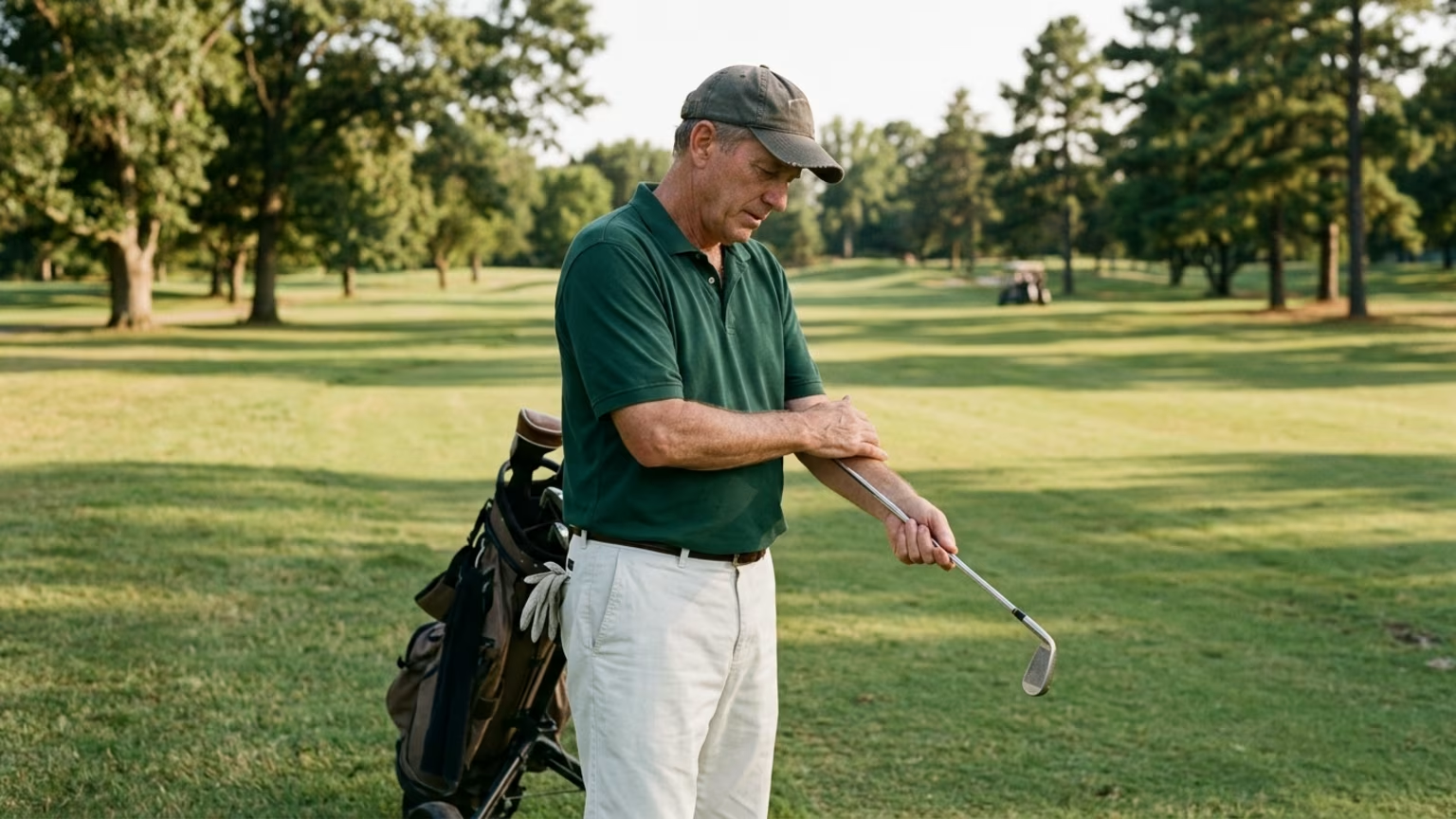
Review elbow and wrist pain patterns in golf through symptom notes, practice changes, ground contact and grip condition, without assuming a quick fix.
Explore practical resources on performance, recovery, mobility and golf longevity.
Read the Blog