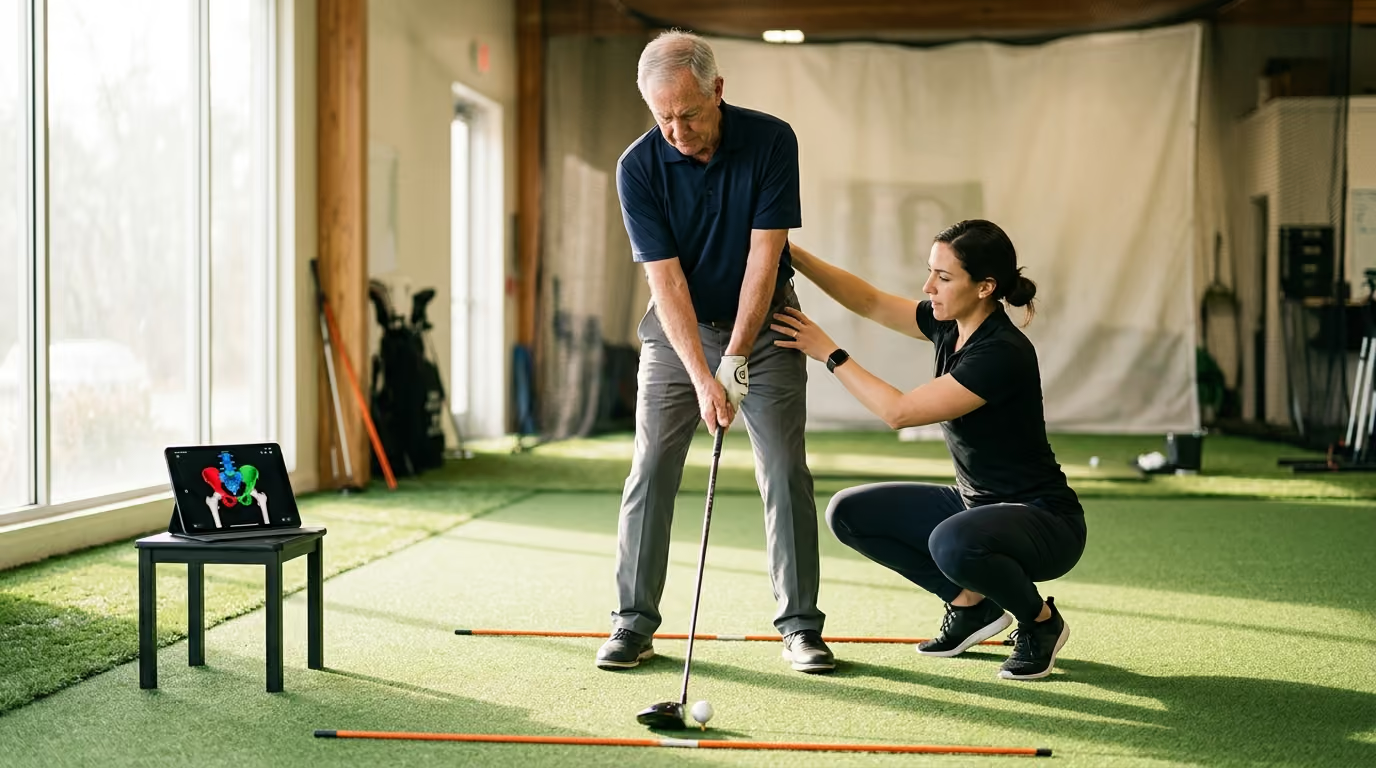

Pain-free golf swings and better hip rotation become possible when senior players fix pelvic alignment faults like S-posture at address.




Do you finish a round of golf with a sore lower back and a feeling that your hips are locked in concrete? Many experienced golfers search the web for terms like lower back pain after golf or how to get more hip turn after 50. This physical restriction often traces back to how your pelvis sits at address. Correcting your pelvic tilt is the single most effective way to restore your swing and protect your spine as you age.
Your pelvis is the physical foundation of your golf swing. It acts as the bridge between your lower body power and your upper body rotation. When your pelvis is out of alignment, your swing mechanics break down. This detailed guide will show you how to identify your postural faults, correct them with simple exercises, and maintain a healthy spine for life.
To understand pelvic alignment, we must look at the work of Dr. Vladimir Janda. He was a pioneer in physical medicine who identified predictable patterns of muscle tightness and weakness. He called these patterns Upper Crossed Syndrome and Lower Crossed Syndrome. These muscle imbalances directly affect how a golfer stands over the ball.
Lower Crossed Syndrome is the primary cause of Anterior Pelvic Tilt, which golf instructors call S-posture. This postural fault is common among golfers who spend hours sitting at a desk. When you sit for long periods, your hip flexors and lower back muscles become tight and short. Meanwhile, your glutes and abdominal muscles become weak and inactive.
When you stand up to address the golf ball, these tight hip flexors pull the front of your pelvis downward. This causes your tailbone to stick out too far. This creates an excessive arch in your lower back. This S-posture places immense compressive stress on your lumbar spine during the high-speed rotation of the swing.
The opposite postural fault is Posterior Pelvic Tilt, which creates a C-posture at address. This setup position is characterized by rounded shoulders and a slumped spine. This posture often stems from Upper Crossed Syndrome. In this state, the chest muscles are tight and the upper back muscles are weak. This rounded position makes it impossible to rotate your spine correctly, which forces you to lift the club with your arms.
A neutral pelvic position is the gold standard for a stable golf setup. In a neutral pelvis, your lower back has a natural, slight curve. Your core muscles are lightly engaged to support your spine. This alignment allows your hips to rotate freely, which reduces stress on your joints and increases clubhead speed.
Imagine you are standing on the fourteenth tee box of a long, challenging course. You spent most of the workweek sitting in meetings or driving. Your lower back is starting to feel tight, and your trail hip feels locked. You bend over the ball, stick your tailbone out to look athletic, and take a mighty swing.
Because of this S-posture setup, your swing is doomed before the club even moves. Your tight hip flexors prevent your hips from rotating around a stable pivot. Instead of turning, your hips slide laterally away from the target during the backswing. This lateral movement is called a sway.
As you transition into the downswing, your weak glutes cannot stabilize your pelvis. To make room for the club to swing, your hips thrust forward toward the golf ball. This biomechanical error is known as early extension. Your lower back arches even further, which forces your chest to stand up.
When early extension occurs, you lose your original spine angle. You must flip your wrists at the last microsecond to make contact with the ball. This leads to inconsistent strikes, weak slices, and a jarring impact. Your lower back absorbs the entire force of the swing, which leads to chronic soreness.
For a golfer with C-posture, the swing feels equally restricted. The rounded upper back limits your thoracic rotation. You cannot achieve a full shoulder turn, so you lift the club high with your arms. This short, steep swing often results in a painful pull or a weak slice.
Research shows that postural faults are incredibly common among recreational players. According to data from the Titleist Performance Institute, approximately 33.1 percent of all golfers exhibit a C-posture at address. Another 25.3 percent of golfers display an S-posture setup. This means more than half of all amateur golfers are swinging from a compromised physical position.
The physical cost of these postures is significant. Golfers with pelvic tilt issues suffer from a 90 percent rate of losing their posture during the swing. Additionally, 70 percent of these players exhibit a lateral slide, while 50 percent demonstrate early extension. These mechanical faults directly reduce power and accuracy.
Age plays a major role in these postural shifts. A study published in the International Journal of Exercise Science looked at the prevalence of Anterior Pelvic Tilt in different age groups. The researchers found that 44 percent of golfers aged 45 to 65 exhibit significant Anterior Pelvic Tilt. This same age cohort showed a 72 percent correlation with chronic low-back pain.
As we age, our physical capacity changes. Research in the Journal of Sports Science and Medicine reveals that senior golfers produce lower clubhead speeds because of physical limitations. Specifically, older golfers show about 7.3 degrees less trunk extension during the swing compared to younger players. They also demonstrate 4.3 degrees less X-factor, which is the separation between hip and shoulder rotation.
It is important to distinguish between functional and structural postural changes in older adults. A functional change is caused by muscle imbalances and can be corrected with training. A structural change is caused by physical conditions like osteoarthritis or spinal stenosis. If you have structural changes, you must adapt your swing rather than forcing a standard neutral posture.
If you feel your posture slipping during a round of golf, you can use a simple physical cue to reset your pelvis. This drill is called the Three-Position Pelvic Rock. You can perform it right on the tee box while holding a mid-iron across your thighs.
First, take your normal golf stance and place your hands on your hips. Next, deliberately arch your lower back as far as possible by sticking your tailbone out. This is Position A, which is the extreme S-posture. Hold this position for two seconds to feel the tension in your lower back.
Second, tuck your tailbone completely under your body while squeezing your glutes. This is Position B, which is the extreme C-posture. Your lower back will feel completely flat or slightly rounded. Hold this position for another two seconds.
Third, find the exact midpoint between these two extremes. This is Position C, which is your neutral pelvic alignment. Your lower back should feel comfortable and tension-free. Focus entirely on turning your trail hip from this neutral starting point.
Perform this physical reset before every tee shot on the back nine. This simple routine re-establishes your brain-body connection. It alerts your nervous system to the correct alignment. It also helps you avoid the painful lower back compression that causes late-round fatigue.
To fix the root cause of pelvic tilt, you must commit to a structured physical routine. This progression moves from basic physical awareness to golf-specific strength. It is designed to rebuild your pelvic control step by step. You can read more about these physical concepts on our page about golf longevity and recovery.
This exercise builds basic brain-muscle awareness without any gravitational load. Lie flat on your back on a comfortable exercise mat. Keep your knees bent at a 90-degree angle and your feet flat on the floor. You will notice a natural space between your lower back and the mat.
Slowly press your lower back flat against the floor. To do this, you must contract your abdominal muscles and tilt your pelvis backward. Do not press down with your feet or legs. Focus entirely on using your stomach muscles to flatten the arch in your back.
Hold this flat position for three deep breaths. Next, slowly reverse the movement by arching your back and creating a larger space under your spine. Repeat this back-and-forth movement ten times. This simple exercise teaches your brain how to control the position of your pelvis.
This movement helps separate the motion of your pelvis from your upper spine. Start on your hands and knees on the floor in a tabletop position. Place your hands directly under your shoulders and your knees under your hips. Keep your neck relaxed and look down at the floor.
Begin the movement by tucking your tailbone under your body. Let this movement ripple up your spine until your entire back is rounded toward the ceiling. Let your head drop naturally as you push the floor away. Hold this rounded position for two seconds.
Next, slowly tilt your tailbone upward toward the ceiling. Allow your belly to sink toward the floor as you gently lift your chest. Do not over-arch your neck or lower back. Repeat this fluid cycle ten times, focusing on smooth transitions.
This drill targets tight hip flexors while activating inactive glute muscles. Kneel on your right knee with your left foot flat on the floor in front of you. Both knees should form a 90-degree angle. Place your hands on your hips for balance.
Without leaning forward, squeeze your right glute muscle as hard as you can. This muscle contraction will push your pelvis into a slight posterior tilt. You should feel a deep, clean stretch in the front of your right hip. Keep your torso completely upright during the stretch.
Hold this active squeeze for ten seconds, then release. Complete five repetitions on your right side, then switch to your left leg. This exercise directly combats the physical damage caused by prolonged sitting. For more physical routines, check out our mobility section.
Once you master basic pelvic movement, you must build strength in that neutral alignment. This ensures your body can handle the extreme forces of the golf swing. These exercises should be performed two to three times per week.
This drill transfers your pelvic awareness directly into your golf setup. Stand in your address position with a golf club held across your chest. Place your feet shoulder-width apart and bend from your hips. Keep your knees slightly flexed.
Without moving your upper body, tilt your pelvis forward and backward. Try to isolate the movement to your hips and lower back. Your chest and shoulders should remain perfectly still. This is highly challenging for many experienced golfers.
If you struggle, perform the movement slower. Focus entirely on tilting your tailbone down, then up. Complete fifteen repetitions. This drill builds the exact motor patterns needed to maintain your spine angle during the swing.
The dead bug exercise builds exceptional core stability to protect your lower back. Lie on your back with your arms pointing straight up at the ceiling. Lift your legs so your hips and knees are bent at 90-degree angles. Press your lower back firmly into the floor.
Slowly lower your right arm behind your head while extending your left leg straight out. Keep your lower back pressed into the floor the entire time. Do not let your back arch as your leg extends. Stop your leg a few inches above the floor.
Return your arm and leg to the starting position. Repeat the movement using your left arm and right leg. Complete ten controlled repetitions on each side. If you want to build more physical resilience, explore our strength articles.
[Phase 1: Supine Pelvic Tilts]
│
▼
[Phase 2: Cat-Cow Mobility]
│
▼
[Phase 3: Half-Kneeling Glute Squeezes]
│
▼
[Phase 4: Standing Golf Stance Pelvic Tilts]
│
▼
[Phase 5: Dead Bugs / Advanced Strength]
Many golfers make critical mistakes when trying to fix their pelvic alignment. The most common error is stretching the lower back to relieve tightness. Golfers with S-posture often feel a dull ache in their lower spine. They assume this means they need to stretch their lower back muscles.
In reality, those lower back muscles are already overstretched and overworked. They are fighting to hold the pelvis stable because the glutes and abdominals are asleep. Stretching the lower back further actually increases joint instability. The correct solution is to strengthen the glutes and core to relieve the workload on the back.
Another common mistake is forcing a perfectly flat back at address. In an attempt to avoid S-posture, some players tuck their tailbone too far under. This creates a rigid, flat lower spine. This flat position destroys the natural athletic hinge at your hips.
Without a proper hip hinge, you cannot generate power from your legs. Your body will feel stiff, and your swing speed will drop. The goal of posture correction is not a flat spine. The goal is a neutral spine that retains its natural, gentle curves.
Finally, older golfers often ignore structural limitations. If you have joint degeneration, do not force your body into a textbook posture. Forcing a position that causes joint pain will lead to injury. Work with a physical therapist to find a functional posture that is safe for your specific joints. You can learn more about safe physical practices on our page covering injury prevention.
Your golf equipment can either help or hurt your setup posture. If your clubs are too short, you will be forced to slump over the ball. This slump encourages a severe C-posture. Conversely, if your clubs are too long, you will stand too upright, which can lead to an S-posture.
Have your club length verified by a professional fitter. They will measure your wrist-to-floor distance and analyze your posture at address. Making sure your clubs match your physical proportions is vital. This adjustment allows you to maintain a neutral pelvic position naturally.
The shaft flex of your clubs also plays a role in your posture. If your shafts are too stiff, you will swing harder to bend them. This extra effort often causes you to lose your spine angle and early extend. Upgrading to a lighter, more flexible shaft can help you maintain your posture throughout the swing.
Your choice of footwear is another overlooked aspect of pelvic alignment. Many modern golf shoes have a high heel-to-toe drop. This elevated heel shifts your body weight forward onto your toes. This forward weight shift naturally triggers an anterior pelvic tilt.
Consider trying zero-drop or low-drop golf shoes. These shoes keep your feet flat on the ground. This even weight distribution makes it much easier to align your pelvis. It also improves your balance and footwork during the swing.
Correcting your pelvic posture requires consistent, daily attention. You cannot fix years of desk sitting in a single practice session. Use this simple weekly checklist to build better physical habits.
First, perform the Supine Pelvic Tilts every morning before you get out of bed. This simple routine takes only two minutes. It wakes up your core muscles and prepares your spine for the day. It also prevents early morning stiffness.
Second, set a timer on your computer to ring every sixty minutes. When the timer goes off, stand up and perform three Half-Kneeling Glute Squeezes. This simple habit breaks up the long periods of sitting that ruin your posture. It keeps your hip flexors long and active.
Third, dedicate ten minutes before every round of golf to a active warm-up. Do not just hit balls on the range with a cold body. Perform the Cat-Cow mobility drill and the Standing Golf Stance Pelvic Tilts. This prepares your nervous system for the physical demands of the swing.
Fourth, monitor your physical sensations during your rounds. If you feel your lower back aching on the back nine, immediately perform the Three-Position Pelvic Rock. Do not wait for the pain to become severe. Take proactive steps to protect your joints. For more practical advice, visit the Golfergy blog.
By building these simple physical habits, you can protect your spine and improve your play. Your golf swing will feel smoother, more powerful, and completely pain-free.
An active, neutral pelvis is the ultimate insurance policy for an aging golfer's lower back.
Follow Golfergy for practical insights on performance, mobility, recovery and healthy ageing. Stay connected for new articles, research-led guidance and ideas to help you play better for longer.


Explore practical resources on performance, recovery, mobility and golf longevity.
Read the Blog