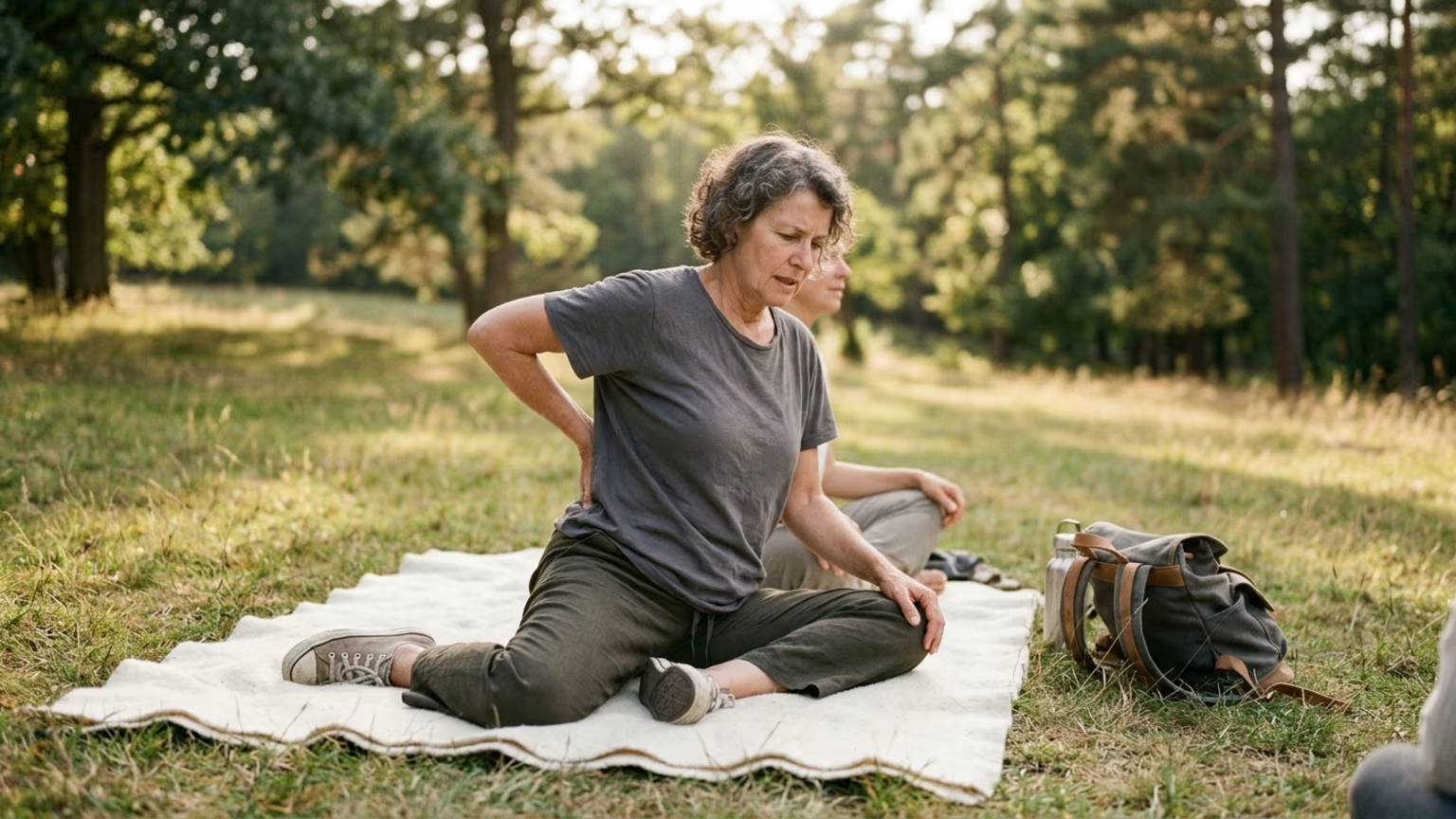

Learn how limited hip rotation forces your lower back to overwork during the golf swing. Discover practical mobility checks to protect your spine.




Most golfers believe their back pain starts in their spine, but the real source of the problem often lies several inches lower. When the hips lose their ability to rotate freely, the lower back is forced to take over the workload. That mechanical shift is a quiet killer of golf swings and playing careers alike. When a professional withdraws from a weekend tournament citing back tightness, the official statement rarely tells the whole story.
The root cause is usually a chain reaction that started long before the painful event. Biomechanics and rehabilitation commentary suggest that when the hips or thoracic spine contribute less rotation, the lumbar spine may have to contribute more. A player might feel a sudden pinch in their back, but the initial failure likely happened in the joints surrounding it. Understanding how movement restrictions shift the workload is the first step toward playing without pain. We have to look past the symptoms to find the actual problem.
The human body is incredibly resourceful when asked to complete a movement task. If your hips are too stiff to turn during a golf swing, your brain simply recruits another body part to do the job. The lower back is almost always the first area to answer that call. This creates a functional imbalance that quietly wears down the supporting tissues over time.
Your lumbar spine is naturally designed for stability rather than massive twisting. It certainly contributes to the golf swing, but excessive or poorly controlled lumbar motion becomes problematic. When your hips cannot rotate well, the lower back handles more twisting force than it was structurally built to withstand. Over the course of an eighteen-hole round, this repeated structural strain adds up quickly.
Instead of a fluid rotation, the swing becomes a stressful wrenching motion on the lower back. The pelvis cannot clear properly on the downswing, forcing the golfer to stand up early or arch their spine. This compensation ruins both shot consistency and spinal health.
The physical demands of a full swing place intense pressure on the body. Golf places combined rotational and compressive demands on the lower back, with one source stating that these forces are particularly high around impact. If the hips are stiff, they cannot absorb or transfer this energy effectively. That unmanaged force is then pushed directly into the spine and the lower legs.
These immense forces explain why joint restrictions cause so many downstream issues. It is easy to see how a slight limitation in one area leads to a major injury elsewhere. When a golfer with stiff hips takes a full swing, their knees and lower back are often forced to manage that transferred force on their own.
The saddest thing I have seen in golf is watching lifelong playing partners slowly drop out of our weekend group. It usually starts with a nagging shoulder or knee issue they ignore until it requires surgery. That pattern is exactly why I became obsessed with golf longevity. We do not have to stop playing as we age, provided we do the right maintenance work between rounds.
Older recreational golfers are especially vulnerable to these compensation patterns. As we age, we naturally lose some rotational flexibility in our joints from daily habits like prolonged sitting. One source summarizing golf-rehabilitation research reports that golfers with lower-back pain showed less lead-hip internal rotation than pain-free golfers. Even with slower swing speeds, older players face significant risks if they avoid the right maintenance work required to protect their joints.
You do not need a medical degree to understand your own physical limitations. A golf-physical-therapy resource recommends 90/90 hip transitions, thoracic rotation, and a knee-to-wall check as practical ways to evaluate common restrictions. To check your hips, sit with both knees bent and feet wider than hip width. From there, allow both knees to move from side to side while keeping the torso as upright as comfortably possible.
One golf-physiotherapy source suggests six to ten controlled transitions on each side. A single session of aggressive stretching is not the answer for restricted joints. Use comfortable mobility work alongside strengthening, and stop when movement produces sharp or escalating pain. Notice whether the movement comes from your hips or if your pelvis has to twist heavily to complete it.
Ankle mobility also plays a massive role in how the lower body moves. You can test your ankles by facing a wall with one foot several inches away. Keep the heel down, and guide the knee toward the wall while tracking it generally toward the second or third toe. Restricted ankle motion can change lower-limb mechanics, so checking the ankle helps prevent you from blaming every limitation on the hips.
Before hitting your first tee shot, physically prepare for the round. Golf-performance and rehabilitation sources recommend light movement followed by progressively faster practice swings before full-speed play. Include thoracic rotation drills such as a controlled side-lying open book stretch, keeping the lower body relatively still. A coaching source argues that modest toe flare can help golfers accommodate hip rotation and reduce the need to force motion from the lumbosacral region or lead knee. Focus entirely on turning your trail hip smoothly instead of forcing a full shoulder turn.
Many players assume that increasing their flexibility will automatically cure their pain. While some golf-performance programs prescribe strict measurement goals for internal and external hip rotation, chasing numbers can be dangerous. The practical goal is sufficient, controlled movement distributed evenly across the body. More rotation is useless if you lack the strength to control it.
The phrase tight hips is not a complete diagnosis for every golf injury you might face. The relationship between hip restriction and back pain is not necessarily causal. Poor balance, a collapsing knee, or a lack of core strength can be just as problematic as joint stiffness. A targeted approach involving practical movement screens works much better than a generic stretching routine.
If a movement feels restricted, do not try to stretch your way out of it through sheer force. Sharp pain, limping or persistent numbness warrant stopping immediately and seeking professional medical advice.
Treating mobility as a regular maintenance practice will extend your playing years significantly. Rather than fighting your body, it is much easier to respect your physical limits and adapt your swing accordingly. If one hip is clearly stiffer, begin practice swings at reduced speed and consider a professional assessment before attempting to change stance width, foot flare, or swing mechanics.
It is far better to play within your physical limits than to force a textbook swing that ruins your weekend. The golf course demands enough of us without our own bodies working against us. What adjustments will you make to your mobility routine this season to steer clear of this hazard?
Follow Golfergy for practical insights on performance, mobility, recovery and healthy ageing. Stay connected for new articles, research-led guidance and ideas to help you play better for longer.


Review elbow and wrist pain patterns in golf through symptom notes, practice changes, ground contact and grip condition, without assuming a quick fix.


Tiger Woods’ 2017 Dubai withdrawal offers a measured lesson for golfers over 40, with NHS guidance on when back pain needs medical attention.

Understand a stiffer golf turn, notice changes without self-diagnosis and learn when comfortable movement or individualized advice may help.
Explore practical resources on performance, recovery, mobility and golf longevity.
Read the Blog


